By Latin America Reports | Created at 2026-09-03 20:56:40 | Updated at 2026-09-26 14:03:42
3 weeks ago
By Latin America Reports | Created at 2026-09-03 20:56:40 | Updated at 2026-09-26 14:03:42
3 weeks ago
Mexico City, Mexico – Last week, the United States signed an oil deal with Venezuela granting a 100-year concession for 17 oil fields, home to proven reserves of 65 billion barrels.
The venture will be led by the private company North American Blue Energy Partners (NABEP) while the Pentagon’s Office of Strategic Capital will assume a 35% ownership stake.
Though the White House hails the deal as essential to U.S. energy security, it has triggered debate in Venezuela over Washington’s intentions in the country, economic viability and the legitimacy of the current government.
In the deal, which was signed by Defense Secretary Pete Hegseth and Secretary of State Marco Rubio, Washington also secured the right to buy 20% of output at cost through the State Department.
The U.S. partner, NABEP, is owned by Venezuelan businessman Alejandro Betancourt, who has been investigated for alleged corruption and money laundering in Venezuela, United States, Spain and Switzerland.
What does it mean for the Venezuelan economy?
Officials on both sides have celebrated the economic upside of the agreement, citing more than US$100 billion in investment and up to $209 billion in projected tax revenue.
But some analysts are skeptical the terms announced translate into real fiscal relief.
“The figures released by Venezuelan authorities suggest that the country may not be in a very good position in terms of fiscal maneuvering room,” Giorgio Cunto Morales, Venezuelan economist and data scientist, told Latin America Reports.
He added that the terms disclosed so far fall below the royalties set out in Venezuela’s hydrocarbons law and are well under historical benchmarks, albeit recognizing the importance of foreign investment for repairing Venezuela’s oil industry.
The national economy has other serious problems to deal with: Venezuela faces heavy financing needs from earthquake reconstruction and is negotiating a debt restructuring, a process whose success depends on convincing creditors the country can repay in the future.
Trump, for his part, has celebrated the deal which could see NABEP drill as many as 1.5 million barrels per day. In a post on Truth Social, the U.S. President said the agreement “MORE THAN DOUBLES American Oil Reserves” and “will substantially lower Gas Prices for all Americans”.
Cunto Morales thinks this message is primarily a media operation because, in practice, it will require a long time to recover the country’s oil production capacity. “Some analyses say that it will take around a decade to take Venezuela back to producing 2.3 million barrels per day (mbd).” Currently, the country produces around 1.2 mbd, far from its historical peak of 3 mbd.
Cunto Morales clarified that despite the South American country’s expansive reserves, Venezuela remains a relatively marginal oil producer on the world stage.
Delcy’s uncertain future
Others point to the political component of the oil agreement, with the government currently in talks with opposition figures to negotiate a transition to democracy.
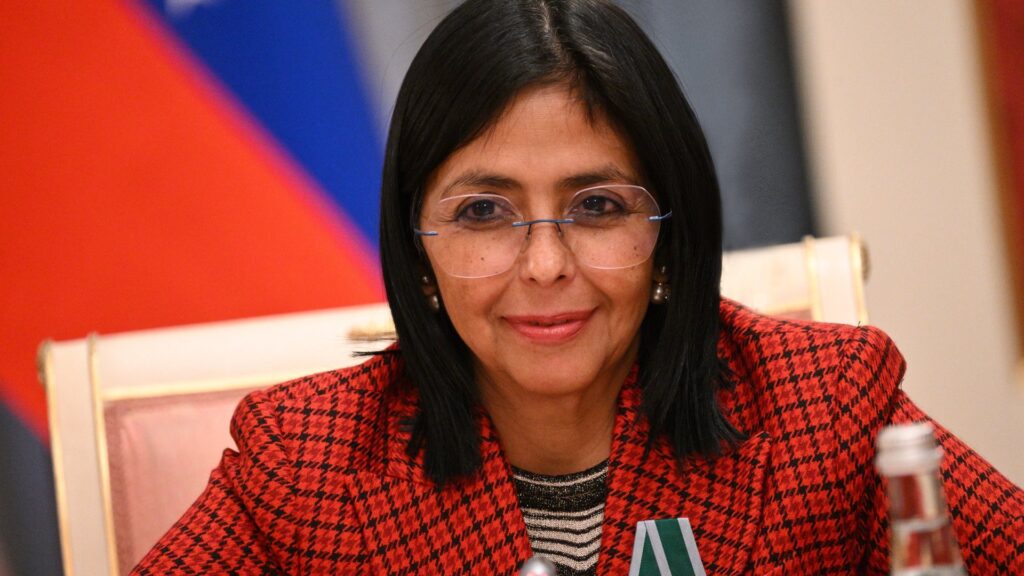 Delcy Rodriguez. Credit: Government of Russia via Wikimedia Commons
The lawyer and political consultant, Daniel Montero, frames the oil deal as a bet with two possible outcomes for Interim President Rodríguez.
The first is that it puts her on a good footing with Trump and strengthens her mandate.
“It weakens Rodríguez internally—who already has low approval ratings—but positions her favorably with Trump, as it demonstrates her obedience, which would delay the democratic transition.”
But Montero added that by offering Trump what he wanted, Rodríguez may have lost some leverage with Washington.
“Another interpretation is that, by signing an agreement of this nature —the one most important to the U.S.—it would mean she is now less useful for Trump and that wouldn’t delay the transition.”
Montero also said that although Trump needs a weak counterpart like Rodríguez to secure favorable concessions, big oil and corporate interests need an executive branch that guarantees the rule of law and implements the necessary reforms – in the economy and public services – to facilitate investment. Pressure from U.S. industry for clear rules based on the rule of law may sway the White House.
Is the deal legal?
The agreement has also ignited a constitutional debate about whether an interim government has the authority to make a decision of this magnitude for the country’s future.
Gabriel Ortiz, a Venezuelan lawyer at American University, argues the agreement is flawed at its root because Rodríguez lacks what he calls “legitimacy of origin” to act as interim president.
After Nicolás Maduro’s capture on January 3, 2026, he said, the Supreme Tribunal of Justice sidestepped Article 233 of the Constitution by invoking a non-existent term, “enforced absence”, instead of calling elections within the constitutionally mandated 30-day period .
In an analysis, administrative law and economic regulation expert José Ignacio Hernández detailed how the Constitution and the Hydrocarbons Law are in contradiction with the agreement announced.
“Although the [White House] Fact Sheet refers to oil concessions, this title was abolished in 1975 with oil nationalization,” he wrote. Additionally, Hernández explained that contracts signed with joint ventures have a limited duration of 25 years – a legal ceiling the NABEP agreement’s 100-year term appears to exceed.
Delcy Rodríguez has contradicted the White House, saying the agreement has a 25-year term.
Ortiz argues the deal, which is set against a shaky political backdrop, ultimately faces an equally uncertain future.
“I don’t foresee a good future for the deal, because it doesn’t just stand on shaky legal ground — it doesn’t fit the country’s political reality either. It was born to die unless it negotiated with a democratically elected government.”
Featured image description: The ‘Perla’ oil rig in Venezuela.
Featured image credit: Repsol via Flickr