By The Straits Times | Created at 2026-09-07 22:09:58 | Updated at 2026-10-02 16:36:18
3 weeks ago
By The Straits Times | Created at 2026-09-07 22:09:58 | Updated at 2026-10-02 16:36:18
3 weeks ago
KATHMANDU – Almost two weeks after a devastating glacial flash flood ripped through Nepal’s riverside villages, the hope of rescuing the thousands of people still missing is now slowly turning into anger for some.
In Kathmandu’s Maitighar Mandala neighbourhood, about 50 people protested on Sept 7, holding photos of their loved ones who have been missing since the flood and demanding that the government expedite their rescue.
Their relatives were working on hydropower projects on the Trishuli river, where at least 50 are suspected to be trapped in a tunnel of the Trishuli 3B hydropower project.
“My husband might still be alive inside, trapped – he could be saved. Why is the army not prioritising the rescues inside the tunnel?” said Sumana Chhetri Amatay, 50, whose husband, Sumesh Amatay, a senior geologist at the Trishuli hydropower plant, has been missing since the day of the flood.
“It is the 13th day since the flood – it is when Hindus do the final funeral rites for our loved ones.”
Sumana said she had had neither good nor bad news as closure.
The photo collage she held of Sumesh, smiling on a mountaintop, included images of two of his colleagues.
They were all working in the 37W run-of-the-river cascade hydropower project in Nuwakot.
The hopes of their families were buoyed by news of miraculous rescues of workers 10 days after the flood, but days later, that has given way to impatience.
Two workers from the Upper Trishuli 3A hydropower project were rescued on the 10th day, and 64-year-old Chandrika Shashtra was rescued from Betrawati Bazar on the 11th. Chandrika is a distant relative of Sumesh’s family.
“My brother must be suffocating inside the tunnel... hoping someone is coming to rescue him... But the Nepal authorities are just not doing enough,” said Sumesh’s younger sister, Reena Amatay.
A healthcare assistant in London, Reena was in Kathmandu for a holiday. She had postponed her return to London by two days so that Sumesh, who had been deployed to the Trishuli 3B project for seven months, could see her off at the airport.
The flood hit on the morning he was to leave to see her.
Sagar Poudel held a family photo of his 37-year-old cousin, Somnath Poudel, an engineer in Trishuki 3B whom he suspects is trapped in the tunnel.
Somnath’s wife and twin girls, aged two, were in the power project’s staff quarters on the riverside. No one has heard from them since the flood.
“The children and their mother are unlikely to have survived under the mud. My cousin, maybe he is alive in the tunnel. We have to know,” said Sagar.
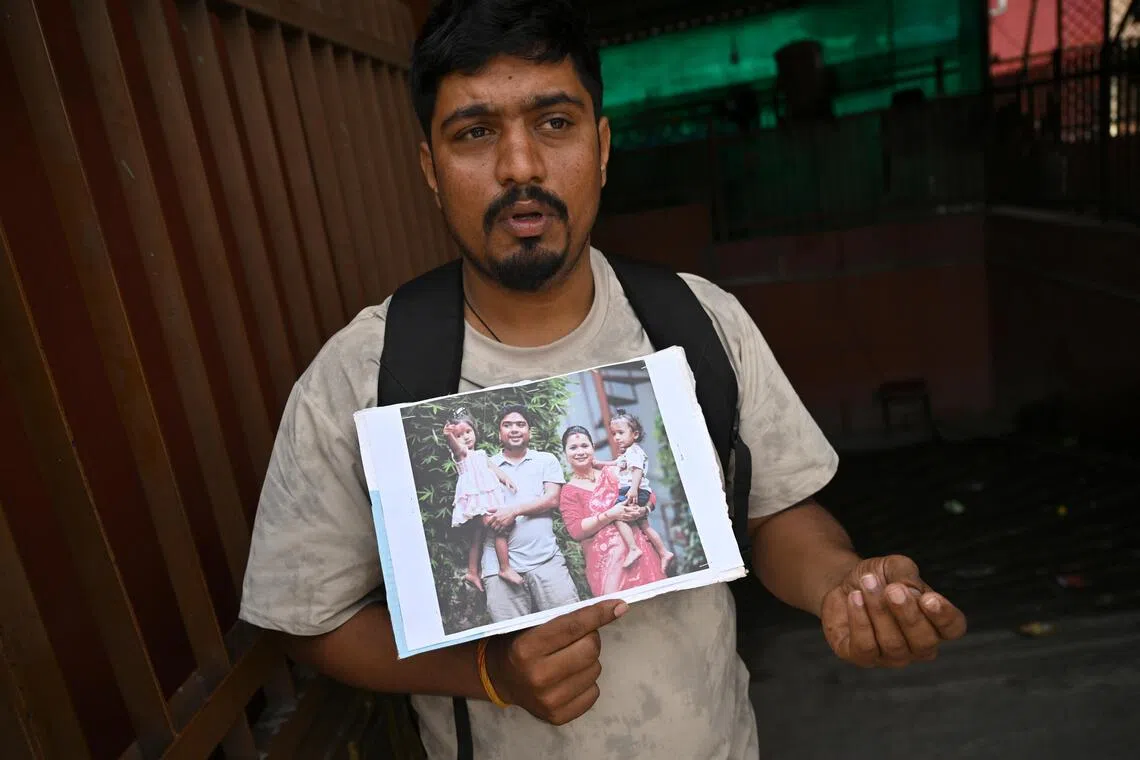
Sagar Poudel holding a family picture showing his cousin Somnath Poudel, an engineer who is missing in Trishuli 3B hydropower tunnel, his wife and twin daughters.
ST PHOTO: DESMOND FOO
He showed The Straits Times a WhatsApp group of 140 family members of the missing from Trishuli, created two days after the flood to coordinate search and rescue, advise each other on how to file missing-person complaints, provide DNA samples and share social media information.
The collapse of a glacier triggered the catastrophic flooding, which killed 1,300 people in Nepal and China and left more than 5,000 missing, including foreigners from India, Australia, Malaysia, Singapore and many other countries.
The protesting families complained that the army and police were deploying only small equipment and teams to the Trishuli 3B hydropower plant, while sending larger excavators and equipment to other hydropower tunnels. A dozen hydro projects have been directly damaged by the flood.
When asked about the delay in rescue efforts, Nepal Army spokesman Raja Ram Basnet said said: “From the beginning, we sent teams to Trishuli 3A and 3B to find missing people. But it was very hard. Any equipment and excavators would just sink in the sludge. Even inside the tunnel, there is silt, and manual teams can’t reach it.
“Even flying helicopters in the narrow valley was challenging, and we could only drop light excavators. Due to all this difficulty, we could not do rescue operations as we wanted to.”
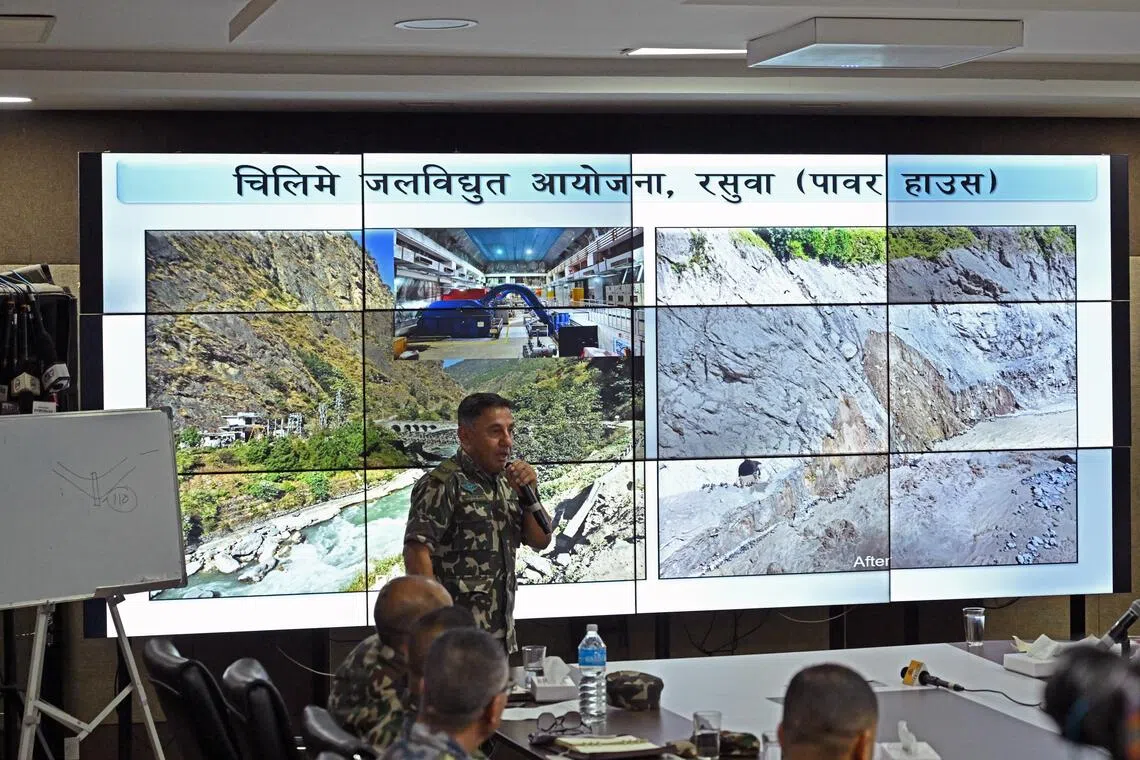
Nepali Brigadier General Subash Jung Thapa giving a briefing about the search and rescue operations being carried out in the tunnels, at a press conference by the National Disaster Risk Reduction and Management Authority on Sept 7.
ST PHOTO: DESMOND FOO
Nevertheless, the families feel these efforts are inadequate.
“We trust the government, but if they can’t handle it. Why not ask for help from other countries?” asked Reena.
Basnet said that with each passing day, the ground is becoming harder and more stable, so more excavating machinery can now be brought in. The team has also found a way to access the inside of the 3B tunnel through the 3A tunnel, he noted.
“Our team will reach 3B soon, and we will now work even faster to rescue the missing,” Basnet said.