By Gatestone Institute | Created at 2026-09-03 09:30:10 | Updated at 2026-09-30 23:13:49
3 weeks ago
By Gatestone Institute | Created at 2026-09-03 09:30:10 | Updated at 2026-09-30 23:13:49
3 weeks ago
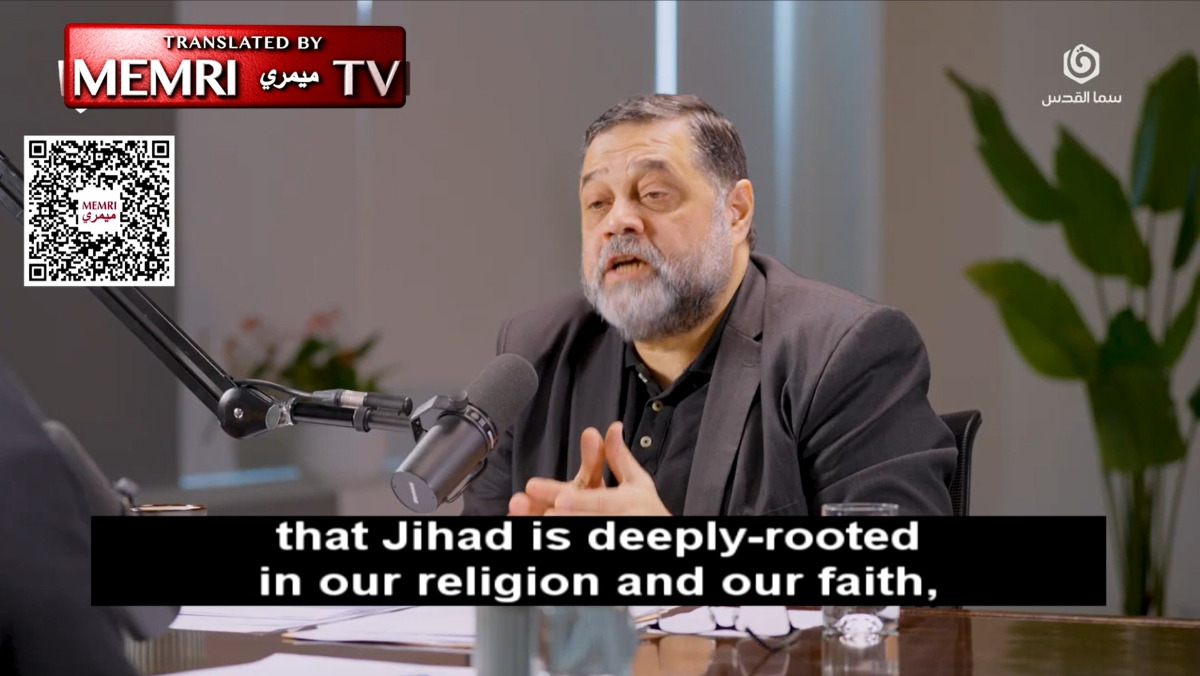 Hamas official Osama Hamdan said, "No one said that we will hand over our weapons." According to Hamdan, the word "hand over" was never part of the agreement his terrorist group reached with the mediators. Instead, Hamdan said, the agreed framework calls for the "containment and storage" of Hamas's heavy weapons. Hamas's laying down its weapons and relinquishing its political and military control over the Gaza Strip must be unconditional. Hamas is a terrorist organization that launched the October 7, 2023 invasion and massacre. It is not a sovereign state entitled to negotiate the terms of its own disarmament. Pictured: Hamdan on a podcast on November 10, 2025. (Image source: MEMRI)
Hamas, like its long-time benefactor Iran, has once again made its position unmistakably clear: It has no intention of surrendering its weapons, abandoning its armed "resistance" against Israel, or relinquishing control over the Gaza Strip.
If anyone in Washington or elsewhere still believes that Hamas has agreed to disarm under the Gaza peace plan presented by US President Donald J. Trump and his Board of Peace, they should listen carefully to what Hamas officials themselves are saying.
Two recent interviews with senior Hamas officials leave little room for doubt.
Hamas official Osama Hamdan said, "No one said that we will hand over our weapons." According to Hamdan, the word "hand over" was never part of the agreement his terrorist group reached with the mediators. Instead, Hamdan said, the agreed framework calls for the "containment and storage" of Hamas's heavy weapons. He added that this would be carried out by the Palestinian Committee for the Administration of Gaza and the Palestinian "resistance factions."
Most revealingly, Hamdan declared: "Not a single bullet will leave the Gaza Strip according to this agreement [with the Board of Peace representatives]." He also insisted that no weapons would be handed over to a non-Palestinian party and that "the weapons will remain in the hands of the Palestinians."
Hamas is not talking about disarmament. It is talking about keeping its weapons. This discussion is not actually about semantics. It goes to the heart of whether Hamas is prepared to abandon terrorism and, in particular, its decades-old goal of destroying Israel.
Hamas's position was reinforced by Khaled Qaddoumi, the terrorist organization's representative in Iran. In an interview published by Iran's Islamic Republic News Agency, Qaddoumi made clear that Hamas regards weapons as essential to its struggle against Israel. He rejected the idea that the question of weapons should even be discussed before Israel's military presence in the Gaza Strip ends. "The question of weapons, whether heavy or light, has nothing to do with Israel," Qaddoumi said. "Only the Palestinians will decide on it."
Qaddoumi's claim that the weapons "have nothing to do with Israel" is particularly revealing. Hamas's weapons are not being stockpiled to fight Canada, Australia, or some other distant country. They are weapons that Hamas has used, and openly intends to use, against Israel. As senior Hamas official Ghazi Hamad vowed soon after the group's October 7, 2023 invasion of Israel:
"The Al-Aqsa Flood [Palestinian name for the October 7 attack] is just the first time And there will be a second, third and fourth. We must teach Israel a lesson and we will do this again and again..."
When Hamad's interviewer asked him, "Does that mean the annihilation of Israel?," Hamad responded, "Yes, of course."
Rockets, anti-tank missiles, explosives, and firearms are not abstract "Palestinian internal matters." They are the very weapons with which Hamas has attacked Israeli civilians and soldiers.
Qaddoumi's formulation is also a reminder of the fundamental problem with the current approach to Hamas. The terrorist group wants the international community to recognize its political claims while treating its military arsenal as an internal Palestinian issue.
Hamas cannot have it both ways. It cannot demand an end to Israel's military presence in Gaza while simultaneously insisting on retaining the weapons that it has used — and clearly plans to use again — to attack Israel. The victims of Hamas's weapons have a say in the matter too.
The question is not who gets to decide what happens to Hamas's weapons. The question is why Hamas should be allowed to keep them at all.
Qaddoumi argued that a Palestinian political framework and a new Palestinian government must first be established. Only afterward, he said, could Palestinians decide whether their weapons should be collected.
This is exactly the opposite of disarmament. Hamas is essentially saying: First give us political power and remove Israelis forces from the Gaza Strip. Afterward, we may discuss what happens to our weapons.
Why should the surrender of weapons be conditional on anything?
Hamas's laying down its weapons and relinquishing its political and military control over the Gaza Strip must be unconditional. Hamas is a terrorist organization that launched the October 7, 2023 invasion and massacre. It is not a sovereign state entitled to negotiate the terms of its own disarmament.
Trump's 20-Point Gaza Peace Plan calls for the "demilitarization" of the Gaza Strip and the "decommissioning" of weapons. Point 13 states:
"Hamas and other factions agree to not have any role in the governance of Gaza, directly, indirectly, or in any form. All military, terror, and offensive infrastructure, including tunnels and weapon production facilities, will be destroyed and not rebuilt. There will be a process of demilitarization of Gaza under the supervision of independent monitors, which will include placing weapons permanently beyond use through an agreed process of decommissioning, and supported by an internationally funded buy back and reintegration program all verified by the independent monitors."
Yet somehow, nearly three years after October 7, the discussion has apparently moved from demilitarization and decommissioning to "containment" and "storage."
Can someone on the Board of Peace explain what "containment" means? Does it mean Hamas will hide its weapons in closets or under terrorists' beds? Does it mean the weapons can be displayed in public only after dark?
Also, what exactly does "storage" mean? "Storage" for what purpose? Are Hamas's weapons being stored so they can be used at some future date to murder more Israelis and launch more October 7-style massacres?
Where should these weapons be stored? In warehouses? In tunnels? In facilities controlled by the new Palestinian administration? Who will guarantee that Hamas terrorists will not simply take them out of storage when they decide that the time has come to resume their jihad (holy war) against Israel?
Would the new Palestinian Committee for the Administration of Gaza really be capable of preventing Hamas and other terrorist groups from accessing these weapons? Would foreign troops, whether from Uganda, Morocco, or elsewhere, be expected to stand guard over weapons belonging to terrorist organizations and prevent them from storming the warehouses?
The entire concept is difficult to take seriously. Was al-Qaeda ever asked to "contain" its weapons? Was ISIS ever asked to "store" its weapons? Terrorist organizations are supposed to be disarmed. Their weapons are supposed to be confiscated and destroyed. There is no legitimate reason for Hamas or any other Palestinian terrorist faction to possess weapons either in the Gaza Strip or in any other territory.
Palestinians do not need rockets, explosive drones and anti-tank missiles to build a better future. They need economic development and accountable institutions.
Weapons have brought catastrophe after catastrophe to Palestinians and the Arab world. They helped turn Jordan and Lebanon into battlefields and rubble. Heavily armed Palestinian factions confronted the Jordanian army, culminating in the 1970-71 "Black September" conflict, prompting King Hussein's forces to reassert their authority over the Jordanian state. In Lebanon, Palestinian organizations ignited the country's descent into civil war in 1975, while subsequently becoming deeply intertwined with Lebanon's government, its internal conflicts and its confrontation with Israel. The Gaza Strip should not be given another opportunity to repeat this history.
Hamas's statements also expose another important problem: the group's strategic relationship with the Iranian regime.
Qaddoumi openly portrayed Iran and Hamas as sharing a common enemy and a common destiny. "Today, we in Palestine and Iran have much in common, and we have come to understand that we have the same enemy," he said. He went on to praise Iran's regime for providing "strong strategic support" to Palestinian "resistance movements."
Hamas has long been part of Iran's regional network of armed groups. Qaddoumi's comments are a reminder that the issue of Hamas's weapons cannot be separated from Iran's strategy of using armed proxies to wage war against Israel and the United States.
The Iranian regime has perfected the strategy of buying time, delaying, negotiating, and exploiting diplomatic processes while preserving its military capabilities and those of its proxies. Hamas appears to be following the same playbook.
Hamas, like its benefactors in Iran, may well believe that its best strategy is to drag out negotiations for as long as possible, at least until Trump is no longer president and someone more accommodating might take his place. Time is on Hamas's side, or so its leaders might calculate. US presidents come and go. Administrations change. International attention shifts. Why surrender weapons today if Hamas can simply wait and see who occupies the White House tomorrow?
This strategy may also explain why Hamas is so interested in the Palestinian parliamentary elections, scheduled for November 28, 2026. Why are the United States and other mediators talking to Hamas about elections when the organization has not even agreed to genuine disarmament?
Allowing Hamas-affiliated candidates to participate in Palestinian elections while it retains its weapons would create the absurd situation of a terrorist organization being permitted to transform its military power into political power — a perfect recipe for legitimizing Hamas.
The United States and its allies should not allow themselves to be trapped by Hamas's terminology.
Hamdan's declaration that "not a single bullet" will leave the Gaza Strip should be enough to settle the matter. Hamas is telling the world exactly what it intends to do: keep its weapons. Qaddoumi is saying essentially the same thing while openly celebrating Hamas's strategic alliance with Iran.
So why is Washington still negotiating the terms? Striking deals with Islamist terrorist organizations is not a substitute for enforcing their disarmament. Agreements that allow terrorists to keep their weapons are not worth the paper on which they are written.
There is only one viable solution for the Gaza Strip: Hamas must be eliminated as a political and military entity. Its weapons must be confiscated or destroyed, not "stored", "contained," or hidden. Until that happens, Hamas remains armed, Iran remains influential, and the threat of another October 7 massacre — or more — remains in the works.
Khaled Abu Toameh is an award-winning journalist based in Jerusalem.