By The Straits Times | Created at 2026-10-16 21:01:21 | Updated at 2026-10-16 22:01:05
1 hour ago
By The Straits Times | Created at 2026-10-16 21:01:21 | Updated at 2026-10-16 22:01:05
1 hour ago
KUALA LUMPUR – Up every morning at 4am to prepare his kitchen for two shifts, 52-year-old Chef Teddy is no stranger to hard work. He runs Dapur Warisan in Puncak Jalil, on the outskirts of Kuala Lumpur, from 9am to midnight daily. But as transboundary haze blankets the area, he is finding that no amount of effort, however gruelling, can outpace the polluted air.
Daily sales at his Chinese Muslim restaurant have plunged by 30% from their usual RM4,500 (S$1,410), with mid-October marking his worst business period since the haze began about a month ago. He said he might have to take drastic action if the situation does not improve.
“I’m considering laying off staff and cutting operating hours to keep the cafe running,” Teddy, who did not want to give his full name, told The Straits Times.
His struggle mirrors a growing crisis for business owners across Malaysia, who are facing weaker sales, rising operating costs and mounting cash-flow pressures because of the haze.
The haze is fuelled by forest and peatland fires in Indonesia, particularly in Sumatra and Kalimantan, during the region’s dry season. In 2026, prolonged dry conditions linked to El Nino, a climate pattern that can bring hotter, drier weather to much of South-east Asia, have worsened the fires. The ASEAN Specialised Meteorological Centre warned that dry conditions will intensify through November, raising the risk of a lengthy disruption.
The economic strain spans multiple sectors. Sunway Lagoon, an outdoor theme park in Selangor, has seen a 50% to 60% drop in visitors since the haze began.
“Parents have concerns over the general well-being of the family,” a spokesperson said, noting the park has temporarily suspended part-time retiree workers, cleared employee annual leave and moved up annual ride maintenance to manage operations during the slowdown.
Farther south in Johor state, 36-year-old farmer Tan Chee Kiong is battling the same atmospheric blanket at his 73ha vegetable farm. Reduced sunlight has extended crop growth cycles from 30 days to 34 days and reduced his daily yields of leafy greens such as mustard greens, chives and spinach from 16,000kg to 11,000kg over the past few weeks.
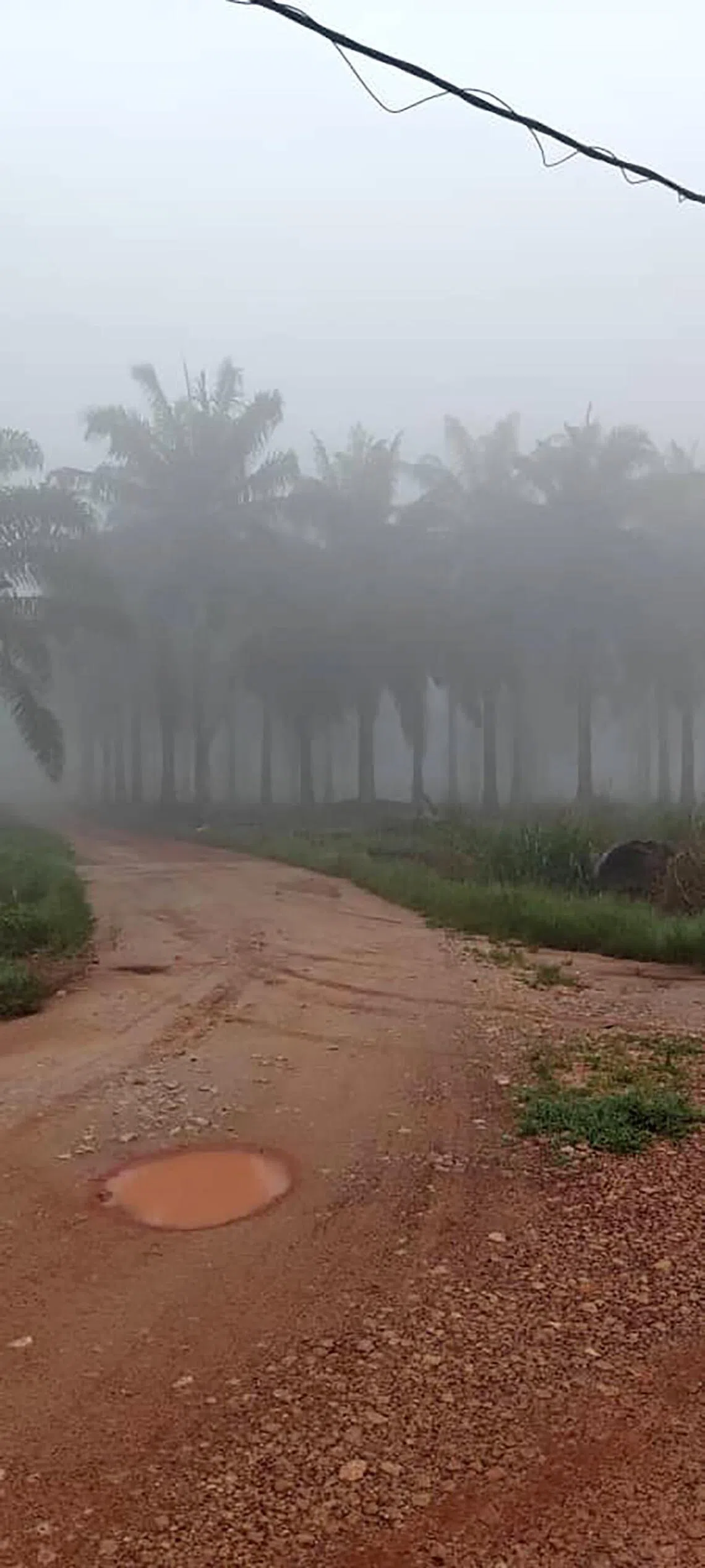
Heavy haze shrouding the access road to Tan Chee Kiong's farm in Bukit Gambir, Johor, on Oct 9.
ST PHOTO: TAN CHEE KIONG
He said the particulate matter in the air also made the rain more acidic, triggering fungal infections in his vegetables. The damage is limited for now, but needs close monitoring, he said.
Tan has not yet experienced any revenue loss, but the longer growing cycle is disrupting planting schedules and delaying the next harvest. All this means higher labour costs and less room for profit.
“Haze or no haze, farm work has to go on. We still need to grow and harvest vegetables, sow seeds, apply fertiliser, cut grass and weeds to keep the production cycle going and ensure a steady supply,” he told The Straits Times.
Tourism, aviation worst hit
Sunway University economics professor Yeah Kim Leng told local media that prolonged haze could cost Malaysia RM20 million to RM50 million a day, potentially reaching RM1.5 billion a month if disruptions persist.
“The hardest-hit sectors are tourism and aviation,” he said. “Air pollution can cut arrivals by up to 8%, with gross domestic product losses up to RM1.5 billion.”
In agriculture, he said vegetable farmers in Johor report production declines, fruit yields have halved, and palm oil faces a lagged impact of six months to 12 months.
The haze is also affecting small and medium-sized enterprises.
SME Association of Malaysia president Chin Chee Seong warned that micro and small enterprises are particularly vulnerable because they often operate on thin profit margins and have limited cash reserves.
Even if revenue falls temporarily, businesses must continue paying rent, salaries, utilities, loan instalments and suppliers.
“If the haze continues for weeks, the situation could become more serious, especially for businesses that are already struggling to survive,” Chin told ST.
On social media, small operators have described disruptions. A baker said an event scheduled in Putrajaya, Malaysia’s administrative capital, was cancelled at the last minute, leaving her trying to sell 500 Dubai chewy cookies prepared using 40kg of chocolate and 50kg of strawberries. She had also paid for travel and accommodation expenses.
An operator offering horse therapy classes said sessions had been disrupted for a third consecutive week, while outdoor swimming lessons for kindergarten children were also affected.
Hole in the pocket
Beyond commercial losses, the haze presents a growing healthcare burden. Air quality in several parts of Malaysia remained at unhealthy levels on Oct 16 at 6pm, with the Air Pollutant Index (API), similar to international Air Quality Index (AQI) scales, reaching 160 to 200 in places like Klang in Selangor, Kuala Lumpur, Johor and Negeri Sembilan.
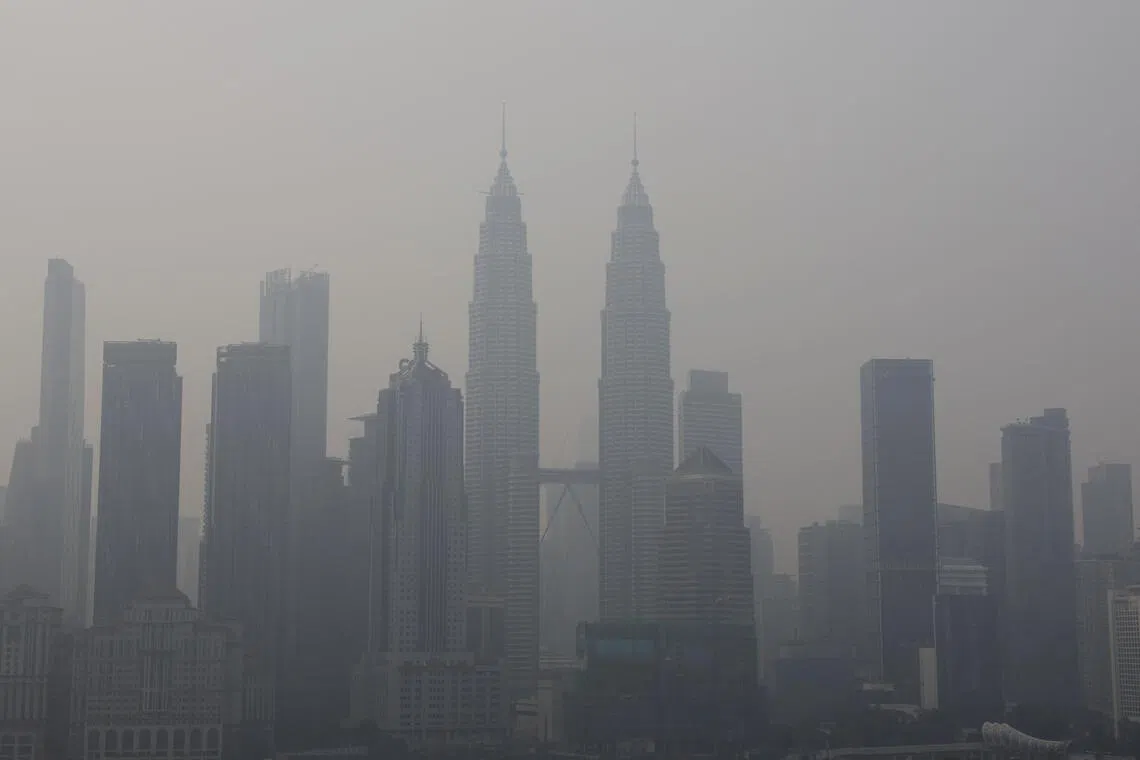
Kuala Lumpur's skyline blanketed in haze from regional wildfires on Oct 9.
PHOTO: SREUTERS
In Seremban, south of Kuala Lumpur, 42-year-old Ahmad Nizam has spent the past week worrying about his four-year-old daughter, who developed a fever, persistent cough and flu-like symptoms that he believes were triggered by the polluted air.
Malaysia’s Health Minister Dzulkefly Ahmad told Parliament on Oct 15 that during a single week in September, upper respiratory tract infections rose 167% to 7,065 cases, asthma surged 127% to 1,117 cases, and conjunctivitis increased 83% to 334 cases. Further increases followed into early October, with haze-related diseases driving up out-of-pocket medical bills for families.
Online, people said frequent clinic visits had cut into their household expenditure, as they reported costs ranging from RM300 for asthma treatments to RM850 for emergency care.
But people and businesses have also been adapting to the haze. Farmer Tan, for instance, has allocated extra land to cultivate price-stable herbs and aromatic plants like curry leaves, turmeric leaves and coriander to help cushion operational overheads.
Economist Barjoyai Bardai emphasised that individual resilience alone is not enough and called for a more systematic approach to measuring the economic costs of the haze by comparing air-quality readings with data on business sales, worker absenteeism, productivity, tourism and agricultural output to establish the true scale of the damage.
“Haze should not be viewed solely as an environmental or public-health issue,” he said. “It is an economic risk that directly affects productivity, household welfare and business resilience.”
Back in Seremban, Ahmad continued to monitor his daughter’s progress and use home remedies to avoid rising medical costs.
“I cannot control the sky, but I will try to keep her safe and healthy,” said Ahmad.
Sign up for our weekly Asian Insider Malaysia Edition newsletter to make sense of the big stories in Malaysia