By The Rio Times | Created at 2026-10-05 18:56:41 | Updated at 2026-10-05 19:30:14
1 hour ago
By The Rio Times | Created at 2026-10-05 18:56:41 | Updated at 2026-10-05 19:30:14
1 hour ago
MIGRATION · HONDURAS
Key Facts
- —The country Honduras is a Central American nation of about 11 million people, led since January 2026 by President Nasry Asfura of the conservative National Party. The United States is the main destination for its migrants.
- —Why it matters Migration ties the two countries together. Remittances from Hondurans abroad reached US$9.6 billion by 17 September, up 11.4 percent on a year earlier, central bank data show.
- —Why now El Heraldo reported National Migration Institute (INM) return records for January to September on 4 October, as tougher US enforcement pushes returns higher.
- —What happened INM records show 36,658 Hondurans returned between 1 January and 30 September 2026, about 134 a day. Of these, 32,851 came back from the United States.
- —The numbers 28,573 people returned by air and 8,085 by land. The nine-month total already equals 85.4 percent of the 42,928 returns recorded in all of 2025.
- —What it means for you This is where US deportation policy lands. Returns shape remittances, local jobs and the pressure to migrate again, which feeds back into US border debates.
- —Still open Official tallies differ between agencies. An IOM study found 28 percent of adolescent returnees had considered leaving again, but repeat migration is not tracked.
Honduras returned migrants numbered 36,658 between 1 January and 30 September 2026, National Migration Institute (INM) records show. Of these, 32,851 came back from the United States, so the count shows where tougher US immigration enforcement lands.
The INM is the government agency that receives Hondurans sent back by air or land. The tally, reported by the newspaper El Heraldo on Sunday 4 October, already equals 85.4 percent of the 42,928 returns of 2025.
What the Nine-Month Count Shows
The INM logs every Honduran handed back at an airport or a land border. Its count to 30 September shows 28,573 arrivals by air and 8,085 by land.
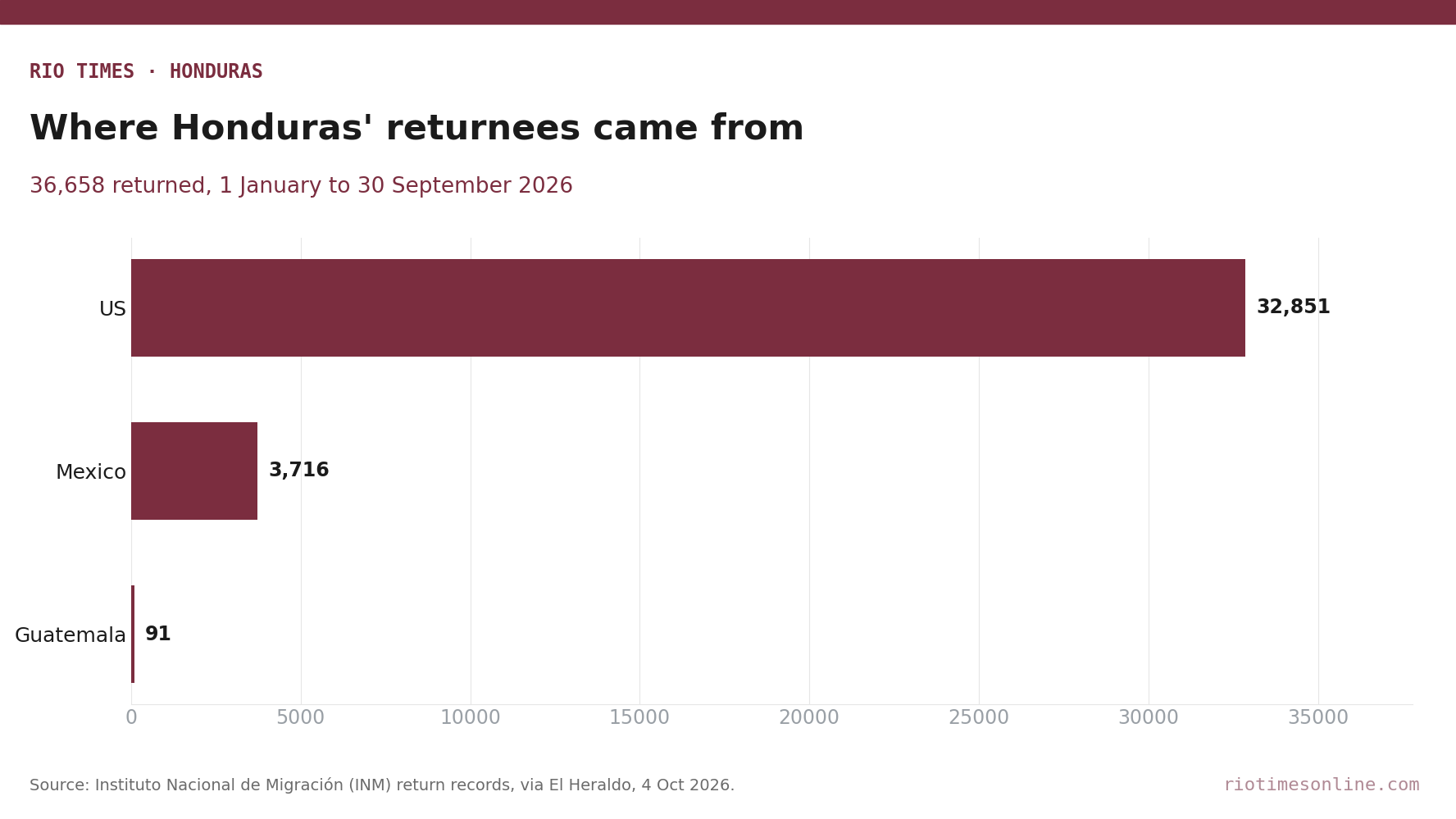
Mexico was the second source of returns this year, with 3,716 Hondurans. Guatemala sent back 91.
Men make up most of the total, at 29,717 people. The rest are women and children, a split the published figures do not break down further.
Follow this story
Get an email when there’s news on Honduras
Free. One email a day at most, and only when there is news. This also signs you up to our weekday newsletter, The LatAm Brief. Nothing arrives until you click the confirmation link, and you can stop either with one click. Privacy policy.
Honduras Returned Migrants Arrive Faster Than in 2025
The daily average this year is about 134 returns, against roughly 118 in 2025, El Heraldo calculated from the same records. Experts quoted by the paper expect the 2025 total to be passed this year.
The International Organization for Migration (IOM), a UN agency, counted 23,952 returns in the first half of 2026. That was about 40 percent more than the 17,102 of January to June 2025.
The rise has not been steady. INM director Carlos Cordero said in August that 4,395 people returned in July, and that August was running lower.
In August, César Castillo of the migration observatory at the National Autonomous University of Honduras (UNAH) projected over 100,000 deportations for 2026. He based the estimate on returns running about 40 percent above 2025, La Prensa reported.
Why Washington’s Policy Shows Up in Honduras
The United States accounts for about 90 percent of this year’s returns. That share reflects tougher US enforcement, including the end of temporary protected status (TPS) for Hondurans.
Returns are only one side of the ledger. Remittances, the money Hondurans abroad send home, reached US$9.6 billion from 1 January to 17 September, central bank data show. That was 11.4 percent more than a year earlier.
So far, more deportations have not dented that flow of dollars. The background is set out in Honduras Remittances Hit US$9.3 Billion, Up 11% as US Deportations Rise.
Returnees come back to the conditions that pushed them out. Lack of work, low incomes and insecurity are the main drivers of migration, experts quoted by El Heraldo said.
Young Returnees Weigh Leaving Again
A new IOM study, reported by Infobae on 4 October, found that 28 percent of adolescent returnees surveyed had considered migrating again. Only 9.3 percent of their caregivers thought that was likely.
Of the returns the study analysed, 86.3 percent came from the United States. Caregivers said 56.8 percent were forced by migration authorities.
INM data cited by the IOM count 151,284 returns of children and adolescents between May 2015 and August 2026. “Return is the starting point of a process,” the study concludes.
The government’s answer is the National Reintegration System, which receives returnees. In March 2026, Social Development Minister Fátima Juárez signed an alliance to strengthen it, covering training, job placement, psychosocial care and business support.
How well it works is a social test for the new administration. The president is profiled in Who Is Nasry Asfura, the President of Honduras in 2026.
What It Means for You
For US readers, these figures show where deportation flights end. Almost 90 percent of this year’s returns came from the United States, and 78 percent of all returnees arrived by air.
For investors, remittances still outweigh returns. Money sent home made up more than half of Honduras’ foreign currency inflows to mid-September, central bank data show.
What Is Not Known
Official tallies do not match. In August, figures from the human rights commissioner’s office (Conadeh) showed 45,632 returns to 14 August. That is well above the INM count, and the gap has not been explained.
The INM’s statistics website was offline on Monday, so the September totals could not be checked against the agency’s own tables. They rest on El Heraldo’s reading of INM records and are not independently confirmed.
The data also do not separate deportations from voluntary returns. Nor do they show how many returnees have since left again.
It is also unclear how many of the roughly 55,000 Hondurans with TPS, a figure Castillo cited, will return.
How many Hondurans have been returned in 2026?
The National Migration Institute recorded 36,658 returns between 1 January and 30 September 2026. Of these, 32,851 came from the United States, 3,716 from Mexico and 91 from Guatemala.
Why are Honduras returned migrants rising this year?
Mainly because of tougher US immigration enforcement, including the end of temporary protected status for Hondurans. The daily average rose to about 134 from roughly 118 in 2025.
What happens to Hondurans after they are returned?
They are received at airports or border posts and can join the National Reintegration System, which offers training and job placement. An IOM study found 28 percent of adolescent returnees had considered leaving again.
Sources: El Heraldo, INM return records to 30 September, 4 Oct 2026; Infobae, IOM study on adolescent returnees, 4 Oct 2026; Radio América, IOM first-half return figures, 22 Jul 2026; Infobae, INM director Carlos Cordero, 22 Aug 2026; La Prensa, UNAH projection, 18 Aug 2026; El Heraldo, Conadeh figures, 20 Aug 2026; Contexto HN, Banco Central de Honduras foreign currency data to 17 September, 28 Sep 2026.
Editorial responsibility: Matthias Camenzind, Editor-in-Chief · Editorial standards · Report an error
Frequently Asked Questions
The Rio Times · Power Map
See who really holds power in Latin America
Click to open the Power Map →