 By The War Zone | Created at 2026-09-04 17:25:33 | Updated at 2026-10-01 15:16:19
3 weeks ago
By The War Zone | Created at 2026-09-04 17:25:33 | Updated at 2026-10-01 15:16:19
3 weeks ago
Ukrainian crews operating Australian-supplied M1A1 Abrams tanks say the battlefield has become so saturated with Russian drones that their tanks cannot currently be used in combat, but they reject the idea that main battle tanks have become forever obsolete.
Since receiving these tanks last year, the crews, serving with Ukraine’s 425th Separate Assault Regiment “Skala,” have used the Abrams in two combat operations in the fight for Pokrovsk, a key Ukrainian logistics hub and part of a defensive belt of towns in Ukraine’s eastern Donetsk region. They recounted their experiences to Hromadske, an independent media channel in Ukraine.

Чому «Скеля» їхала на Abrams у Покровськ / hromadske
Fighting around Pokrovsk
The first major deployment described by the crews took place in December of last year, when Abrams tanks were used to support assault groups entering Pokrovsk.
The crewmember with the callsign Kent described moving into the city behind a mine-clearing tank and ahead of two infantry fighting vehicles (IFVs) carrying assault troops, during a mission that was deliberately aggressive.
“Since a tank is a priority target — my task was to draw their attention, while our infantry dismounted and moved in successfully.”
The Abrams was also assigned three target points to engage along the route.
“We went right in there, poured it on, and drove back out,” he recalled.
A video showing the 425th Separate Assault Regiment in action in August 2025, soon after receiving the Abrams:
![Танки Abrams в 425 ОШП "Скала" [Серпень 2025] thumbnail](https://i.ytimg.com/vi/tAsBO3BCMn0/hqdefault.jpg)
Танки Abrams в 425 ОШП "Скала" [Серпень 2025]
The second operation, on March 31, involved an attempt to enter and hold an industrial area near Pokrovsk to help block Russian movement toward Hryshyne, a contested village in the district.
The operation was prepared for more than two weeks. Ukrainian forces conducted reconnaissance flights, examined difficult sections of the planned routes, and provided crews with extensive video and imagery.
“They knew every meter of the route,” another of the unit’s commanders, with the callsign Kubik, said.
Weather was considered essential. The Ukrainians waited for fog and rain, hoping to limit the effectiveness of Russian drones.
“Without the right weather we wouldn’t have been able to pull off operations like that,” Kubik said.
The operation nevertheless resulted in the destruction of four out of five armored vehicles, some of which are seen in the video embedded below.
Russia's Rubicon Drone Center FPV drones destroyed a Ukrainian assault group near Pokrovsk, hitting an M1A1 Abrams tank, M1117 APC and BMP-2 as the unit tried to advance near Hryshyne under fog cover. #Ukraine pic.twitter.com/ZzE52qAYxp
— NOELREPORTS 🇪🇺 🇺🇦 (@NOELreports) April 1, 2026The commander acknowledged that the Russian side may have had advance knowledge of the operation.
“I can’t rule out the possibility that the enemy knew our plan,” he said.
His Abrams was not immediately destroyed. According to the crew, it completed its task and the assault troops dismounted before the weather changed.
“Once the fog lifted, they started working on it with an FPV drone,” the commander said.
Why use tanks at all?
The losses prompted criticism from Ukrainian military commentators, particularly after footage of the destroyed vehicles was published.
However, the crews defend the decision to use armored vehicles for the missions. According to the men of the Skala interviewed, the alternative was often to send infantry over several miles on foot while carrying weapons, ammunition, water, and other supplies.
“That takes more time,” Kubik explained. “And the enemy isn’t standing still — the enemy is moving toward them.”
🇦🇺🇺🇦 Australia-supplied M1A1 Abrams AIM main battle tank in service of the Ukrainian 425th Separate Assault Regiment "Skala."
The tanks of such type recently saw combat in the area of Pokrovsk. pic.twitter.com/qhjSyGbhH6
The argument that infantry could simply move more stealthily on foot also has limitations.
“Every day the Mavic drones are flying, the fixed-wing drones are flying,” he said. “No fog, guys are visible.”
Combined witu IFVs, the Abrams can provide the ability to rapidly move troops while simultaneously delivering heavy direct fire against enemy positions and offering substantial protection to its crew.
The crews argue that this capability remains worthwhile even when the tank itself may eventually be lost.
One commander was asked whether deploying a roughly $5-million tank makes sense if a single sortie can result in its destruction.
“Yes, of course it makes sense to deploy it,” he replied.
“First and foremost — it saves the lives of the crew inside it.”
Russian forces captured a relatively lightly damaged M1A1SA Abrams main battle tank operated by the 47th Separate Mechanized Brigade in the Pokrovsk direction.
The tank is equipped with added cage armor, as well as Kontakt and ARAT ERA. pic.twitter.com/mHyKk1xNRY
A tank under attack by drones
The Ukrainian crews repeatedly highlighted the Abrams’ accuracy and survivability.
“What are the biggest advantages of the Abrams?”, Kent was asked.
“Accuracy.”
Its biggest disadvantage, he said, is equally obvious on a modern battlefield: “It’s very tall — and very large — so it’s hard to conceal.”
A video showing a U.S.-supplied Abrams under attack from Russian FPV drones:
Kent described surviving an engagement in which his tank was struck repeatedly while on the move.
“More than 20 drones hit me,” he said of one operation into Pokrovsk.
He attributed the Abrams’ survival to the combination of its armor and additional anti-drone protection fitted to the vehicle.
“All of it together is effective,” he said.
He pointed to fairly basic modifications including rubber strips and a foldable wire cage mounted on the turret, as additional layers of protection against drone attacks.
“A drone doesn’t hit the actual penetrating element directly — it just can’t reach it,” he explained. “It hits the rubber, and then the blast wave travels from there.”
Even with their tanks festooned with explosive reactive armor (ERA) bricks, the crews acknowledge that such protection has limits.
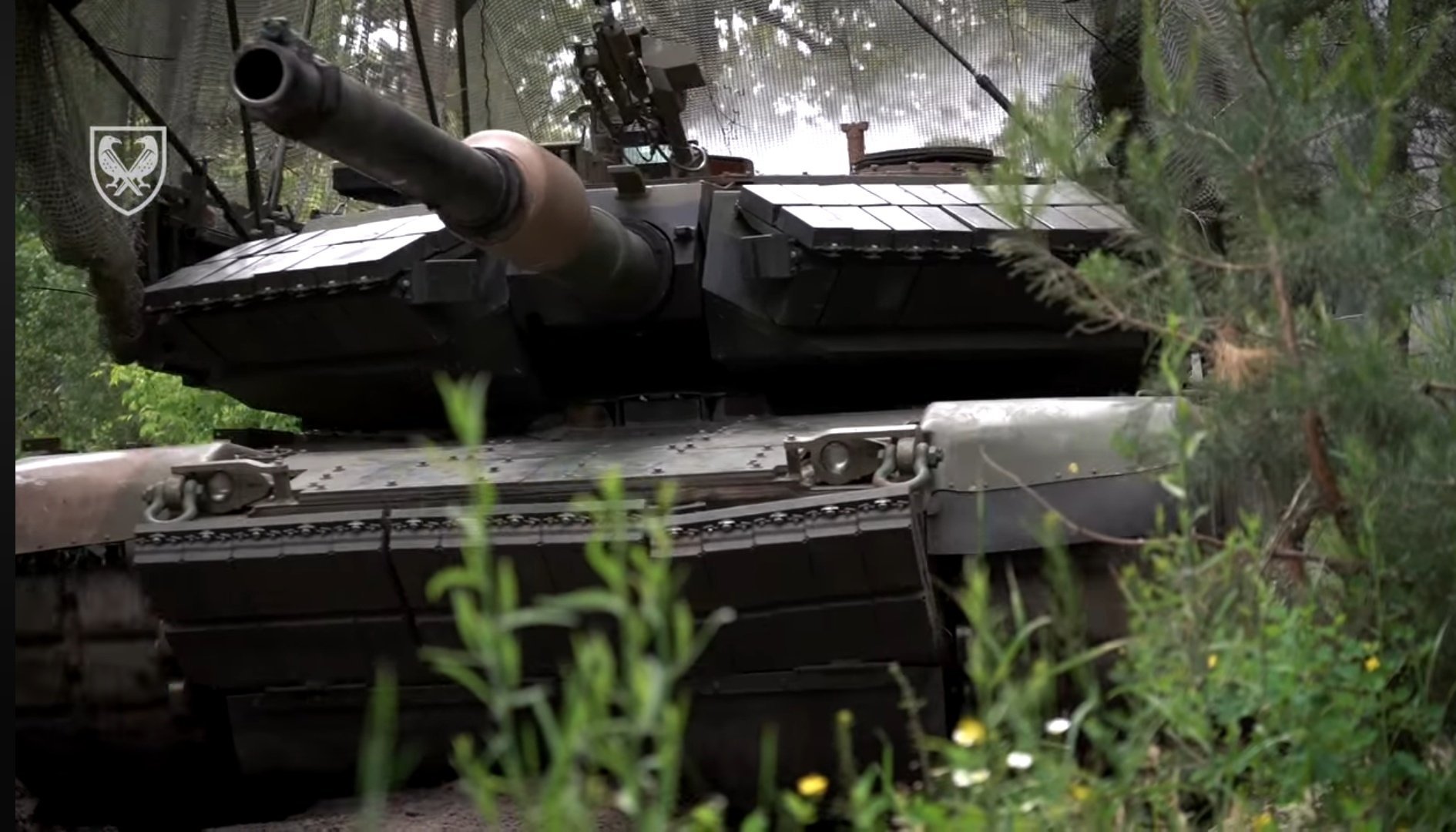 A head-on view of an M1A1 of the 425th Separate Assault Regiment shows the ERA bricks installed around the turret and in front of the hull. Ukrainian Armed Forces
 US-supplied M1A1 Abrams tank in service of the Armed Forces of Ukraine with added Kontakt-1 ERA on the frontal hull and standard ARAT ERA on the sides. pic.twitter.com/PC2kDfxefO
— Status-6 (War & Military News) (@Archer83Able) May 21, 2024Kent also noted that the Abrams was still missing the ‘hedgehog’-type protective coverings that have been seen on Russian tanks.
“They also protect very well. An effective thing,” he said.
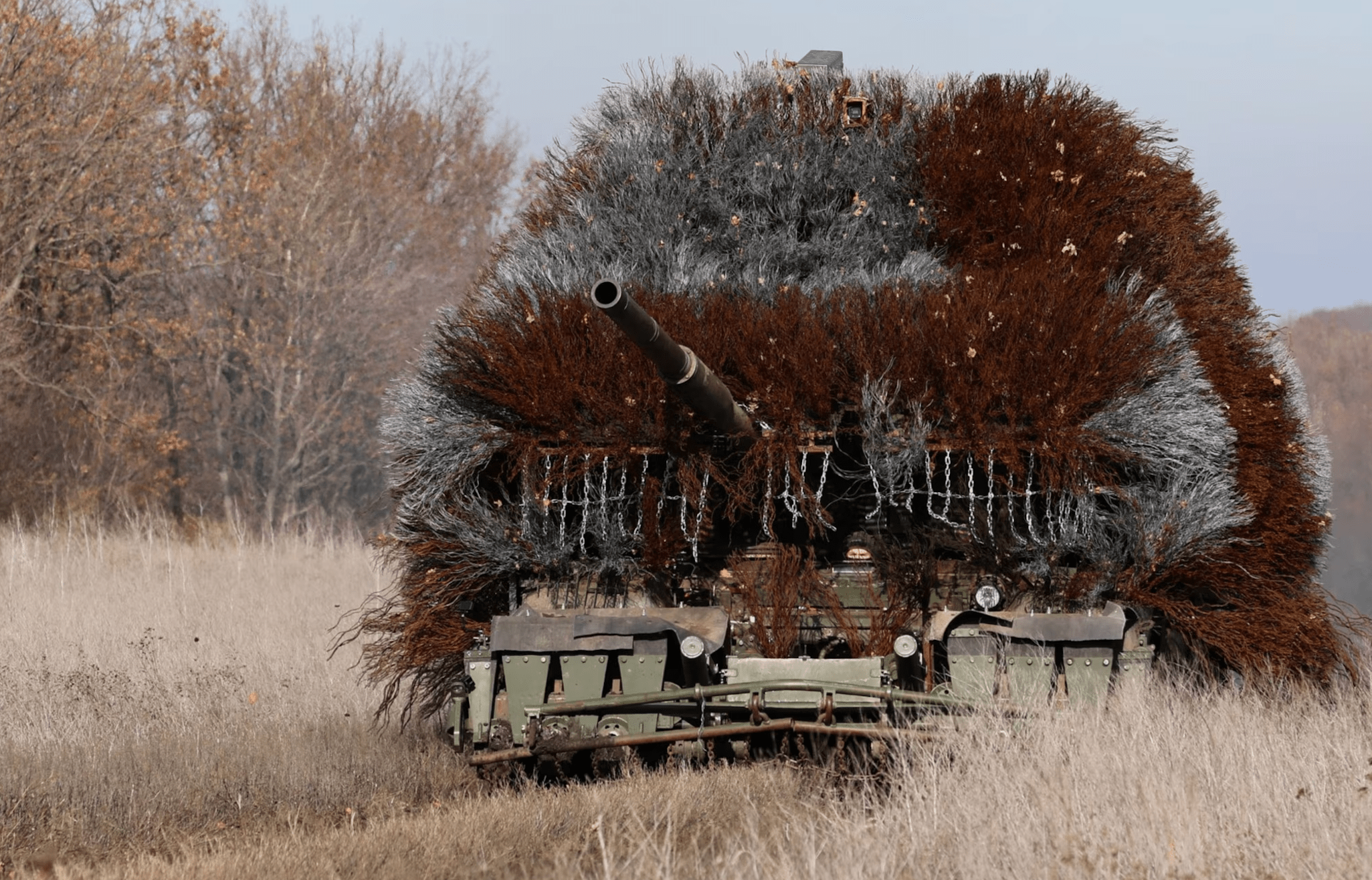 A Russian tank with the ‘hedgehog’-type protective covering. Russian state media
 For now, the drone threat has led the regiment to keep its Abrams out of combat, as we will return to later.
The Abrams as a machine
The crews’ assessment of the Abrams included praise for its mobility, roomy interior, gun, and fire-control system.
Kubik said he had personally driven an Abrams to 50 miles per hour cross-country.
“The engine is an absolute beast,” he added.
The tank can also rapidly perform a pivot turn, which the crews consider particularly useful when maneuvering in confined spaces. Despite its prodiguous weight, it only rarely becomes bogged down after the kind of very heavy snow-melt that effects all vehicles on the battlefield.
Loading a 120mm M1028 canister cartridge into an M1A1 AIM Abrams main battle tank of the tank battalion of the 425th Assault Regiment. pic.twitter.com/tMd8QcROQe
— 𝔗𝔥𝔢 𝕯𝔢𝔞𝔡 𝕯𝔦𝔰𝔱𝔯𝔦𝔠𝔱 🦩🇬🇪🇺🇦🇺🇲🇬🇷 (@TheDeadDistrict) June 21, 2026Its disadvantages include its demanding maintenance requirements. The running gear was described as particularly sensitive, with crews inspecting, lubricating, and replacing components after every sortie.
Fuel consumption is another major burden. The crew cited roughly 400 to 700 liters (106 to 185 gallons) per 100 kilometers (62 miles) depending on terrain and operating conditions.
“On asphalt it burns about 400 liters,” one said. In boggy terrain, consumption can reach “700 liters or more.”
The Abrams thirsty gas turbine engine and extreme logistical demands have always been a criticism of the platform.
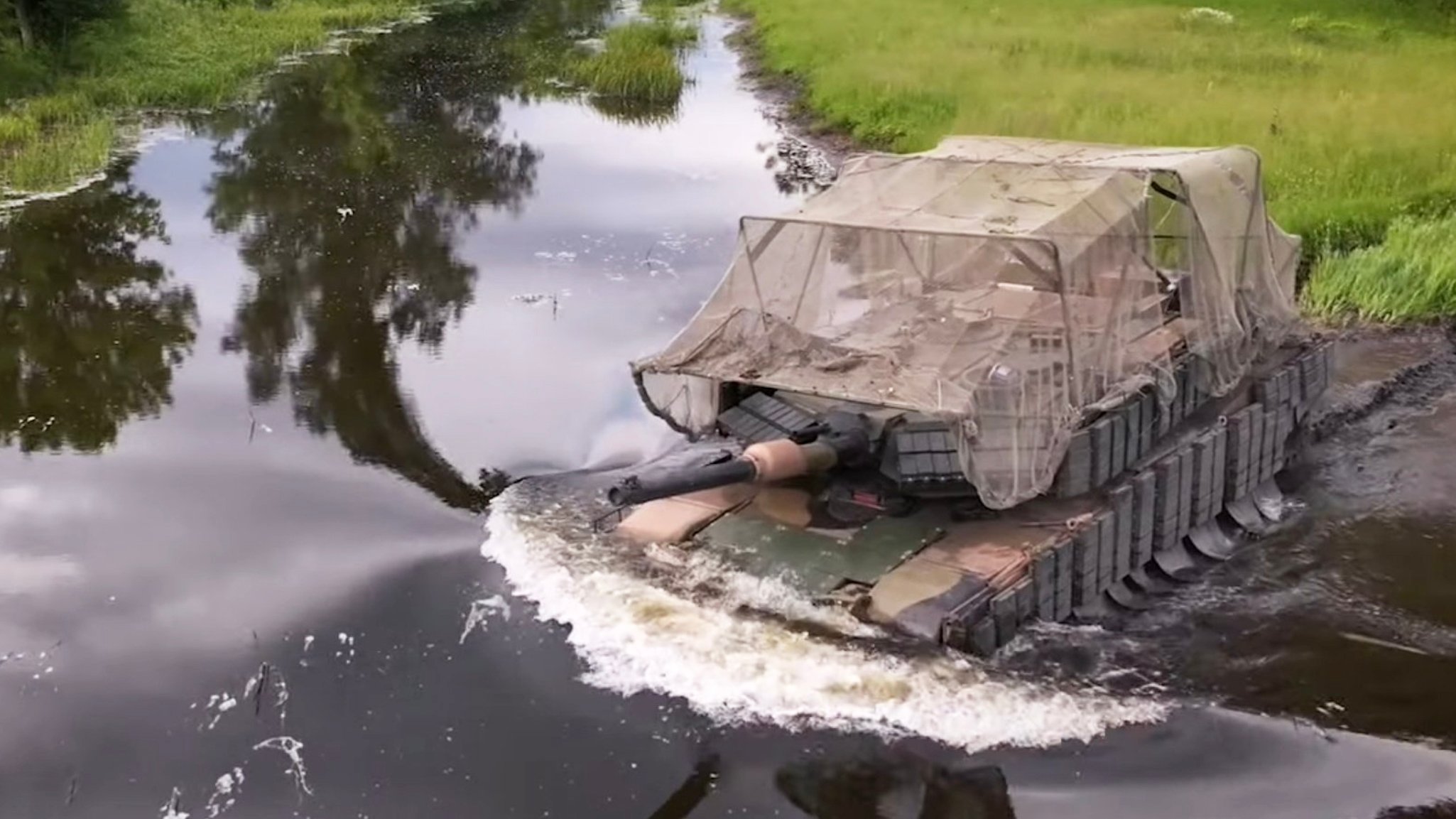 An M1A1 of the 425th Separate Assault Regiment fording a river. Ukrainian Armed Forces
 The crews said the vehicle’s ability to operate on different fuels is useful, although diesel provides the best engine-hour performance in their experience. Prior to delivery, the gas turbine engines of the tanks were reconfigured to use diesel fuel instead of the standard JP-8 aviation kerosene, according to earlier reports.
They also praised the Abrams’ protected ammunition storage and crew space compared with Soviet-designed tanks.
The version operated by the Ukrainians is an M1A1 rather than the latest Abrams configuration, with less sophisticated electronics than newer variants. It also lacks the classified armor found on its U.S. Army counterpart.
“For me — as a tanker — this configuration, what we have right now, is more than enough,” Kubik said. “The sight is absolutely excellent. The gun is also great.”
Waiting for a solution to the drone problem
The interview ultimately presents a more complicated picture than either the declaration that tanks are obsolete on the Ukrainian battlefield.
At the time of writing, at least 25 Abrams have been confirmed visually to have been destroyed, damaged, or abandoned in Ukrainian service. This is from a total of 31 provided by the United States and 49 from Australia.
“For now, we’re not using them further — there’s no way to,” Kubik said. “The enemy has developed their drone component very heavily, and for now we don’t have the means to counter that.”
While tanks remain exceptionally powerful direct-fire and protected mobility platforms, the proliferation of inexpensive uncrewed aircraft has made operating them increasingly difficult.
M1A1 AIM Abrams tanks of the 425th Assault Regiment 🇺🇦.
The reinforced upper glacis and turret roofs are clearly visible. pic.twitter.com/Sn9h8OWZ9P
“If someone had told me, as a tanker, back in 2022: ‘Take this — we’re giving you an Abrams, we’ll give you time to train and you’ll fight in it,’” Kubik said, “I would never have climbed out of it.”
“I’d only be saying: ‘Bring me shells. I’ll drive non-stop wherever needed, arrive and work.’”
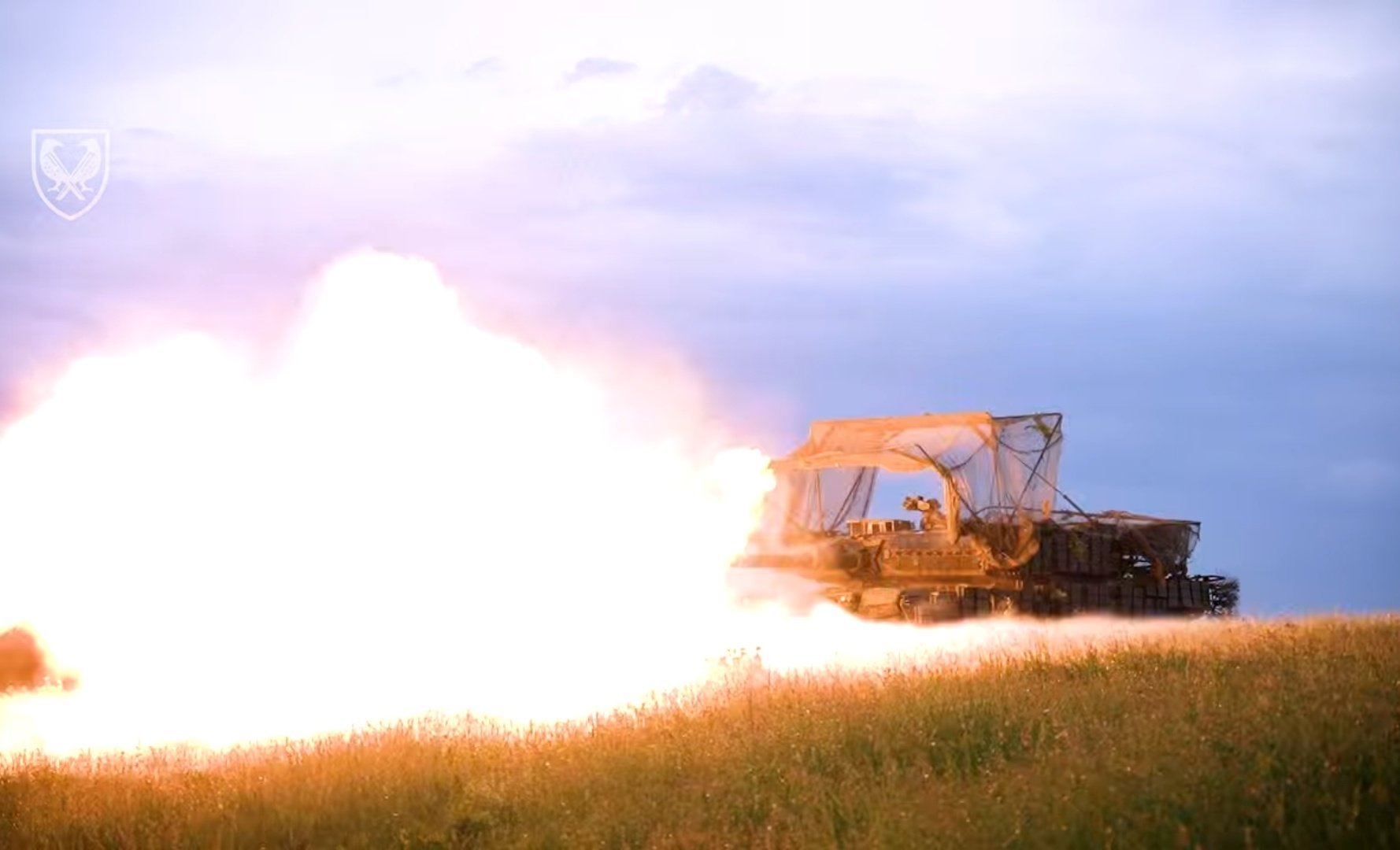 An M1A1 of the 425th Separate Assault Regiment firing its main gun. Ukrainian Armed Forces
 As it stands, reconnaissance drones can find the Abrams, FPV drones can attack it, and persistent surveillance makes concealment difficult. Experience has shown that without more effective counter-drone capabilities, even a heavily protected tank can eventually be overwhelmed.
But Kubik believes that will change.
“The day will come when one of our bright minds figures out some excellent solution against drones — and we’ll start using them again.”
Asked whether the era of tanks is over, his answer was unequivocal.
“It’s not over … They’re just waiting it out for now, biding their time. Writing off tanks — in my opinion — is still too early.”
Contact the author: [email protected]