By The Straits Times | Created at 2026-09-07 13:01:35 | Updated at 2026-10-02 11:46:13
3 weeks ago
By The Straits Times | Created at 2026-09-07 13:01:35 | Updated at 2026-10-02 11:46:13
3 weeks ago
JAKARTA – Yacintha Maria’s motorbike-taxi ride to her workplace in South Jakarta usually takes more than 30 minutes on a Monday. This time, it took 20.
“For a Monday, the roads were quiet,” said the 31-year-old office worker, who was late leaving her boarding house but arrived early anyway. She could not say why. “Maybe (some) people were working from home, or the kids were doing remote learning,” she told The Straits Times.
The trains told a different story. Jakarta’s commuter line carriages were just as crowded as any normal Monday. The only visible change was the rise in passengers wearing standard masks – though few wore the N95 masks recommended for protection from volcanic ash, which is far more abrasive than the city’s usual air pollution.
Finding the protective N95 masks over the weekend proved difficult – many supermarket shelves were stripped bare on Sunday, and by Monday, pharmacies across Jakarta’s shopping malls were down to minimal stock.
A series of eruptions at Indonesia’s Mount Anak Krakatau since Sept 4 has disrupted daily life as volcanic ash spread more than 150km away, blanketing Jakarta and nearby areas, and drawing inevitable comparisons to the catastrophic Krakatau eruption of 1883, when the city was known as Batavia.
Jakarta’s schools have shifted online, though workplaces largely remain open. The Home Affairs Ministry has approved remote work for civil servants in the capital and in cities nearer Anak Krakatau, such as Serang and Bandar Lampung. Several private-sector employers have followed suit.
Yacintha had not expected her office to be among them. Her company sent a message on the afternoon of Sept 6, saying: “We’re monitoring the situation, don’t believe hoaxes.” By that evening, the instruction was to come in as normal.
“We won’t be allowed to work from home unless it’s really bad,” she said. Her company did not allow this during protests in August either. “So, basically, not until the apocalypse. I’ve just learnt to laugh about it.”
So Yacintha went to work as usual, but with a few small adjustments to mitigate the effects of the fallout: long sleeves, closed shoes instead of sandals and glasses instead of contact lenses. She has been wearing standard masks almost daily since the Covid-19 pandemic, a habit that simply continued. “I can’t afford to get sick right now,” she said.
Lola Loveita, 34, was a bit more fortunate. The NGO she works for already allows its staff to work from home on Mondays and Thursdays. However, that still left her with the dilemma of what to do with her seven-year-old son, Banyu.
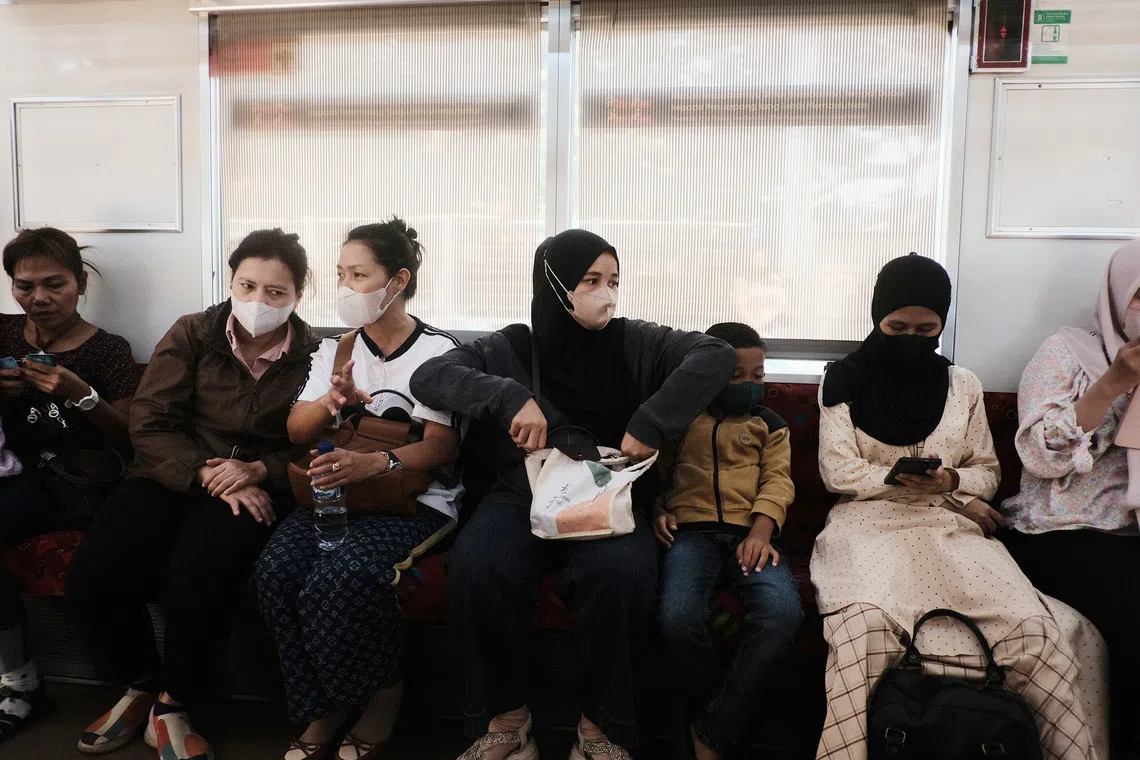
Passengers wearing masks in a commuter line train in Jakarta on Sept 7.
ST PHOTO: KARINA TEHUSIJARANA
Banyu’s private school went back and forth all weekend on whether to go fully online. Announcing the decision just hours before Monday classes, the school left the ultimate choice to parents: children could either attend in person wearing a mask and protective goggles, or log on from home.
Lola eventually decided to drive Banyu the few hundred metres to school.
“Even though I’m at home (on Mondays), I have to work, so there’d still be nobody to sit with him,” she said. Banyu also had a presentation to give using paper props he had made. “I couldn’t support him doing that online,” she added.
Adapting to the fallout
Unlike Lola, Dini, 41, didn’t have the option to work from home. The private school where her two sons, aged 14 and 9, study is located in Depok, on the outskirts of Jakarta but technically part of the neighboring province of West Java.
“There was no news until last night, when they finally announced that students would be studying from home for Monday, Tuesday, and Wednesday,” the private-sector employee told ST.
Her office, located in Gatot Subroto, Central Jakarta, almost never allows remote work, so she initially worried about how to manage. “In the end, I felt that since they’re a bit older, they should be able to study online without my supervision,” said Dini, who declined to give her full name. She decided to leave her sons at home with her domestic helper.
Meanwhile, the more affluent parents of the students that Henda, 37, teaches at an international school in South Jakarta, are less fussed about their children studying from home.
“The families of the students at my school tend to suggest studying from home before the school has announced anything,” Henda, who also declined to give his full name, told ST.
Henda, who teaches Bahasa Indonesia to Grade 11 students, took both of his Monday classes from home and was largely unfazed by the switch. “We did two years of this during Covid-19, and again during the protests in Jakarta last year. It’s just readjusting what we’ve already done.” The harder part was the students. Even though his first class wasn’t until 10am, “you could really tell they had just woken up.”
Whether the arrangement holds beyond this week remains uncertain. Following Anak Krakatau’s last eruption on the night of Sept 6, the Health Ministry activated emergency operations centres from the national level down to affected districts, with clinics and hospitals in Jakarta, Banten and West Java on 24-hour standby for a rise in respiratory cases.
Children, the elderly and people with lung or heart conditions are most at risk, Health Minister Budi Gunadi Sadikin warned during a weekend health briefing.
Issuing advice intended for the general public in an official ministry statement, he said: “If there’s nothing urgent, try to stay at home. But if you have to go out, always wear a mask and glasses.”