By The Rio Times | Created at 2026-09-19 08:41:59 | Updated at 2026-09-19 15:44:24
7 hours ago
By The Rio Times | Created at 2026-09-19 08:41:59 | Updated at 2026-09-19 15:44:24
7 hours ago
Brazil · Defence
Key Facts
—The story. Brazil’s first nuclear-powered submarine, the Álvaro Alberto, is now due to launch in 2038.
—Why it matters. Only six nuclear-armed states run such submarines, and Brazil wants to join them.
—The background. France agreed in 2008 to help, and the boat was due in 2025.
—The numbers. Navy officers said it needs at least R$1 billion (US$194 million) more a year.
—The catch. The section finished on 9 September is a test piece and will never sail.
—What comes next. Congress must still pass the 2027 budget, and October’s winner inherits the gap.
Brazil wants to join the six nuclear-armed nations that run nuclear-powered submarines, without having nuclear weapons itself. This month it finished a steel test piece for its first such boat, whose launch has slipped to 2038.
One-stop reference
Company Intelligence
Every listed company in Latin America — financials, ownership and structure for 1,450+ companies across 26 exchanges, in one place.
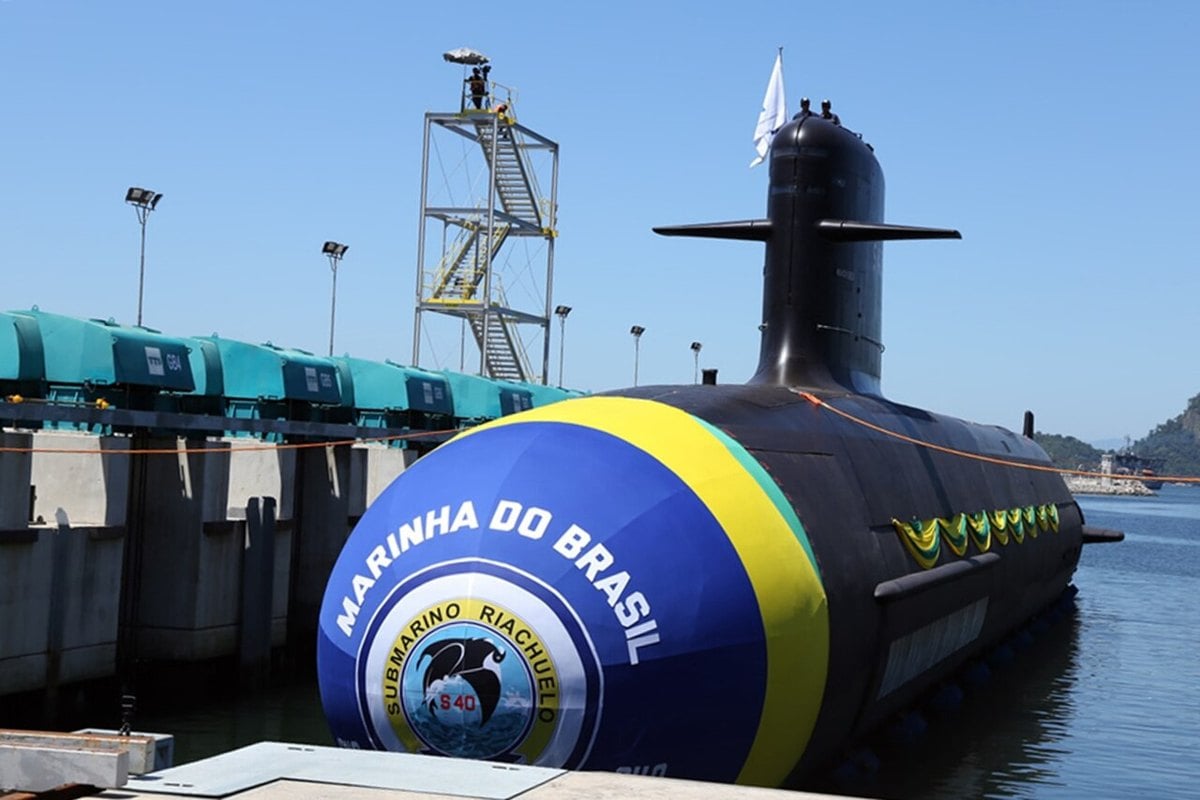
NUCLEP, a state-owned heavy engineering firm, said on 9 September 2026 it had finished its part of a hull test section. The milestone for the Álvaro Alberto comes months after the Defence Ministry told Congress its launch had moved to 2038.
Why This Matters Beyond Brazil
Nuclear-powered submarines have so far been built and operated only by six countries, all of which have nuclear weapons. They are the United States, Russia, China, France, the United Kingdom and India.
Brazil has had a policy of no nuclear weapons since the 1990s, yet it is building a reactor to power a submarine. Australia, through the AUKUS pact with the US and UK, and South Korea are pursuing the same capability.
Brazil’s boat would be the first nuclear-powered submarine in Latin America, the EurAsian Times noted on 13 September. The Álvaro Alberto is designed at about 100 metres long and 6,000 tonnes, with a 48-megawatt pressurised-water reactor.
Its stated job is to patrol what Brazil calls the Blue Amazon, its sea area off a coast of about 7,400 km. That area of about 3.5 million square kilometres holds some 90% of Brazil’s oil and 77% of its gas.
The delay therefore touches energy security, a domestic arms industry and Brazil’s standing among naval powers. It also lands weeks before Brazil’s 4 October general election, and the next government will inherit the programme.
What Was Actually Delivered
Nuclebrás Equipamentos Pesados, known as NUCLEP, built the section with Itaguaí Construções Navais, the Itaguaí shipbuilder. The piece reproduces a slice of the pressure hull, the inner shell that must resist the weight of water at depth.
It will not be installed in the finished submarine, according to NUCLEP’s statement reported by Poder Naval, a naval news site. Its job is to prove the steel plates, welding procedures, equipment and welders before real hull sections are made.
NUCLEP president Adeilson Telles said Brazil spent decades training people and building capacity for a project this complex. Contract manager Vinícius Leone said the work confirmed the company’s technical capacity, Tecnodefesa reported.
NUCLEP is also building Block 40 at the Aramar nuclear centre in Iperó, São Paulo state. That block will house the reactor of LABGENE, the land-based prototype of the submarine’s propulsion plant.
A Launch Now Set for 2038
The Defence Ministry gave the Chamber of Deputies, Congress’s lower house, the new date in a 22 June letter, Metrópoles reported. The previous estimate had been 2034, so the latest revision adds four years on its own.
The Navy cited a lack of resources and an absence of budget predictability, according to the same report. When Brazil and France launched the programme in 2008, the nuclear boat was meant to enter service in 2025.
That puts the slip at 13 years against the original plan, a figure Brazilian defence outlets have used widely. Brasil 247, citing the 2027 bill, gave 2037 as the project’s completion date, without reconciling it with 2038.
Two Billion Received, Three Billion Needed
The funding gap figure comes from Navy officers who spoke to CNN Brasil in March 2025. They said the submarine programme was receiving about R$2 billion a year (about US$388 million).
They said at least R$1 billion more a year (about US$194 million) was needed to hold the schedule. That implies roughly R$3 billion a year (about US$582 million), an arithmetic total rather than a single quoted figure.
CNN Brasil reported funding reached nearly R$4 billion a year (about US$776 million) in the programme’s early years. It fell to about R$1.5 billion (about US$291 million) during the 2015-16 recession, CNN said.
Poder Naval reported that the whole Naval Nuclear Programme received R$1.4 billion in 2025 (about US$271 million). The submarine project itself received another R$649 million (about US$126 million), it said, citing Folha.
Dollar figures in this article use the Central Bank of Brazil PTAX selling rate of R$5.1575 per dollar on 18 September 2026. PTAX is the official reference rate the central bank publishes each business day.
How PROSUB Works
PROSUB, the Navy’s submarine development programme, grew out of a 2008 partnership signed by Lula and Nicolas Sarkozy. France agreed to transfer design and construction know-how for four conventional boats derived from the Scorpène class.
The deal also covered help with the non-nuclear parts of Brazil’s first nuclear-powered submarine. The reactor and propulsion plant are Brazilian work, developed by the Navy at Aramar.
Construction is centred on the Itaguaí complex in Rio de Janeiro state, which includes a shipyard and a naval base. The site also has a structures plant where hull sections are assembled before moving to the yard.
The Álvaro Alberto is described as conventionally armed, meaning nuclear propulsion but torpedoes and anti-ship missiles only. Nuclear propulsion lets a submarine stay submerged far longer than a diesel-electric boat, which must surface or snorkel to recharge.
Where the Four Conventional Boats Stand
The Riachuelo, the first of the class, entered service in 2022 and was in its first routine docking in July. The Humaitá and the Tonelero are operating, according to Poder Naval’s July report.
The fourth boat, the Almirante Karam, is scheduled to join the fleet in 2027. That means the conventional half of PROSUB is close to done, while the nuclear half is still in qualification work.
A Bigger Budget That Mostly Pays People
The 2027 budget bill sets the Defence Ministry’s allocation at R$147.68 billion (about US$28.6 billion), Revista Sociedade Militar reported. The military news outlet put the 2022 figure at R$122.52 billion (about US$23.8 billion), a rise of 20.5%.
Most of that money is not for ships or aircraft, according to Brasil 247. Personnel and social charges take about R$108 billion (about US$20.9 billion), the site reported.
Revista Sociedade Militar said personnel costs made up 87.1% of Defence spending actually executed in 2025. Investment in the 2027 bill is R$12.7 billion (about US$2.46 billion), or 8.6% of the total, according to Brasil 247.
The summary lists R$1.4 billion (about US$271 million) for LABGENE and about R$400 million (US$78 million) for the submarine. The budget bill still has to pass Congress, so these amounts can change before they are spent.
The Minister Who Says He Will Not Stay
Defence Minister José Múcio Monteiro, a civilian who oversees the armed forces, has signalled he does not want another term. He told Metrópoles on 8 September that “eu não tenho mais idade para isso” and that the job was draining.
In English, the first phrase means he is too old for this now, and Múcio has held the post since January 2023. “I came here to spend a year, and I will complete four,” he said in the same interview.
Revista Sociedade Militar counts him as the second longest-serving defence minister, behind Nelson Jobim. Múcio did not say directly whether he would serve if President Lula wins re-election in October.
Argentine F-16s Cleared to Stage at Natal
A separate decision shows Brazil’s role as a regional stopover for neighbours’ military hardware. Brazil’s Federal Revenue Service cleared Argentine F-16s to stay at Natal Air Base, in a gazette notice on 11 September.
The window runs from 21 September to 1 October 2026, an 11-day period, according to Aviacionline and Zona Militar. Zona Militar said six aircraft are covered, and the base was cleared to act as an international airport.
That was needed because the base has no permanent customs post, and immigration checks will be done on arrival. The jets are the second batch of 24 F-16s Argentina bought from Denmark, flying to the Río Cuarto maintenance centre in Córdoba.
A US Air Force KC-135 tanker is due to refuel them over the Atlantic. It did the same for a first batch in December 2025, Aviacionline reported.
What It Means If You Follow Brazilian Defence
For suppliers and investors, the lesson is that Brazilian defence money is large but mostly locked into payroll. Investment lines such as PROSUB, the Gripen fighter jets and the Tamandaré frigates compete for a small, unpredictable slice.
Firms in the Itaguaí supply chain face a longer, thinner order book rather than a cancellation. The qualification section shows the industrial work is continuing, at a pace set by annual budget votes.
For energy investors, the boat’s stated mission is guarding offshore oil and gas, but that remains years away. Anyone tracking the October election should note the next government will inherit both the submarine and the budget gap.
What Is Not Yet Known
Brasil 247 cited a projected R$22.6 billion total for the submarine project, with R$5.8 billion spent by May. It is not clear whether the 2027 allocation is enough to keep 2038 from slipping further.
The Navy has not published a date for starting the first real pressure hull section of the Álvaro Alberto. Nobody has been named as Múcio’s successor, and he has not set a departure date.
Frequently Asked Questions
Why does Brazil’s nuclear submarine matter?
Only six countries, all with nuclear weapons, have operated nuclear-powered submarines. Brazil would be the first in Latin America and wants the boat to patrol waters holding most of its oil and gas.
When will Brazil’s nuclear submarine be launched?
The Defence Ministry told the Chamber of Deputies in June 2026 that the launch is now planned for 2038. The 2008 plan had it in service in 2025.
Did Brazil finish the hull of the Álvaro Alberto?
No, NUCLEP finished a qualification section on 9 September 2026. It tests materials and welding and will not go into the real boat.
Why is the submarine delayed?
The Navy cites unpredictable budgets, and officers told CNN Brasil the programme gets about R$2 billion a year (about US$388 million). They said it needs at least R$1 billion (about US$194 million) more.
Sources: Poder Naval, NUCLEP completes the hull qualification section, Poder Naval, Álvaro Alberto launch moved to 2038, CNN Brasil, the submarine programme’s budget challenge, Revista Sociedade Militar, Defence budget and Múcio, Brasil 247, Defence in the 2027 budget bill, Metrópoles, Múcio interview, Zona Militar, Brazil authorises the Argentine F-16s, Aviacionline, F-16 stopover in Natal, Wikipedia, the Álvaro Alberto and nuclear submarine operators, Wikipedia, PROSUB and the Blue Amazon, EurAsian Times, the spread of nuclear submarine programmes, Wikipedia, 2026 Brazilian general election