By The Rio Times | Created at 2026-10-03 07:36:52 | Updated at 2026-10-03 08:23:07
1 hour ago
By The Rio Times | Created at 2026-10-03 07:36:52 | Updated at 2026-10-03 08:23:07
1 hour ago
Key Facts
- Nigerian shares edged lower: the NGX All-Share Index (ASI) fell 403.40 points, or 0.16%, to 250,808.27 on Friday, its first session after the Independence Day holiday
- Banks led the decline: the NGX Banking Index lost 0.97% to 2,685.71 points, with First Holdco down 6.16%, while Fidelity Bank rose 8.55%
- Market value slipped: equity market capitalisation fell N261.92 billion (about US$197 million) to N162.84 trillion (about US$122.7 billion), at N1,327.66 per US dollar
- Trading cooled: investors exchanged 557.12 million shares in 53,370 deals; volume was down 45.91% on the last session, and breadth was level at 26 gainers and 26 decliners
- Factories and shops grew fastest in years: the Stanbic IBTC Nigeria PMI rose to 56.4 in September from 54.3, its highest reading since February 2022
- The naira held steady: the dollar closed at N1,327.66, down 0.20% on the day, as a three-day public-sector warning strike over fuel prices and pay was due to begin
Today’s Focus
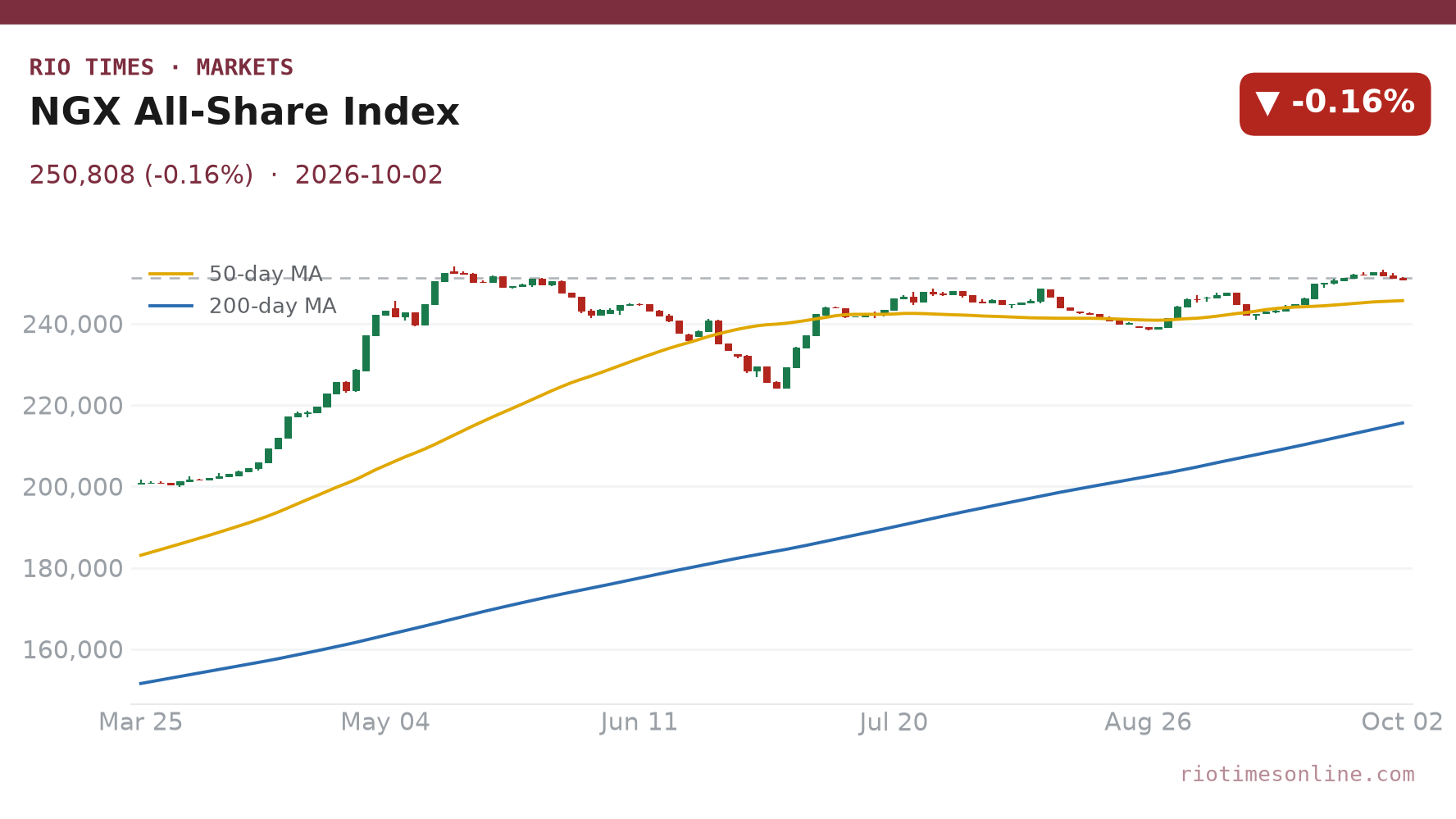
Nigeria’s stock market ended a short week with a small loss on Friday, 2 October 2026. The All-Share Index, which tracks every share listed on the Nigerian Exchange (NGX), slipped 0.16% to 250,808.27 points. It was the first trading day after the Independence Day holiday on Thursday.
Banks did most of the damage. The NGX Banking Index fell 0.97%, while insurers rose and oil and gas shares stood still. The naira, Nigeria’s currency, barely moved at N1,327.66 per US dollar.
The economic data were stronger than the market mood. Private-sector activity expanded at its fastest pace since February 2022, according to the Stanbic IBTC purchasing managers’ index (PMI). Public-sector unions were also due to begin a three-day warning strike over petrol prices, a risk that sits behind the numbers.
What matters today. The index is still up about 61% this year in naira terms. Friday’s small dip is a pause near the highs, not a reversal. The test for the week ahead is whether the strike and fuel costs dent the upbeat factory data.
One-stop reference
Company Intelligence
Every listed company in Latin America — financials, ownership and structure for 1,450+ companies across 26 exchanges, in one place.
01 The session in one read
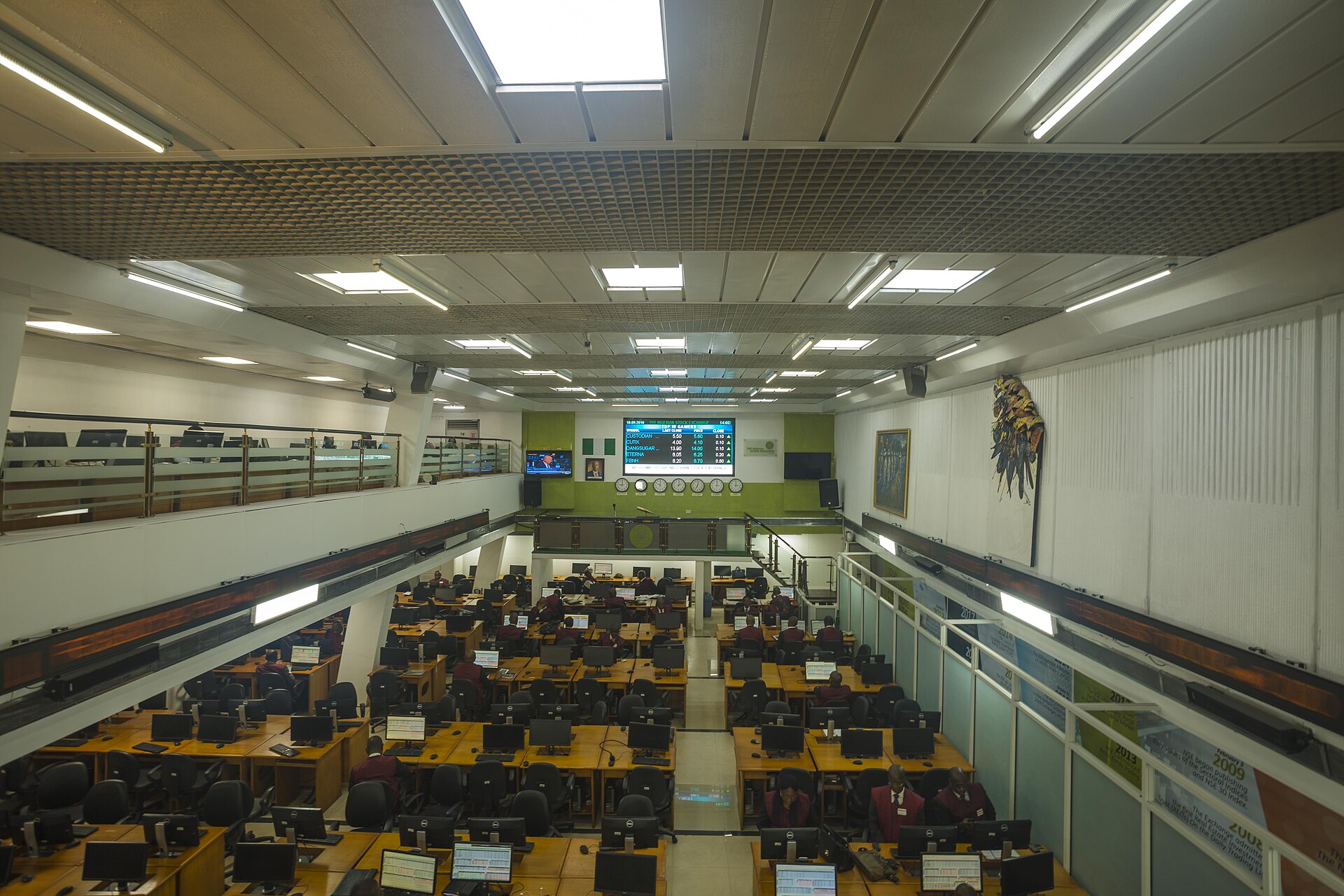
The Nigerian Exchange, the main stock market of West Africa’s largest economy, closed Friday slightly lower. The All-Share Index ended at 250,808.27, down from 251,211.67 at the last close on Wednesday, 30 September. There was no trading on Thursday because of the national holiday.
Equity market capitalisation, the total value of all listed shares, fell N261.92 billion (about US$197 million) to N162.84 trillion (about US$122.7 billion). We convert at the RT close of N1,327.66 per dollar.
Activity was lower than before the break. Investors traded 557.12 million shares in 53,370 deals. Volume fell 45.91% from Wednesday, while the number of deals rose 20.21%. That points to many small trades rather than a few large ones.
Breadth was balanced: 26 stocks rose and 26 fell. Access Holdings was the most active stock with 183.56 million shares, about a third of all volume. Critical Minerals Financing Corp (38.52 million) and Fidelity Bank (27.75 million) followed.
Assessment: A pause near the highs, led by banks MEDIUM
The pattern fits profit-taking after a strong run. The index closed at 252,635.11 on Monday, 28 September, its highest close in the past year, and has given back 0.7% since. Banks fell as a group, but Fidelity Bank and GTCO (Guaranty Trust) rose, so the selling was selective. Insurers gained 1.21% and the oil and gas index was unchanged. What we cannot confirm is the full naira value of Friday’s trade, which we could not find in a published report, so we do not compare turnover with earlier days.
02 The day’s numbers
| NGX All-Share Index | 250,808.27 | −0.16% | Down 0.52% on the week; up 61.2% since 31 December 2025 |
| NGX Banking Index | 2,685.71 | −0.97% | Main drag on the market |
| NGX Consumer Goods Index | 4,057.09 | −0.03% | Almost flat |
| NGX Oil & Gas Index | 6,246.75 | 0.00% | Unchanged |
| NGX Insurance Index | n/a | +1.21% | Best sector of the day |
| USD/NGN | 1,327.66 | −0.20% | Naira slightly firmer; 1,330.37 on Thursday |
| Stanbic IBTC Nigeria PMI (September) | 56.4 | +2.1 pts | August 54.3 |
The All-Share Index has gained 2.7% since the end of August, when it closed at 244,199.50. It sits 2.1% above its 50-day moving average (245,684) and 16.3% above its 200-day average (215,626), so the trend is still firmly upward. The index is 81.5% above its level of 3 September 2025 (138,157.14).
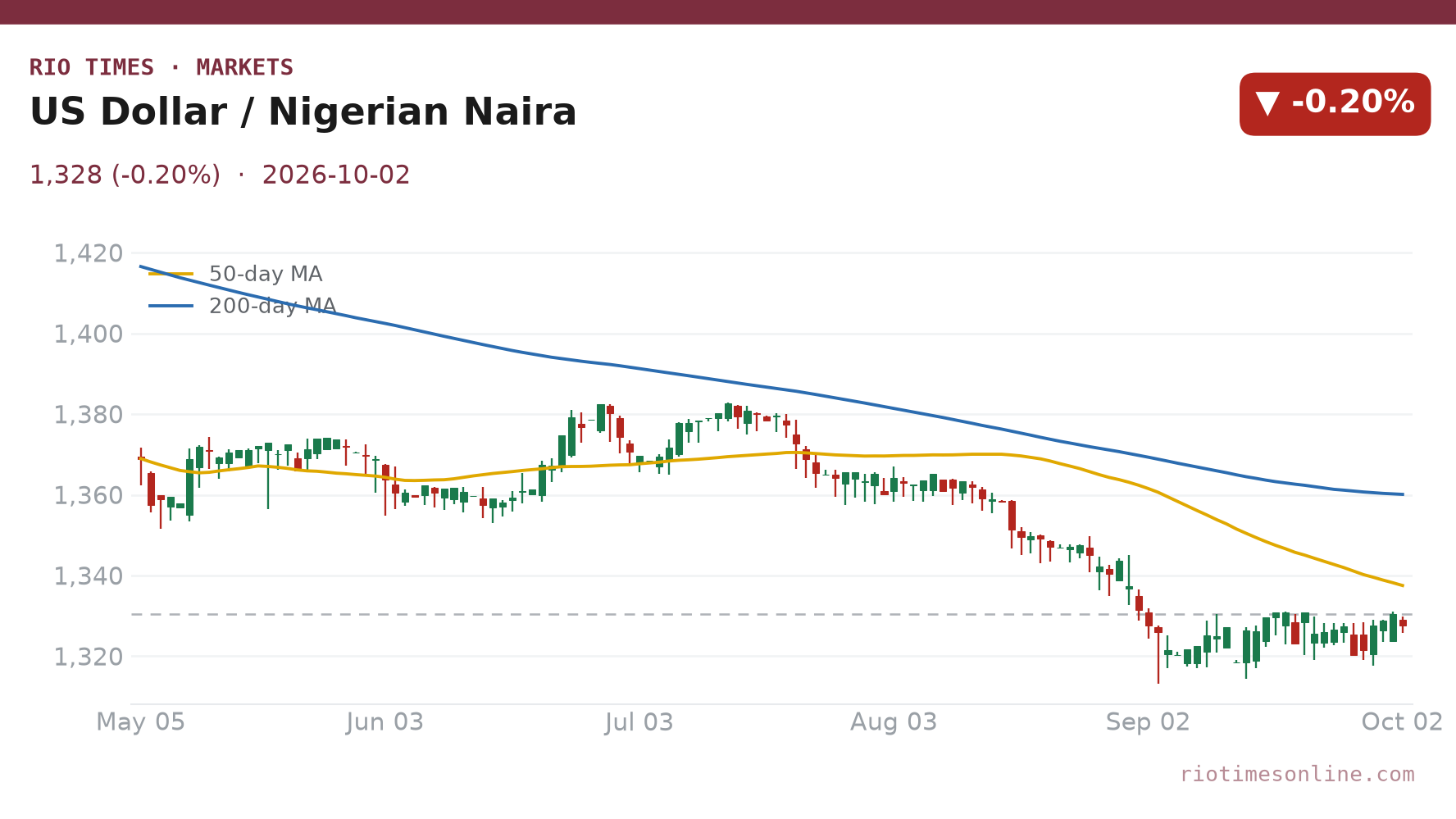
The naira has been calm. Since 24 September the dollar has stayed between N1,320.34 and N1,330.37. A steady currency matters for foreign investors, because a share gain is worth more in dollars if the naira does not weaken at the same time.
Rio Times · Live Market Intelligence
Global Markets — Live Board
World
Oct 3, 2026 · 03:55
S&P 500 · benchmark
7,751 +0.29%
Market breadth · 15 names
60% advancing
9 ▲ advancing6 declining ▼
Currencies, rates & key inputs
Full instrument board
| SPX | 7,751 | +0.29% | — | — | — | — | — |
| NDX | 29,799 | +0.93% | — | — | — | — | — |
| DJI | 53,810 | +0.03% | — | — | — | — | — |
| RUT | 3,041 | +0.46% | — | — | — | — | — |
| US10Y | 4.6760 | -0.17% | — | — | — | — | — |
| VIX | 14.60 | -4.45% | — | — | — | — | — |
| DAX | 26,331 | -0.23% | — | — | — | — | — |
| FTSE | 10,833 | -0.10% | — | — | — | — | — |
| CAC | 8,675 | -0.46% | — | — | — | — | — |
| STOXX | 659.48 | -0.16% | — | — | — | — | — |
| NIKKEI | 67,524 | +0.83% | — | — | — | — | — |
| HSI | 25,440 | -0.83% | — | — | — | — | — |
| KOSPI | 6,579 | +3.68% | — | — | — | — | — |
| CSI300 | 4,691 | +0.58% | — | — | — | — | — |
| NIFTY | 24,436 | -0.15% | — | — | — | — | — |
| TSX | 36,619 | +0.39% | — | — | — | — | — |
| GOLD | 4,461 | +1.78% | +33.20% | 4,383 | 4,503 | 4,421 | 139,824 |
| SILVER | 65.59 | +1.26% | +73.05% | 64.77 | 66.98 | 64.81 | 46,406 |
Largest moves today
VIX 14.60 -4.45%
KOSPI 6,579 +3.68%
GOLD 4,461 +1.78%
SILVER 65.59 +1.26%
NDX 29,799 +0.93%
NIKKEI 67,524 +0.83%
HSI 25,440 -0.83%
CSI300 4,691 +0.58%
The session read
The S&P 500 rose 0.29%, with breadth positive — 9 of 15 names higher. KOSPI led, while HSI lagged.
03 Why it moved: bank profit-taking after a long run
Banks are the heaviest group on the exchange, so they set the direction of the index. The NGX Banking Index fell by 26.39 points, from 2,712.10 to 2,685.71. First Holdco dropped 6.16%. UBA slipped 0.33% and Wema Bank 0.48%.
Not every lender fell. Fidelity Bank gained 8.55% and GTCO rose 0.61%. That split suggests investors were picking names, not leaving the sector.
Other stocks carried their own news. NGX Group, the exchange’s own parent company, fell 6.85%, and VFD Group fell 6.90%. Access Holdings, the most traded stock, told the exchange on Friday that it had received a further extension to publish its audited H1 2026 results. The group says it is still waiting for approval from the Central Bank of Nigeria (CBN). The data do not show why Access traded so heavily.
The naira gave no extra push. At N1,327.66 it was 0.20% firmer than on Thursday and well inside its recent range. The market was reacting to company news and positioning, not to a currency shock.
04 Friday’s data and news, one by one
Three items shaped the day. One was strong data, one was a company filing and one was a labour dispute.
Stanbic IBTC PMI. The headline index rose to 56.4 in September from 54.3 in August. Readings above 50 signal growth. New orders rose for the eighth month in a row and at the fastest pace since February 2022. Output also grew at its strongest rate since that month, with growth in all four sectors that the survey tracks.
The PMI’s weak spots. Purchase prices rose sharply again, to a three-month high. Firms cited fuel, foodstuffs and other raw materials. Staff costs also rose faster, while hiring stayed modest. Strong sales with rising costs can squeeze company profit margins, which matters for the earnings season ahead. Our wider read on the currency is here.
Access Holdings. The bank’s board approved its accounts on 27 August, and the NGX had already granted one extension, to 30 September. The second extension has no new date. Access said it will publish promptly once the CBN completes its approval process.
Public-sector warning strike. The Joint National Public Service Negotiating Council, a body of eight public-sector unions, called a three-day warning strike from Friday 2 October. It wants petrol cut to N500 per litre (about US$0.38) and a wage award. Pump prices of N1,395 to N1,450 per litre in Abuja (about US$1.05 to US$1.09) are the trigger. The current minimum wage is N70,000 a month (about US$53). We have no confirmed government response. Our earlier report has the background.
05 The day’s movers
| AIICO Insurance | N4.18 | +10.00% | Top gainer, at the daily limit |
| Trans-Nationwide Express | N2.97 | +10.00% | Also at the daily limit |
| Livestock Feeds | N8.90 | +9.88% | Third-best gainer |
| Fidelity Bank | n/a | +8.55% | 27.75 million shares traded |
| PZ Cussons | N66.40 | −9.91% | Biggest loser |
| eTranzact International | N11.00 | −9.84% | Second-biggest loser |
| First Holdco | n/a | −6.16% | Heaviest loss among large banks |
| Access Holdings | n/a | n/a | Most active: 183.56 million shares |
Prices are in naira; at N1,327.66 per dollar, N1 is about US$0.00075. Many of the top movers are low-priced shares, so a 10% move can come from very small trades.
The exchange allows a share to rise or fall by no more than 10% in a day, which is why AIICO Insurance and Trans-Nationwide Express stopped at exactly 10.00%. For readers who follow the market itself, our guide to the Nigerian Exchange explains how it is run.
We could not confirm closing prices for the large banks or turnover in naira, so those cells are marked n/a rather than estimated.
06 The regional scoreboard
| NGX All-Share Index | Nigeria | −0.16% |
| Satrix 40 ETF (Top 40 tracker) | South Africa | +0.81% |
The Satrix 40 ETF, which tracks the FTSE/JSE Top 40 index, rose 0.81% to R102.77 (about US$6.18) on Friday, recovering part of Thursday’s fall. Lagos and Johannesburg moved in opposite directions, so the day was driven by local factors rather than a continent-wide trend.
Egypt’s EGX30 does not trade on Fridays. Closing data for Nairobi and Casablanca were not available to us at the time of writing, so they are left out rather than estimated.
07 The technical picture
The All-Share Index closed 0.7% below its 28 September high of 252,635.11. That is the first line to watch: a close above it would set a new one-year high. The 50-day moving average at about 245,684 is the nearest support, roughly 2% below Friday’s close.
For the naira, the dollar has held between N1,320.34 and N1,330.37 since 24 September. A move outside that band would be the first sign of fresh pressure either way. The 200-day moving average for the index (215,626) is far below the price, which shows how steep the year’s climb has been.
08 What to watch
- The strike: The three-day warning strike runs to Sunday 4 October; a longer stoppage or a fuel-price concession would change the mood on Monday
- Bank earnings and filings: Access Holdings still has no date for its audited H1 results; late filings from other lenders would add to the pressure on the banking index
- The 252,635 mark: A close above Monday’s high would confirm that Friday was only a pause
- Input costs: The PMI shows purchase prices at a three-month high; watch whether firms pass them on in the next inflation print
- Dangote Refinery offer: Priced at N525 (about US$0.40) per share, the offer’s allotment and listing dates are not yet confirmed, and it competes for investor cash
Background: Nigerian Exchange (NGX): how it works, who runs it, and what issuers must disclose. More from the region: Nigeria news and the naira and reserves.
Frequently Asked Questions
How did the Nigerian stock market close on 2 October 2026?
The NGX All-Share Index fell 0.16%, or 403.40 points, to 250,808.27. Market capitalisation dropped N261.92 billion (about US$197 million) to N162.84 trillion (about US$122.7 billion).
Why did Nigerian bank shares fall on Friday?
The NGX Banking Index lost 0.97%, led by First Holdco (down 6.16%). Fidelity Bank and GTCO rose, so the fall was not across the board. Access Holdings also said it needs another extension for its H1 results.
What did the Nigeria PMI show for September?
The Stanbic IBTC Nigeria PMI rose to 56.4 from 54.3 in August and was the strongest reading since February 2022, though input costs also rose.
Was the Nigerian stock market open on 1 October 2026?
No. The exchange did not trade on Thursday 1 October, which is Nigeria’s Independence Day. Friday’s change is measured against the 30 September close of 251,211.67.
What was the naira rate on 2 October 2026?
The dollar closed at N1,327.66, down 0.20% from N1,330.37 on 1 October, based on RT market data. Other published rates for the day were similar.
Source: RT live market data (RT), close of Friday 2 October 2026 for the NGX All-Share Index and USD/NGN; sector indices, market capitalisation, volume, movers and breadth from Nairametrics and the Nigerian Exchange; PMI from S&P Global and Stanbic IBTC; strike from Premium Times; Access Holdings filing from the NGX disclosure via Nairametrics.
This article was produced by The Rio Times’ automated newsroom system. How we use AI · Report an error · Editorial responsibility: Matthias Camenzind, Editor-in-Chief
LatAm Markets: Live Signals → — real-time movers, turnover leaders and FX across Latin America.