By The Rio Times | Created at 2026-10-04 21:41:37 | Updated at 2026-10-04 22:28:03
1 hour ago
By The Rio Times | Created at 2026-10-04 21:41:37 | Updated at 2026-10-04 22:28:03
1 hour ago
One-stop reference
Company Intelligence
Every listed company in Latin America — financials, ownership and structure for 1,450+ companies across 26 exchanges, in one place.
AGRICULTURE · PANAMA
Key Facts
- —The country Panama. The main drought zone is the Arco Seco: Herrera, Los Santos and parts of Veraguas and Coclé. Panama uses the US dollar.
- —What happened On 28 September 2026 the Agriculture Ministry (MIDA) put a US$8.2 million plan into action for small and medium producers hit by El Niño drought and heavy rain.
- —The numbers US$2.45 million for water systems (1,158 producers), US$2.4 million for cattle feed (3,106) and US$636,000 for crop inputs (1,345), per MIDA on 28 September.
- —What it means for you The minister has projected rice output 15–20% lower; he also says rice stocks are sufficient. Watch rice, onion and beef prices into 2027.
- —Still open Delivery dates, how farmers apply, and how the unpriced machinery and Bocas del Toro items fit into the total.
Panama has put a US$8.2 million emergency plan into action for small and medium farmers hit by El Niño. The Ministry of Agricultural Development (MIDA), led by Roberto Linares, announced the measures on 28 September.
The money targets two opposite problems: drought in the Arco Seco and too much rain in Bocas del Toro. It is the agriculture slice of a wider US$80 million national emergency fund approved in August.
Where the Money Goes
The largest item, US$2.45 million, pays for water. It covers collective reservoirs, 2,500-square-metre irrigation kits for fodder grass, small pumps and repairs to masonry mini-dams for 1,158 producers.
Another US$2.4 million buys feed for 3,106 cattle farmers. The list includes hay bales, haylage, maize silage, rice straw, molasses and alfalfa.
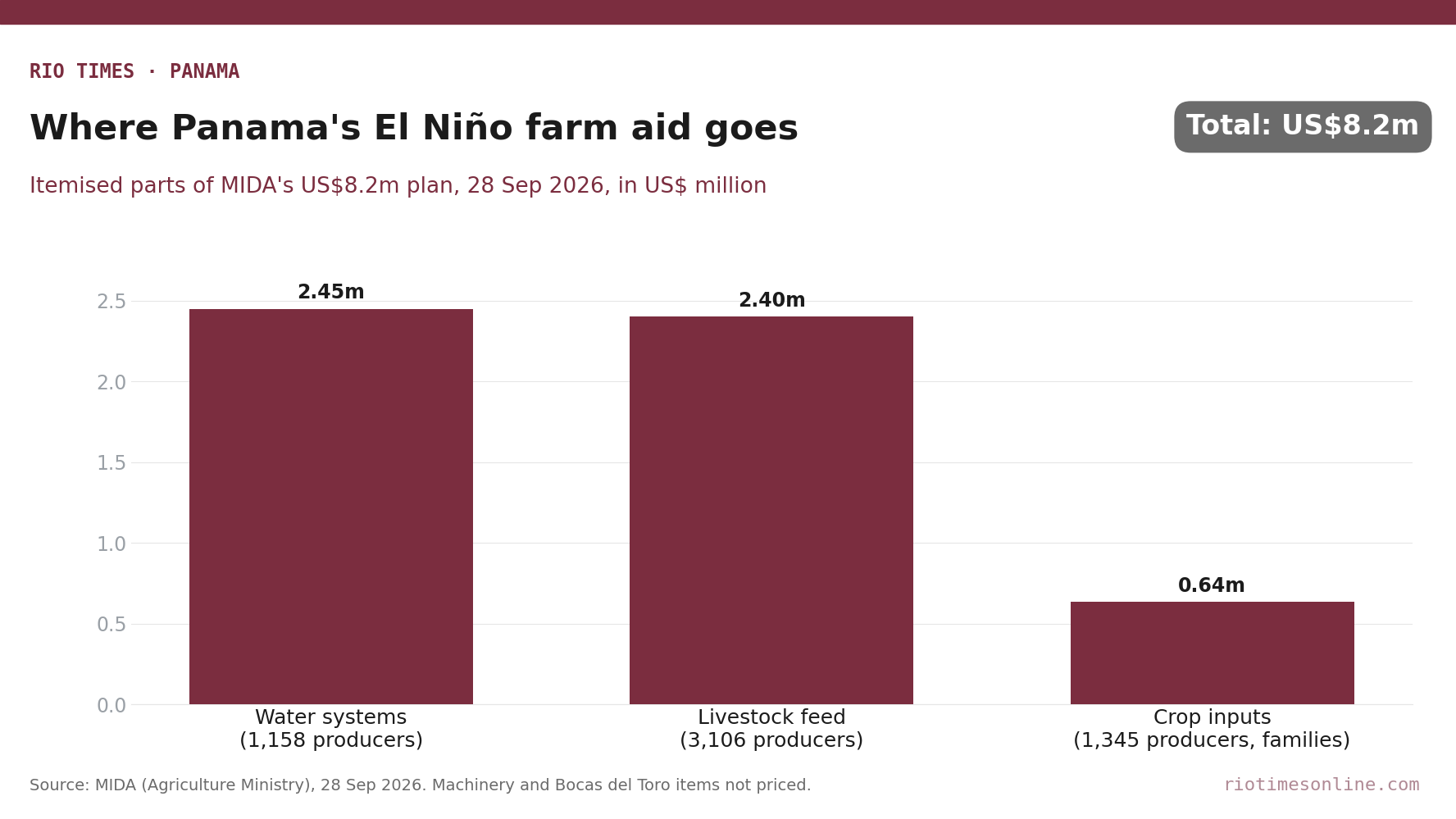
A further US$636,000 goes on fertiliser, seed, tool kits, small nurseries and greenhouses for about 1,345 producers and families. MIDA will also buy tools and machinery for some 600 producers, without giving a price.
In Bocas del Toro, on the Caribbean side, the plan supports 1,050 producers and 100 families. It provides seed for maize, rice and beans and aims to reach more than 2,400 hectares of crops.
Follow this story
Get an email when there’s news on Panama markets
Free. One email a day at most, and only when there is news. This also signs you up to our weekday newsletter, The LatAm Brief. Nothing arrives until you click the confirmation link, and you can stop either with one click. Privacy policy.
Drought in the Arco Seco, Floods on the Caribbean
The Arco Seco, or “dry arc”, covers Herrera, Los Santos and parts of Veraguas and Coclé. It is Panama’s driest region, and MIDA lists it among the areas most vulnerable to El Niño.
In early September Deputy Minister José Aníbal Rincón set out a first split, La Prensa and TVN reported on 3 September. About US$6.7 million would fight drought, and US$1.5 million would repair flood damage in Bocas del Toro and Puerto Armuelles.
Part of a US$80 Million Emergency
The Cabinet created the wider fund by Resolution No. 80 of 25 August 2026, La Estrella de Panamá reported. The Economy Ministry runs it through a National Bank trust, with emergency contracts allowed until 30 June 2027.
Both newspapers put MIDA’s share of that fund at US$8.2 million, roughly a tenth. It comes on top of a ministry investment budget of about US$120 million.
The ministry says it has already spent about US$1.2 million on machinery, spare parts and veterinary supplies. The National Assembly’s budget committee also approved US$2.3 million for three deep-well drilling rigs.
Doubts in the Assembly
Lawmakers questioned on 3 September whether US$8.2 million is enough. Linares himself noted that about US$10 million had reportedly gone to an earlier Azuero drinking-water emergency, which more than a year later is still unresolved, TVN reported.
Linares told deputies that rice output could fall 15–20% and onions about 15%. He also said Panama holds sufficient rice stocks, and that impacts differ by region and crop. Our earlier report shows how El Niño splits Latin America into winners and losers.
Water has long been contested in this region, as our report on farmers resisting Panama Canal water projects showed. MIDA says regional agro-climatic panels brief producers on forecasts every quarter.
What Is Not Yet Known
As of 4 October, MIDA has not published delivery dates or an application process for farmers. The three priced items total about US$5.5 million, and the ministry has not costed the rest.
It is also unclear how long El Niño will last or how far harvests will fall. Linares has promised to report spending on the ministry’s website.
Sources: Ministerio de Desarrollo Agropecuario (MIDA) press release (28 September 2026); La Estrella de Panamá (28 September 2026) and La Estrella de Panamá (4 September 2026); La Prensa (3 September 2026); TVN (3 September 2026).
This article was produced by The Rio Times’ automated newsroom system. How we use AI · Report an error · Editorial responsibility: Matthias Camenzind, Editor-in-Chief
LatAm Markets: Live Signals → — real-time movers, turnover leaders and FX across Latin America.