By The Rio Times | Created at 2026-06-22 07:21:38 | Updated at 2026-06-22 19:03:34
11 hours ago
By The Rio Times | Created at 2026-06-22 07:21:38 | Updated at 2026-06-22 19:03:34
11 hours ago
SOUTH AFRICA · MARKETS
Key Facts
—Record year: Richemont, controlled by South African billionaire Johann Rupert, posted revenue of €22.4 billion ($24.2 billion) for the year to 31 March 2026, up 11% at constant exchange rates.
—Profit jump: Net profit rose 27% to €3.5 billion ($3.8 billion), beating analysts who expected gold prices and US tariff uncertainty to weigh more heavily.
—China is the soft spot: Asia Pacific is the group’s single biggest market, yet it was the only region left out of a double-digit jewellery surge.
—A new rival: Hong Kong-listed Laopu Gold saw sales jump about 170% to 10 billion yuan ($1.4 billion), reaching a $20 billion value and the rank of seventh-largest luxury group.
—Cash cushion: Richemont held net cash of €7.6 billion in late 2025 and exited the loss-making online retailer Yoox Net-a-Porter to lift margins.
—Who holds the keys: Rupert, 74, controls Richemont through a dual-class structure that hands him most voting rights despite a minority economic stake.
Richemont’s record year confirmed the strength of Johann Rupert’s luxury empire, yet the group’s biggest vulnerability is unchanged: a Chinese market that is no longer simply spending less, but increasingly choosing homegrown brands over Cartier and Van Cleef & Arpels.
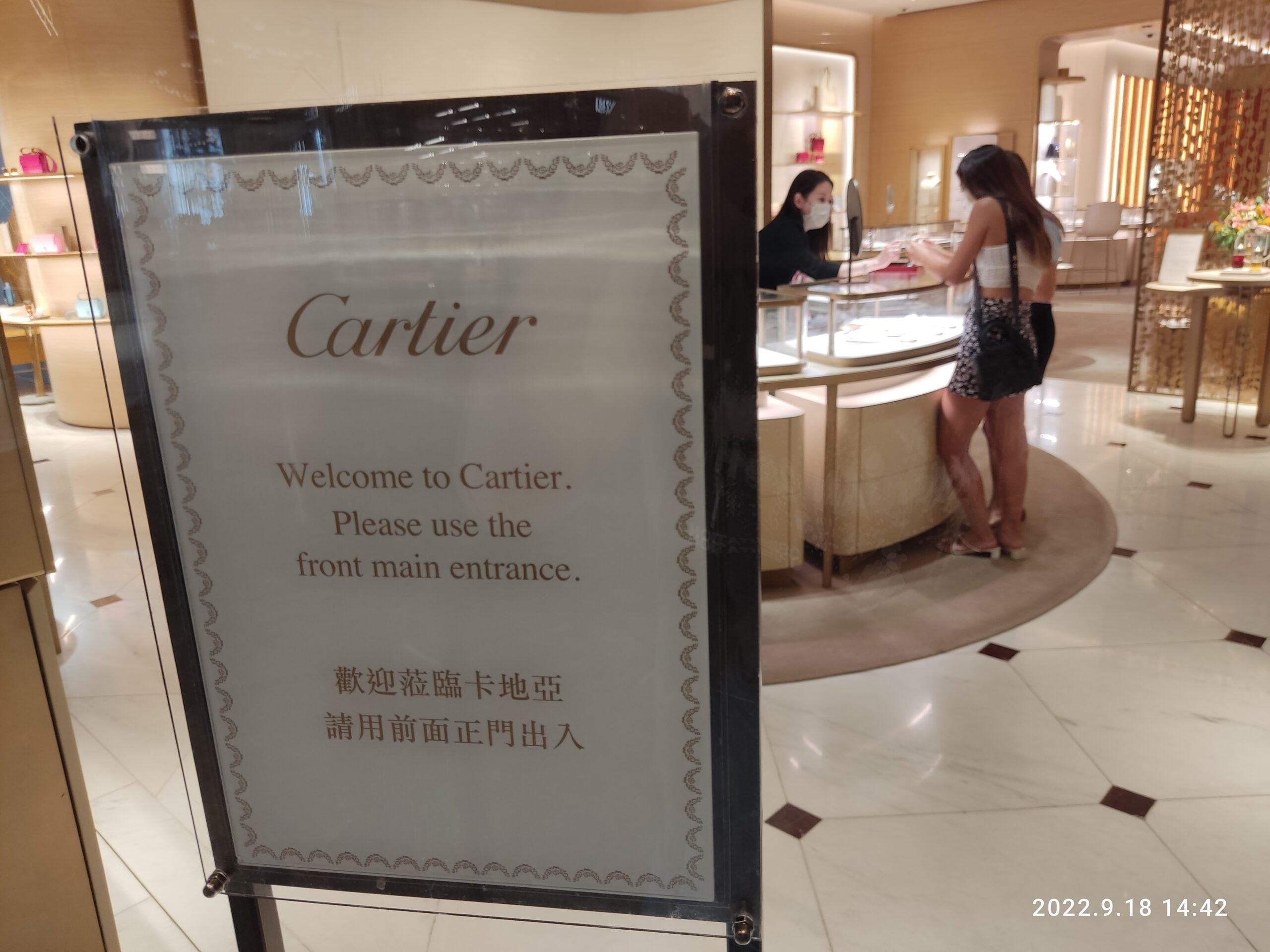 A Cartier boutique, the flagship maison of Johann Rupert’s Richemont, in Hong Kong. (Photo: Chua Pak King, CC BY-SA 4.0, via Wikimedia Commons)
Inside Richemont’s record year
Richemont reported revenue of €22.4 billion ($24.2 billion) for the financial year ended 31 March 2026, an 11% rise at constant exchange rates. Net profit climbed 27% to €3.5 billion ($3.8 billion).
The result surprised the market. Many analysts had expected record gold prices, uncertainty over US tariffs and softer consumer confidence to drag more heavily on the Swiss group behind Cartier and Van Cleef & Arpels.
Jewellery led the way, with sales up 14% and every region posting double-digit growth. Every region, that is, except one.
Why China is the unresolved risk
For much of the past decade, Chinese shoppers drove between a quarter and a third of global luxury spending, and Richemont’s jewellery and watch houses were among the main beneficiaries.
That engine has stalled. The watch division, home to IWC Schaffhausen, Jaeger-LeCoultre and Piaget alongside Cartier’s timepieces, saw sales fall 13% in the prior financial year on weak Asia Pacific demand.
Asia Pacific was again the laggard in the latest year, the only region left out of the jewellery surge. A property slump and economic anxiety have made Chinese consumers far more cautious.
LVMH’s deputy chief executive Stéphane Bianchi told French lawmakers in May 2026 that Chinese customers are both pulling back and shifting toward domestic labels, according to reporting on his testimony.
The challenger from Hong Kong
The clearest sign of that shift is Laopu Gold, a Hong Kong-listed Chinese jeweller whose sales jumped about 170% to 10 billion yuan ($1.4 billion) in a single year.
That run lifted Laopu to a market value of roughly $20 billion, making it the seventh-largest luxury group in the world by market capitalisation.
Its pitch is pointed: handmade, vintage-style pieces sold at fixed prices regardless of the gold price, with more gold per item than many Western rivals.
Asked about the newcomer, Rupert said he respects Laopu and watches it closely, but argued that Cartier and Van Cleef & Arpels appeal universally and hold their value at international auctions.
What it means for investors
Bernstein analysts have named Richemont their top luxury pick for 2026, while cautioning that any Chinese recovery is likely to be a slow, U-shaped grind rather than a sharp rebound.
That matters for the numbers. Strength elsewhere is real, with the Americas up 14% and the Middle East and Africa up 20% in the most recent comparable quarter, but neither is yet big enough to fully offset a prolonged China slowdown.
The balance sheet offers room to manoeuvre. Richemont held net cash of €7.6 billion in late 2025, and its exit from the loss-making Yoox Net-a-Porter, sold to Mytheresa, helped margins even as gold prices hit record highs.
A South African fortune with global reach
Richemont’s performance matters well beyond Switzerland. Rupert recently became the second African, after Aliko Dangote, to cross $20 billion on the Bloomberg Billionaires Index, a milestone powered largely by Richemont’s surging shares.
His investment company, Remgro, also won approval this month to take full control of South Africa’s Mediclinic hospital network, underlining how a luxury empire abroad underwrites influence at home.
The Middle East and Africa region, though small in the overall mix, was Richemont’s fastest-growing at 20%, a hint that demand for high-end goods is broadening beyond its traditional Asian base.
For Rupert, who built Richemont in 1988 out of his family’s Rembrandt Group, the question is whether a China that is actively choosing local brands is a different test from the downturns he has already weathered.
For an outside investor, the takeaway is simple. Richemont is thriving, but its fortunes now hinge on whether Chinese shoppers return, and on whether they still want European names.
Frequently asked questions
How did Richemont perform in its 2026 financial year?
Richemont posted record revenue of €22.4 billion, up 11% at constant exchange rates, and net profit rose 27% to €3.5 billion.
Why is China a risk for Richemont?
Asia Pacific is the group’s largest market, and a property slump and economic caution have left Chinese consumers spending less and increasingly choosing domestic brands.
What is Laopu Gold?
Laopu Gold is a Hong Kong-listed Chinese jeweller whose sales surged about 170% to 10 billion yuan, lifting it to a roughly $20 billion value and the rank of seventh-largest luxury group.
Who controls Richemont?
Johann Rupert, 74, controls Richemont through a dual-class share structure that gives him most of the voting rights despite holding a minority economic stake.
The Rio Times · Power Map
See who really holds power in Latin America
Click to open the Power Map →