 By The War Zone | Created at 2026-08-29 19:30:37 | Updated at 2026-09-18 22:24:16
2 weeks ago
By The War Zone | Created at 2026-08-29 19:30:37 | Updated at 2026-09-18 22:24:16
2 weeks ago
The TWZ Newsletter
Weekly insights and analysis on the latest developments in military technology, strategy, and foreign policy.
Russia has suddenly ramped-up the number of attacks, and their duration, on Kyiv. Ukrainian officials state there was a record number of waves of one-way attack drones on the capital on Thursday. This is in contrast to the typical Russian mass barrages that launch a larger number of missiles and drones that strike over a short period in an attempt to overwhelm defenses and inflict maximum damage. The change from prioritizing amplitude to frequency of these assaults indicates that Moscow could be switching to a new strategy aimed at wearing down the populace, halting commerce and exhausting air defenders.
“Again and again throughout the day, sirens sounded as Russia launched drones in small groups towards the Ukrainian capital,” the Ukrainian Foreign Affairs Ministry noted on X. “Each new threat put people at risk and forced them to seek safety – while repeatedly interrupting work, public services, transport, and everyday plans. In total, Kyiv spent 872 minutes – almost 15 hours – under air raid alert that day.”
Kyiv faced 13 separate air raid alerts on 27 August.
Again and again throughout the day, sirens sounded as Russia launched drones in small groups towards the Ukrainian capital. Each new threat put people at risk and forced them to seek safety – while repeatedly interrupting… pic.twitter.com/hTxOipgx0I
This was reportedly the largest number of air raid alerts experienced in Kyiv since the opening days of the all-out war. “The previous record appeared to be set on March 1, 2022, when Kyiv was placed under air raid alert 12 times in a single day,” the Kyiv Independent explained.
In addition, “the capital saw eight more air raid alerts by the morning of Aug. 28 as Russian forces continued attacking Kyiv and the surrounding areas overnight,” the publication added.
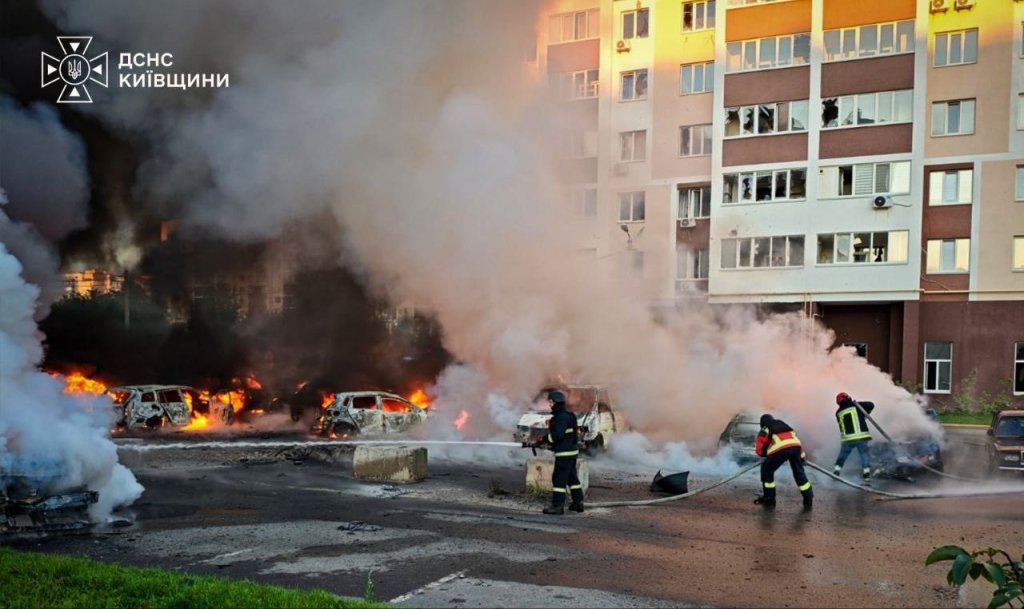 Kyiv
Kyiv Russia’s attacks on Kyiv and the surrounding region continue almost nonstop for a second day. Other regions of Ukraine were also targeted overnight.
▪️ A Russian strike with guided aerial bombs in Sumy killed a 61-year-old civilian. Seven other people were injured. Residential… pic.twitter.com/XUHlw9CKUG
💔This is Kyiv, Ukraine today.
People are sheltering from russian attacks wherever they can – even sitting on the stairs of metro stations.
For the second day in a row, russians are attacking Kyiv and the region.
Another day of life interrupted by war. pic.twitter.com/h7gYGtwpvH
Iryna Terekh, CEO of the Fire Point company which makes FP-1 and FP-2 drones and heavy-hitting Flamingo cruise missiles, suggested that Russia is trying to drain the populace of the will to resist.
“For over 40 hours straight, Russia has been terrorizing Ukraine’s capital with combined barrages, setting a new grim record for the number of air raid alerts and destroyed civilian infrastructure sites,” Terekh stated on X Friday. “The enemy has long employed this tactic in frontline cities, scorching the earth and any chances of normal life. Its goal is to make our hands drop in despair. To make us search for culprits among ourselves. To make us snap at our own. To make us peer into the future with squinted eyes. To leave not a single minute when it’s appropriate to rejoice in anything: from life’s little joys to our successes on the front lines. To let exhaustion win.”
Вже понад 40 годин поспіль росія тероризує українську столицю комбінованими обстрілами, встановлюючи черговий антирекорд за кількістю повітряних тривог і знищених обʼєктів цивільної інфраструктури. Цю тактику ворог давно застосовує у прифронтових містах, випалюючи землю і…
— terekh (@iraterekh) August 28, 2026A former high-ranking Ukrainian military officer offered us a similar assessment, though he surmised that it could backfire on Moscow.
“They want to keep constant pressure on the population and plant a fear of losing lives, increasing starvation, demoralizing the population, plant panic etc.,” the retired officer told us. “My belief is that they won’t achieve such strategic objectives. It is too late. It could have the opposite effect: more hate, more aggression and anger toward Russians.”
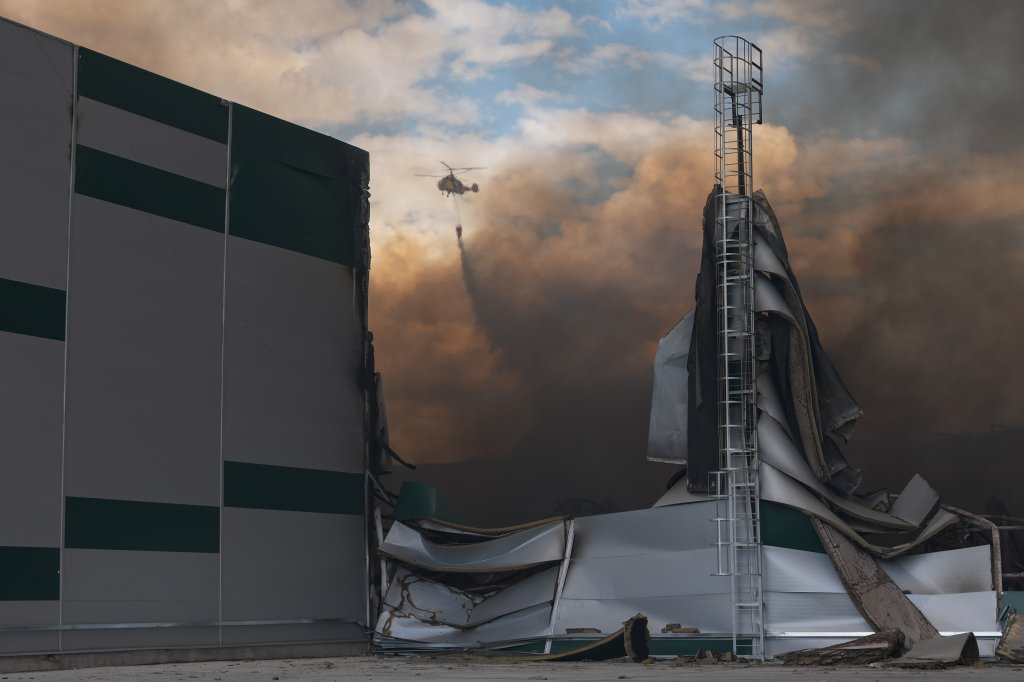 A helicopter extinguishes a fire in warehouses damaged by Russian drone strikes on August 27, 2026 in Kyiv, Ukraine. Russian forces launched a massive attack on Kyiv with drones, hitting warehouses. (Photo by Ivan Antypenko/Suspilne Ukraine/JSC “UA:PBC”/Global Images Ukraine via Getty Images) news
The retired officer posited that this spike in the pace of Russian strikes could be part of the escalation Russian President Vladimir Putin recently threatened. Still, it remains unknown at this point whether this is a one-off or the sign of things to come. The coming days should give us an indication of that.
The Latest
Most of the fiercest fighting at this point is centered around Kupyansk in Kharkiv Oblast and Slovyansk in Donetsk. Here are some key takeaways from the latest Institute for the Study of War (ISW) assessment:
- Kharkiv: Russian forces continued offensive operations in northern Kharkiv Oblast on August 26 and 27 but did not advance as Ukrainian forces counterattacked. The Russians also continued offensive operations in the Kupyansk direction on August 26 and 27 but did not advance as Ukrainian forces counterattacked.
- Donetsk: Russian forces continued offensive operations in the Slovyansk direction on August 26 and 27 but did not make confirmed advances as Ukrainian forces counterattacked around Lyman. Russian forces also continued offensive operations in the Dobropillya tactical area, Pokrovsk, near Novopavlivka itself and northeast and south of Oleksandrivka on August 26 and 27 but did not make confirmed advances.
- Zaporizhia: Russian forces continued limited offensive operations in western Zaporizhia Oblast on August 26 and 27 but did not advance.
- Kherson: Neither Russian nor Ukrainian forces reported ground activity in the Kherson direction on August 27.
Ukrainian officials are investigating why weapons were stored in a residential neighborhood after a deadly Russian drone attack on a warehouse in a village near Kyiv. Ukrainian President Volodymyr Zelensky said the investigation centers on negligence. The strike and resulting secondary explosions at the facility in the village of Myla killed at least 37 people and injured at least another 15, according to Ukraine’s Defense Ministry (MoD).
Zelensky didn’t specify the exact variants of the weapons stored, but the Russians claimed they struck a warehouse containing the Fire Point company’s FP-1 and FP-2 drones and another one in a different Kyiv suburb that stored Flamingo cruise missiles.
TWZ cannot independently verify this Russian claim and Ukriane did not confirm the attack on the warehouse containing the Flamingos. We’ve reached out to Fire Point for more details.
“Since yesterday evening and throughout the day today, I have been receiving reports on the situation in the village of Myla, Kyiv region, where detonation began following a Russian strike,” Zelensky stated on X. “A terrible situation and terrible negligence on the part of those who stored explosives right next to people. Another such crime – after what happened in Vyshneve – is absolutely unacceptable.”
Since yesterday evening and throughout the day today, I have been receiving reports on the situation in the village of Myla, Kyiv region, where detonation began following a Russian strike. A terrible situation and terrible negligence on the part of those who stored explosives… pic.twitter.com/YyRpBxQ8Kz
— Volodymyr Zelenskyy / Володимир Зеленський (@ZelenskyyUa) August 29, 2026Vyshneve is a town where an ammunition depot belonging to the Ukrainian defense conglomerate Ukroboronprom, the country’s largest weapons manufacturer, was attacked in July. The secondary explosions killed seven and wounded 29 others, according to the Kyiv Independent.
“I expect the details to be presented to the public promptly,” the Ukrainian leader added. “The first strike was on an ammunition storage site that definitely shouldn’t have been there – a Defense Forces storage facility. Shells, mines, other ammunition, and drones detonated. The scale is significant. We have already spoken with the Prosecutor General, the Ministry of Internal Affairs, the Security Service of Ukraine, and the Commander-in-Chief – they have everything necessary for the investigation. I want to separately thank everyone who is there on the ground and at other sites of Russian strikes, doing everything possible to help and save people.”
Smoke is still rising from the ammunition depot in the village of Myla, Bucha District, Kyiv Oblast, which was targeted by Russian Geran-4 drone strikes.
The reported death toll has risen to 37, with at least 42 others injured and 381 people evacuated.
Ukrainian President… https://t.co/PBAQllR7BI pic.twitter.com/toDpPvjFkU
The retirement home at Myla near Kyiv where twenty people died after a Russian strike caused secondary detonations at a secret ammunition depot placed amidst dense suburbia. pic.twitter.com/iPhODiVXJ7
— Leonid Ragozin (@leonidragozin) August 29, 2026The Ukrainian MoD called for a full accounting of all weapons and ammunition storage locations.
“Siting depots holding explosives next to civilians is unacceptable,” MoD stated on X. “The heads of all relevant components of the Security and Defence Forces and of Ukraine’s defence industry must carry out a full audit of the sites where weapons and ammunition are stored. Facilities of this kind must not stand next to residential buildings where people live.”
We bow our heads in deep sorrow together with every family that has lost loved ones in the terrible tragedy in the village of Myla, Kyiv region.
As of 15:00 on 29 August, 37 people are known to have been killed and 15 injured. Two more are still being searched for under the…
As we noted earlier in this story, the Russian Defense Ministry (MoD) claims it hit “an ammunition depot in [Myla] (Fire Point LLC), where components and launch boosters for long-range FP-1/FP-2 unmanned aerial vehicles were stored in warehouses.”
The MoD also claims it struck the “Fim Service transport and logistics center in Chayki” whose “warehouses were used to store Flamingo long-range cruise missiles.” The village is also near Kyiv; however, there have been no reports of collateral damage. Ukrainian officials have not independently confirmed that weapons were stored there. The Kyivschina24 media outlet reported that the Chayki attack struck a tile warehouse owned by the Agromat company, not a weapons storage area.
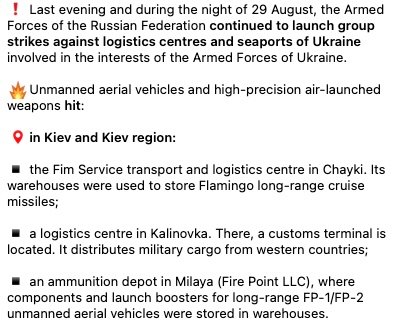 Russian Defense Ministry (MoD)
 Whether it was the case in these instances or not, it should come as absolutely no surprise that Moscow would do everything possible to target Fire Point standoff munitions and their supply chain, considering how big of a threat they have become. Regardless, while Ukrainian officials are now investigating why explosives were stored so close to a residential neighborhood, the incident highlights the precarious nature of the country’s weapons production. Due to repeated Russian attacks, this work is widely distributed to avoid having a single point of failure.
In a recent interview with TWZ, Terekh, the Fire Point CEO, addressed that concern.
“Well, the logistics are hell, to be frank,” she told us. “But we do not have the luxury to have the factory in a classic way, with the walls and roof, … when I say factory — and we have 90 of them in the moment — when I say factory I mean this whole ecosystem with logistics, with warehouses, everything is hidden and dissolved in a way that the critical components are always duplicated, triplicated, quadruplicated. It’s a lot of additional investments and, of course, a lot of risks and a lot of additional time for logistics specifically, but again, we do not have any other choice. Therefore, the factory in this matter is a whole ecosystem.”

Footage of the production and testing of the FP-1/2 attack UAVs and the FP-5 Flamingo cruise missile
In the wake of the Vyshneve attack, Ukroboronprom fired two of its directors after Zelensky said that the ammunition depots were stored too near to civilian areas “in violation of Ukrainian law and orders from military leaders,” the Kyiv Independent noted. The criminal investigation in that case is ongoing.
It is too early to say what will happen with this latest incident. The investigation into the Myla case has just started and there is no immediate word about whether Ukraine is also investigating the storage of weapons in Chayki. We will monitor this situation and provide updates when warranted.A satellite image obtained by TWZ appears to back up Ukrainian President Volodymyr Zelensky’s claim that his country’s Alpha Unit destroyed a Tu-95MS Bear bomber during a drone attack on Russia’s Engles Air Base. The facility is located about 350 miles east of Ukrainian-held territory.
The satellite image, provided by Vantor, shows the right wing of the bomber partially severed. It is unclear from the image how extensive any damage was caused by shrapnel.
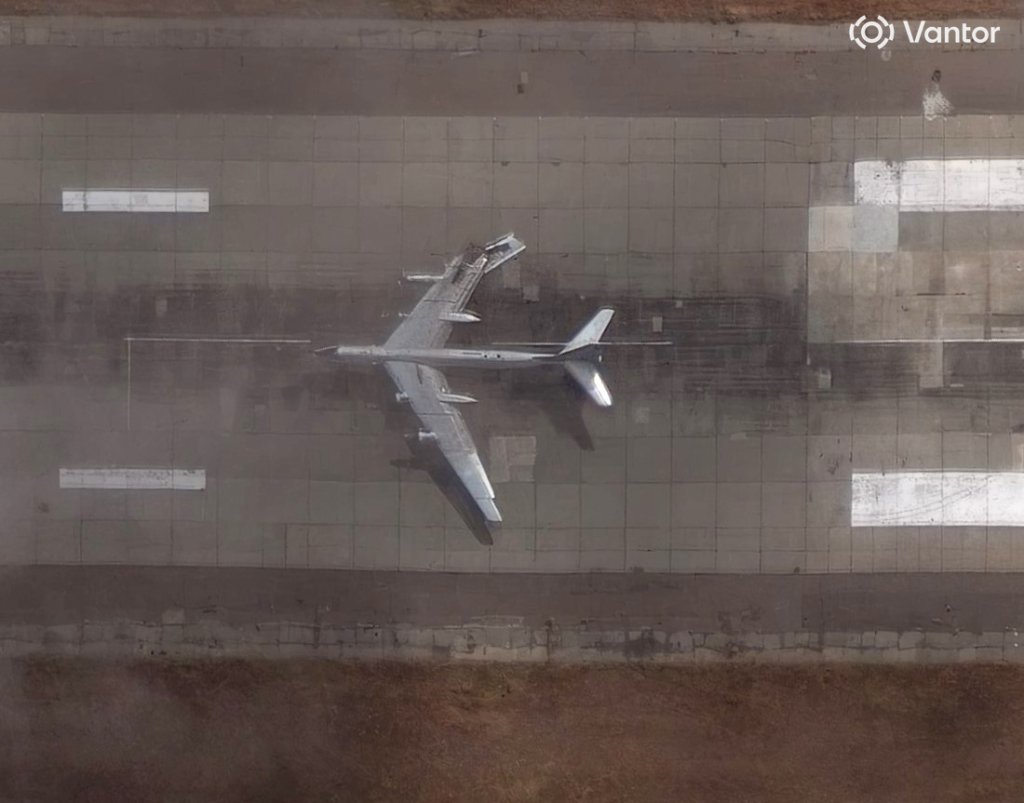 This Tu-95MS Bear bomber was damaged during a Ukrainian drone strike. (Satellite image ©2026 Vantor)
 Ukraine has frequently attacked Engels in its effort to destroy the bombers housed there. Russia, trying to defend against this ‘kill-the-archer’ approach, is building protective shelters for its military aircraft, which now extend to long-range bombers, an unprecedented development for the Russian Aerospace Forces.
Engels, also known as Engels-2, is one of the most important airfields of Russia’s Long-Range Aviation Branch. It is home to the 22nd Heavy Bomber Aviation Division, which is responsible for Russia’s only squadron of Tu-160s, plus another squadron of Tu-95MS bombers.
Both those types have been widely employed in the conflict in Ukraine and especially in the standoff strikes that have targeted Ukraine’s energy infrastructure, among other objectives, civilian and military, across the country.
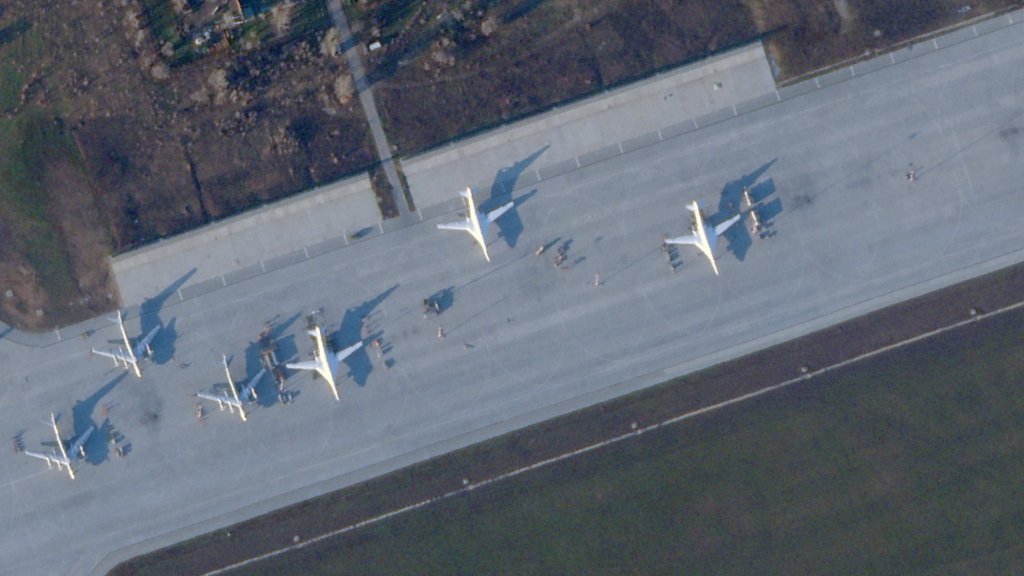 Some of the bombers seen at Engels on November 29, 2022. Visible here are, from left to right, three Tu-95MSs and three Tu-160s. (PHOTO © 2022 PLANET LABS INC. ALL RIGHTS RESERVED. REPRINTED BY PERMISSION)
 Zelensky said the U.S. read him in Friday on CIA Director John Ratcliffe’s mysterious visit to Moscow. However, the Ukrainian leader offered no details of what was discussed.
“Today, we received information from the American side about the meetings in Moscow that took place the other day,” the Ukrainian leader stated on X. “There was a series of meetings. We spoke before the meetings, and we have spoken again now with the Americans. Thank you for the information – and for the necessary tone of the conversation with Russia.”
“We value the alignment of steps and the fact that America is advancing a realistic vision of what needs to be done and what must be achieved,” he added. “Russia must end its war, and all the necessary conditions must be created to make that happen.”
Ratcliffe’s visit has sparked a wide range of conjecture, and disparate reports about the purpose. The New York Times, for instance, wrote that the journey was made “to privately share his bleak assessment of the state of the Russian war against Ukraine, and to urge the Russians to cut a deal before their military and economic situation gets worse.”
The Wall Street Journal reported that Ratcliffe was there to warn Putin, whom he didn’t see, not to attack NATO.
President Donald Trump, for his part, tried to downplay the whole thing, calling it “semi-routine,” which doesn’t exactly square with the fact that this was the first publicly known visit of a CIA director to Moscow since November 2021, just months before Putin launched his full-on invasion.
Today, we received information from the American side about the meetings in Moscow that took place the other day. There was a series of meetings. We spoke before the meetings, and we have spoken again now with the Americans.
Thank you for the information – and for the necessary… pic.twitter.com/2dBbHH4y2X
Kyrylo Budanov, the Head of the Office of the President, said the Armed Forces of Ukraine need to mobilize 30,000 every month in order to keep defending against Russia. He made the comments during an interview on the national nightly newscast.
“Unfortunately, we have to accept it [mobilization] as it is,” Budanov explained. “We cannot do otherwise. We have to find the courage and honestly say: we cannot mobilize fewer than 30,000 people a month. This is the minimum number needed to maintain what we have.”
Budanov’s comments come as Ukraine is struggling to put enough troops on the front lines and is facing opposition to how recruits are often forced into service, sometimes physically.
“So, no matter how we say that we are now going to recruit people differently, the numbers will not change,” Budanov added. “And that means the number of dissatisfied people will not change either. There is nothing we can do about it.”
Meanwhile, Budanov expressed hope that it would be possible to change the approach to what he described as “forceful mobilization” to some extent.
“I hope we can change the approach to this forceful mobilization, which sometimes takes place,” Budanov acknowledged. “It is not happening everywhere, but such cases do occur. We need to tackle this.”
Kyrylo Budanov: "Unfortunately, we have to accept it [mobilization] as it is. We cannot do otherwise. We have to find the courage and honestly say: we cannot mobilize fewer than 30,000 people a month. This is the minimum number needed to maintain what we have."… pic.twitter.com/csebu3b3cV
— Rob Lee (@RALee85) August 28, 2026As we have frequently noted, AI plays a key role for Ukraine, especially helping guide weapons to target. To help improve these functions, Ukraine has created a sandbox of sorts where weapons developers can fine-tune their AI systems with real-world data.
“In the past, coordinating a fire mission – from an observer detecting a target to the actual opening of fire – could take 15–20 minutes, or even longer, when done manually,” the Ukrainian Defense Ministry (MoD) explained. “In modern warfare, such a delay is effectively unacceptable. This is where artificial intelligence comes in to assist human operators.”
“At the find stage of the kill chain, reconnaissance drones can use visual data repositories to detect objects,” the MoD noted. “For this purpose, the Brave1 defense innovation cluster created Brave1 Dataroom, a secure platform that provides developers with access to structured datasets for testing, training, and fine-tuning military AI solutions.”
Over 100 Ukrainian companies are already using this platform to train AI models on real-world data, MoD added.
“The platform specializes in detecting and intercepting aerial targets, including Shahed-type drones,” the ministry proffered. “To train drone AI systems using real-world battlefield data, the Ministry of Defence of Ukraine has provided Ukrainian developers with access to Avengers Labs. The platform provides access to an annotated dataset of 5 million frames collected during military missions.”
The dataset is regularly updated, with Ukraine’s homegrown DELTA battlefield management and situational-awareness system serving as its primary source.
“Targets included in the dataset range from tanks, artillery, and air defense systems to enemy infantry groups and aerial targets, including reconnaissance UAVs and Shahed-type drones,” according to the ministry.
Coordinating a fire mission manually once took 15-20 minutes. In this war, that's a lifetime.
Avengers AI, trained on 5M annotated battlefield frames and integrated into DELTA, now flags 70% of enemy equipment in real time across 100,000+ video streams a month.
Read more:…
The city of Druzhkivka, in Ukraine’s eastern Donetsk region, is on the front line of a grinding battle. It is part of the so-called fortress belt of cities where ensconced Ukrainian forces have held off brutal waves of Russian attacks for years. Recently released drone video shows the extent of the damage, with virtually no building untouched and vast swaths of the city completely abandoned.
Irish journalist Caolan Robertson provides a gripping view of another fortress belt city, Kramatorsk, and the last power plant in the region, which is a frequent target of Russian attacks.
Another Ukrainian city is being wiped out right now while the world looks away
Here’s what’s happening in Kramatorsk:
• Glide bombs & FPVs pound the city to make them unliveable.
• Civilians evacuated every day but not everyone is leaving.
• I spent the night with power… pic.twitter.com/oUU4FoSfnc
Ukraine claims that Russian forces have executed at least 345 Ukrainian service members who surrendered and killed 375 Ukrainian citizens whose deaths in Russian captivity have been verified, the Ukrainian Ukrinform news outlet reported.
Ukrainian Parliament Commissioner for Human Rights Dmytro Lubinets made the statement during a press conference held at the publication, focused on Russian disinformation concerning prisoners of war, exchanges, and people missing in action.
According to the ombudsman, the 345 documented executions involved Ukrainian soldiers who had clearly surrendered, including by laying down their weapons, raising their hands, or lying on the ground to demonstrate that they were no longer taking part in hostilities.
TWZ cannot independently verify those figures.
That’s it for now.
Contact the author: [email protected]