By The Rio Times | Created at 2026-09-29 07:01:51 | Updated at 2026-09-29 07:46:59
1 hour ago
By The Rio Times | Created at 2026-09-29 07:01:51 | Updated at 2026-09-29 07:46:59
1 hour ago
Key Facts
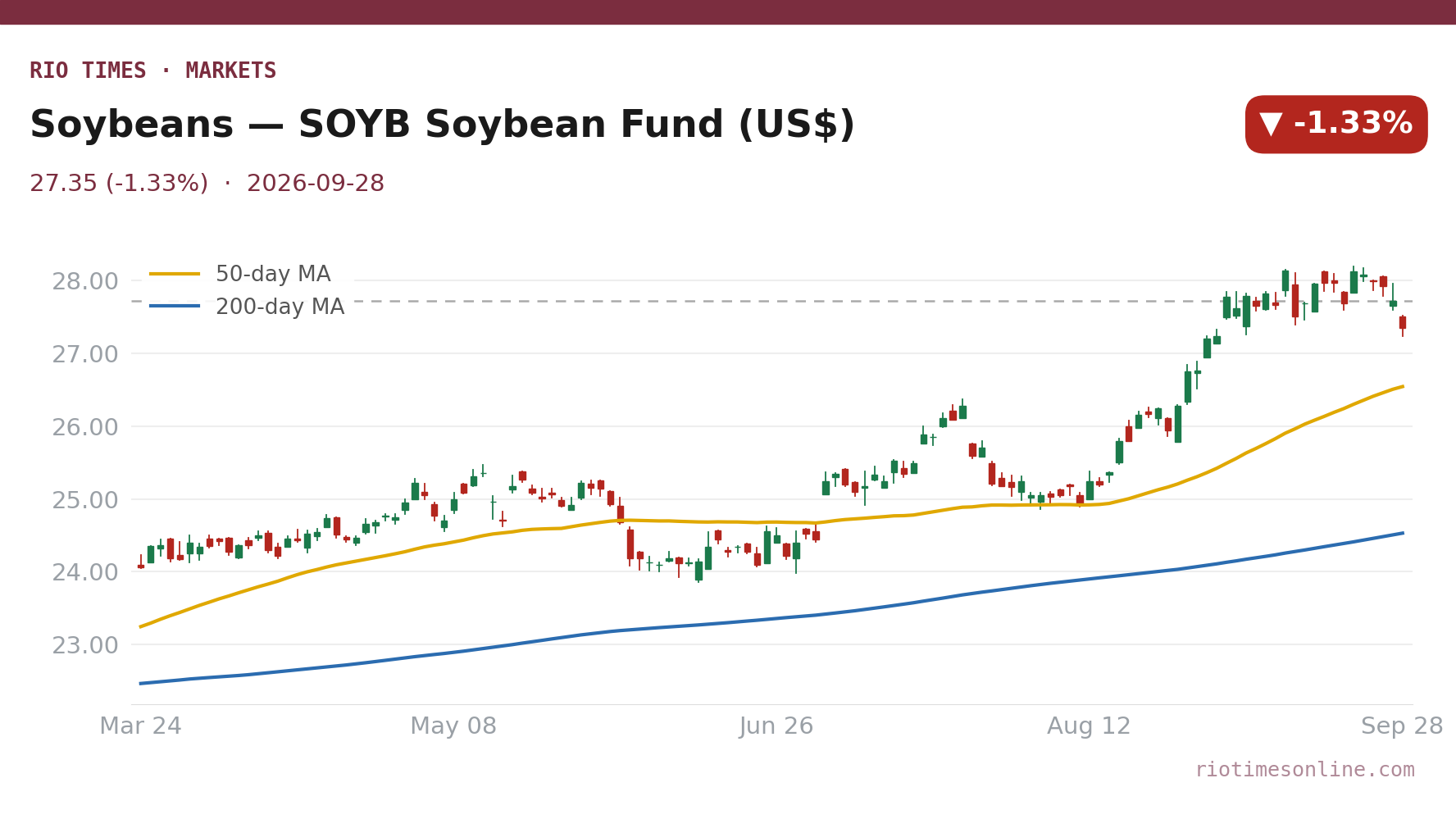
- Soybeans led the futures decline: November soybeans fell 30¾ cents, or 2.3%, to US$12.88¼ a bushel, a new monthly low; the SOYB tracker fell 1.33% to US$27.35.
- China left soybeans off its tariff-cut list: the list of US farm goods includes corn, wheat, sorghum, soyoil and soymeal, but US soybeans still face an extra 10% tariff.
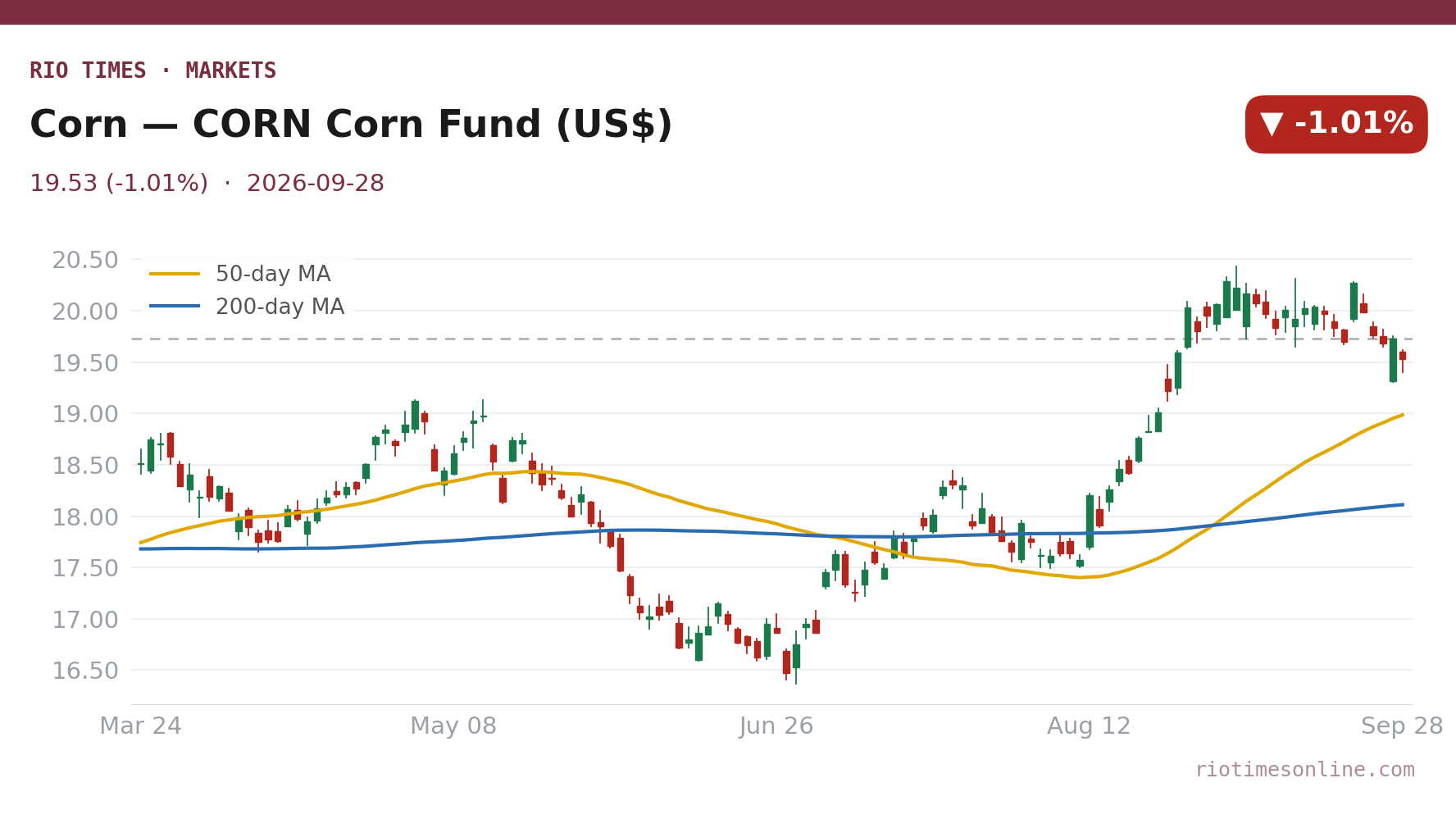
- Corn saw a milder fall: December corn lost 5¼ cents, or 1.0%, to US$5.23; the CORN tracker fell 1.01% to US$19.53.
- Wheat fell to its lowest close since mid-August: December Chicago wheat dropped 14½ cents, or 2.1%, to US$6.88¾; the WEAT tracker fell 2.08% to US$24.97.
- A firmer dollar added pressure: the US dollar index rose 0.22% to 101.20, and the real weakened 0.86% to 5.2255 per US dollar.
- Traders want Chinese buying: with soybeans left off the list, the market is waiting for fresh export sales to confirm demand.
Today’s Focus
Grain prices fell across the board on Monday. Soybeans took the brunt of the selling after China published a list of tariff cuts on US farm goods that left the oilseed out. November soybeans fell 2.3% to US$12.88¼ a bushel, December corn 1.0% to US$5.23 and December wheat 2.1% to US$6.88¾. Among the trackers, SOYB fell 1.33% to US$27.35, CORN 1.01% to US$19.53 and WEAT 2.08% to US$24.97.
China’s list covers corn, wheat, sorghum, soyoil, soymeal, meat and dairy, but US soybeans still face an additional 10% tariff. Traders warn that is too high for private crushers to absorb. Corn’s inclusion limited its losses. Wheat faced its own pressure from ample supply and improving Black Sea shipping prospects.
Brazil and Argentina are the core of the world’s soybean export supply, so planting progress in those two countries will be a key supply factor through the southern hemisphere spring.
Free daily brief — no card needed
Get every Markets story in one morning email
We build you a personalized brief around the topics you follow — free for 7 days. Love it? Your first month after that is US$1.
Yes, email me my free daily brief — I can unsubscribe any time.
What matters today. China excluded soybeans from its tariff cuts, forcing the market to reassess US export demand just as South American planting gathers pace.
One-stop reference
Company Intelligence
Every listed company in Latin America — financials, ownership and structure for 1,450+ companies across 26 exchanges, in one place.
01 The session in one read
Grain markets slipped on Monday as traders digested China’s tariff cuts on US farm goods, which pointedly left soybeans out. November soybeans fell 30¾ cents to US$12.88¼, the steepest futures loss of the three and a new monthly low.
December corn lost 5¼ cents to US$5.23 and December wheat 14½ cents to US$6.88¾, its lowest close since mid-August. Ample supply, harvest pressure and uncertain Chinese demand outweighed any lift from the tariff news.
Assessment — Soybean premium erodes on China exclusion MEDIUM
The session’s clearest signal was the removal of any tariff-relief premium from soybeans, which fell hardest in futures, while corn held up better after making China’s list. Wheat fell almost as much as soybeans in futures and the most among the trackers. The direction was uniform: sellers controlled the day. The variable to watch is whether China books fresh US soybean cargoes in the coming sessions.
02 The board
The price board showed a consistent pullback across grain trackers, with no instrument managing a gain. SOYB fell 1.33% to US$27.35. The tracker holds several contract months, so it moved less than the November futures.
CORN’s more modest loss of 1.01% left it at US$19.53. WEAT fell the hardest among the trackers, down 2.08% to US$24.97, as ample global wheat supply and exporter competition kept a lid on prices.
| Soybeans (SOYB) | US$27.35 | -1.33% |
| Corn (CORN) | US$19.53 | -1.01% |
| Wheat (WEAT) | US$24.97 | -2.08% |
Source: RT close, 2026-09-28. Where a commodity has no spot feed, an exchange-traded tracker or leading producer is shown as a labelled proxy.
Rio Times · Live Market Intelligence
Latin America — Cross-Market Board
Regional
Sep 29, 2026 · 03:43
Ibovespa · benchmark
182,991.13 -0.26%
L 167,142day rangeH 168,310
+21.85% over 12 months
Market breadth · 5 names
0% advancing
0 ▲ advancing5 declining ▼
Currencies, rates & key inputs
Latin America scoreboard
IndexLastTodayStrength
IbovespaBrazil 182,991.13 -0.26%
S&P/BMV IPCMexico 64,737.82 -0.39%
S&P IPSAChile 11,137.59 -1.06%
S&P MERVALArgentina 2,798,925 -3.28%
MSCI COLCAPColombia 2,579.33 -0.21%
BVL S&P PerúPeru 60,698.35 -0.79%
Full instrument board
| IBOV | 182,991.13 | -0.26% | +21.85% | 183,476.86 | 168,310 | 167,142 | — |
| IPSA | 11,137.59 | -1.06% | — | 11,256.80 | 11,210 | 10,984 | 1,513,213,483 |
| IPC MEX | 64,737.82 | -0.39% | +12.17% | 64,992.23 | 66,121 | 65,405 | 108,886,187 |
| MERVAL | 2,798,925 | -3.28% | +30.51% | 3,022,485 | 3,042,365 | 2,991,150 | — |
| COLCAP | 2,579.33 | -0.21% | — | 9.04 | 9.05 | 9.02 | 4,133 |
| BVL PERÚ | 60,698.35 | -0.79% | — | — | — | — | — |
| USD/BRL | 5.16 | +0.01% | -5.13% | 5.16 | 5.18 | 5.14 | — |
| EUR/BRL | 5.95 | +1.01% | -5.83% | 5.89 | 5.98 | 5.94 | — |
| USD/MXN | 17.06 | -0.24% | -8.58% | 17.10 | 17.08 | 17.01 | — |
| USD/CLP | 913.98 | +0.04% | -5.67% | 913.65 | 915.11 | 906.68 | — |
| USD/COP | 3,140 | +0.03% | -22.04% | 3,139 | 3,141 | 3,105 | — |
| USD/PEN | 3.36 | -0.66% | -4.82% | 3.38 | 3.38 | 3.35 | — |
| USD/ARS | 1,493 | +0.10% | +12.96% | 1,491 | 1,494 | 1,480 | — |
| USD/UYU | 40.27 | +1.24% | +1.80% | 39.77 | 40.27 | 40.23 | — |
| USD/PYG | 5,939 | +1.68% | -19.54% | 5,841 | 5,939 | 5,925 | — |
| USD/BOB | 11.64 | -0.76% | +72.04% | 11.73 | 11.72 | 11.64 | — |
| USD/DOP | 58.34 | +1.25% | -3.44% | 57.62 | 58.34 | 58.04 | — |
| USD/CRC | 445.92 | +0.89% | -9.71% | 441.97 | 448.50 | 445.92 | — |
Largest moves today
MERVAL 2,798,925 -3.28%
USD/PYG 5,939 +1.68%
USD/DOP 58.34 +1.25%
USD/UYU 40.27 +1.24%
IPSA 11,137.59 -1.06%
EUR/BRL 5.95 +1.01%
USD/CRC 445.92 +0.89%
BVL PERÚ 60,698.35 -0.79%
The session read
The Ibovespa eased 0.26%, with breadth negative — 0 of 5 names higher. COLCAP led, while MERVAL lagged.
03 What moved it
The dominant driver was China’s announcement of tariff cuts on US agricultural goods, with soybeans excluded from the list. The cuts follow a Washington summit between Xi Jinping and Donald Trump. The omission left traders questioning whether Chinese importers will return to US soybean suppliers, and analysts said a large fund long position in soybeans was unwound.
Corn’s inclusion on the list cushioned its decline. Wheat fell on its own fundamentals, with traders assessing abundant global supply and improving Black Sea shipping prospects.
A stronger dollar added a secondary headwind: the dollar index rose 0.22% to 101.20, making US grains dearer for overseas buyers. A drier forecast that should speed the US harvest added supply pressure.
04 The Latin American read
Brazil is the world’s largest soybean exporter and Argentina the largest exporter of soymeal and soyoil. That makes the developing South American planting season a key supply factor.
For Latin American growers, the session’s tariff headlines cut two ways. If US soybeans keep facing the extra 10% tariff, Brazilian and Argentine exporters could keep a larger share of Chinese demand.
Yet the weaker tone across all grains also signals that global supply remains ample, which tempers any expectation of sharply higher local prices. The real weakened 0.86% to 5.2255 per US dollar, which helps Brazilian exporters’ local-currency returns. The Argentine peso was steady at 1,525 per US dollar.
05 The names to watch
The soybean tracker SOYB at US$27.35 remains the clearest barometer for whether the China exclusion becomes a lasting demand problem or a one-day reset.
The corn tracker CORN at US$19.53 will show whether the more favourable tariff treatment translates into confirmed export sales to China.
The wheat tracker WEAT at US$24.97 bears watching because Black Sea shipping can shift the competitive landscape for exporters in Argentina, a major wheat supplier to Brazil and beyond.
06 The outlook
The immediate question is whether Chinese buyers will book US soybean cargoes despite the tariff exclusion, or whether they will continue sourcing from Brazil and Argentina. The next few sessions of export sales data will provide the answer, and the soybean tracker is likely to remain the most volatile of the three until that picture clears.
South American planting progress and weather will also shape the outlook. The market’s focus will stay on how much of the world’s soybean and corn supply comes from Latin America this year.
07 What to watch
- US soybean export sales: whether China books fresh US cargoes despite the tariff exclusion
- South American planting weather: rainfall across Brazil and Argentina will decide how smoothly seeding advances
- Black Sea wheat shipping: smoother exports would add competitive pressure on Argentine wheat
- Dollar strength: a firmer dollar would keep pressure on dollar-denominated grain trackers
Frequently Asked Questions
Why did soybeans fall on Monday?
China’s new tariff cuts on US farm goods excluded soybeans, which still face an extra 10% tariff. November soybeans fell 2.3% to US$12.88¼ a bushel.
What happened to corn?
December corn fell 1.0% to US$5.23 and the CORN tracker 1.01% to US$19.53. The loss was milder because corn is on China’s tariff-cut list.
Why did wheat fall so sharply?
December wheat fell 2.1% to US$6.88¾, its lowest close since mid-August, and the WEAT tracker 2.08% to US$24.97. Ample global supply and improving Black Sea shipping weighed.
How does this affect Brazil and Argentina?
Brazil and Argentina could keep more Chinese soybean demand while US beans face the extra 10% tariff, but ample global supply still caps prices.
Source: RT live market data, close of Monday 28 September 2026.
This article was produced by The Rio Times’ automated newsroom system. How we use AI · Report an error
LatAm Markets: Live Signals → — real-time movers, turnover leaders and FX across Latin America.
The Rio Times · Power Map
See who really holds power in Latin America
Click to open the Power Map →