 By The War Zone | Created at 2026-10-16 19:25:39 | Updated at 2026-10-16 20:07:56
47 minutes ago
By The War Zone | Created at 2026-10-16 19:25:39 | Updated at 2026-10-16 20:07:56
47 minutes ago
America’s adoption of long-range one-way attack munitions like the Low-Cost Uncrewed Combat Attack System (LUCAS) is evolving quickly. Training on how to fold these relatively low-cost, but potentially highly destructive systems into a joint force playbook for targeting adversaries on land and at sea, from the Pacific to Europe, and anywhere in between, continues.
How exactly LUCAS drones, and other types to come, will be used in future fights globally was highlighted during a panel at the Association of the U.S. Army’s (AUSA) main annual symposium earlier this week, at which TWZ was in attendance. The discussion was centered on how Army training is changing to meet the extreme combat demands of the future.
The U.S. military first announced it had begun fielding LUCAS, which was reverse-engineered from the Iranian-designed Shahed-136, in December 2025. This came just months after TWZ laid out a detailed case for why the U.S. military should start acquiring Shahed-136 clones in large volumes. LUCAS made its official combat debut in the opening phases of major combat operations against Iran earlier this year. The pusher-propeller, combustion-engine-powered kamikaze drones, which are employed from static launchers that can be positioned on the ground or installed on ships, and with the help of a small rocket booster, were subsequently praised as “indispensable” by America’s top commander in the Middle East.
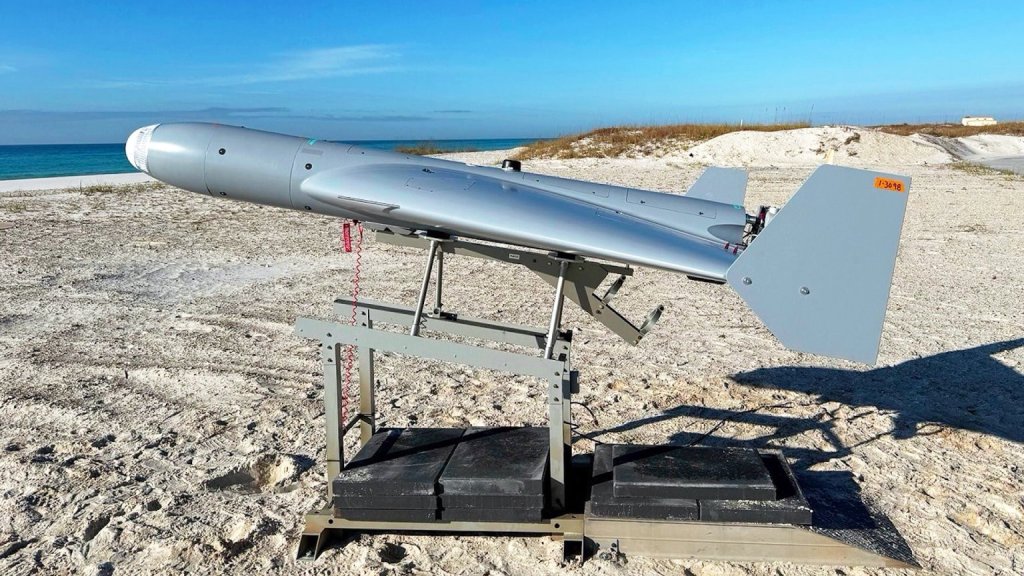 A LUCAS drone on a static launcher. Shield AI
 With all that in mind, “long-range strike drones like LUCAS, how is that fitting into your planning and training?” our Howard Altman asked the panelists at AUSA.
“We’ve taken our Bayonet Academy, as we call it, a training area at JBLM [Joint Base Lewis-McChord in Washington State], and have started incorporating the employment of long-range one-way attack. Like, how do I maintain it? How do I employ it? How does that then get orchestrated in order to achieve that effect?” Maj. Gen. Bernard Harrington, head of the 7th Infantry Division, responded. “So we see that playing a key role in order to be able to achieve that effect at mass, … [and] in an affordable manner, while also being able potentially to preserve something that’s more exquisite for something that requires an exquisite munition.”
Earlier this year, the Army brought the 7th Infantry and the 1st Multi-Domain Task Force together under the umbrella of what it now calls the Multi-Domain Command-Pacific (MDC-PAC). Maj. Gen. Harrington is also now the commander of MDC-PAC, and has talked previously about how he sees uncrewed capabilities as critical to overwhelming adversaries in future conflicts. The service’s MDTFs, of which there are now four, have been at the leading edge of fielding new long-range strike and other advanced capabilities.
In his response to Altman’s question, Harrington elaborated more on how he sees long-range one-way attack munitions like LUCAS factoring specifically into future fights in the Pacific, such as one against China. The Chinese People’s Liberation Army (PLA) has already established extensive anti-access and area denial (A2/AD) bubbles in the Western Pacific and is continuing to expand on that strategy.
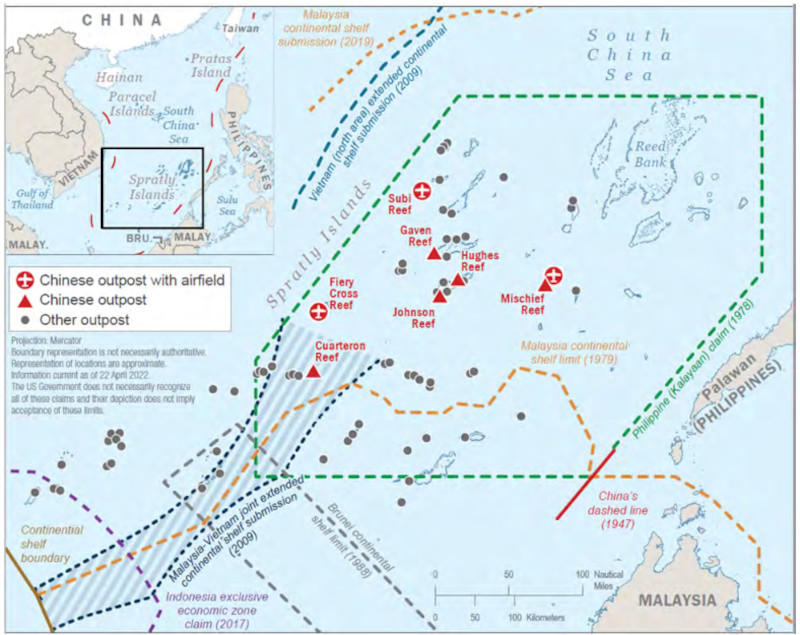 A map showing Chinese military outposts in the Spratly Islands at the southern end of the South China Sea, including those seen in the pictures in this story, as well as other non-Chinese facilities in the hotly contested region. This gives a good sense of the anti-access/area denial bubbles that China has already established and continues to expand upon. DOD
 “So as we start modeling out what it looks like to be able to penetrate a portion of the anti-access/area denial network in support of the joint task force in the PACOM [U.S. Pacific Command] area of operations, we started looking at, well, how do I bend – how do I achieve mass at a cost curve?” the 7th Infantry and MDC-PAC commander explained. “What effect am I really trying to achieve on a system in order to provide that window of opportunity for that joint force commander?”
“So maybe I don’t necessarily need to sink a ship, but if I take out certain systems on that vessel, well then it creates this temporal window opportunity,” he continued. “Then that joint force commander can surge in that carrier strike group or bomber task force.”
What the general is describing here is typically referred to as a mission kill. For years now, TWZ has repeatedly highlighted how long-range one-way attack drones and loitering munitions could be used in exactly this way against even larger warships. Damaging or destroying radars, communications antennas, and other subsystems could severely degrade a ship’s combat effectiveness and increase its vulnerability to follow-on attacks. The time and effort required for repairs could keep it sidelined for a protracted period of time.
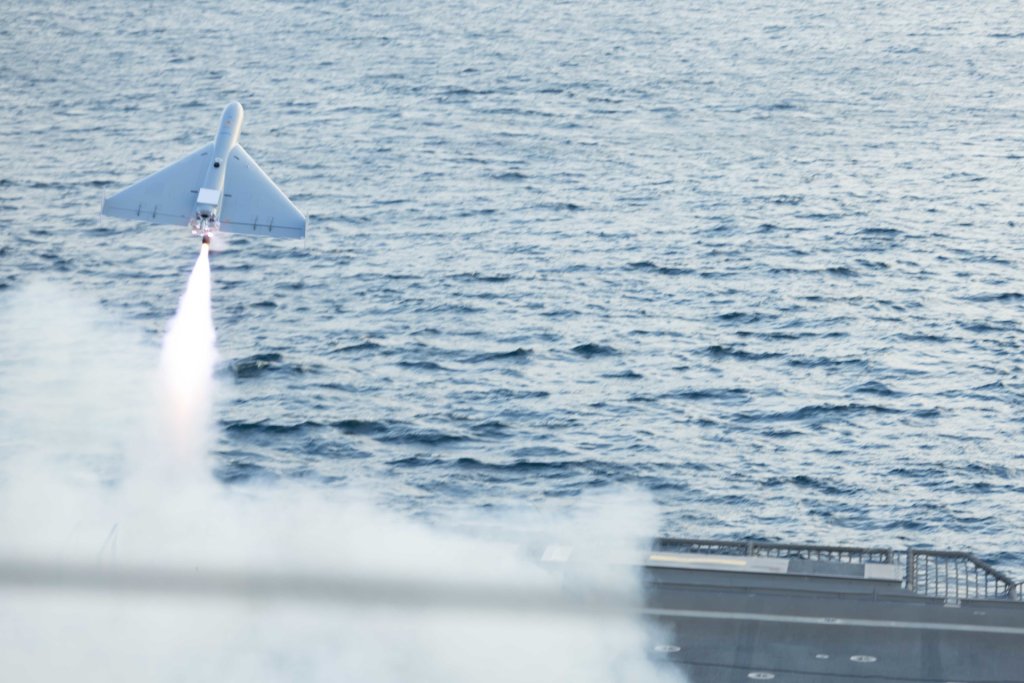 A LUCAS drone seen being launched from the stern flight deck of the US Navy’s Independence class Littoral Combat Ship (LCS) USS Santa Barbara during a test. NAVCENT/C5F/U.S. Army Spc. Kayla Mc Guire
 “So when we started looking at that, we saw great value. That maybe I don’t have to use specifically or unmask an exquisite system to achieve that effect,” Harrington added. “If I can achieve [the] effect of mass utilizing lower cost systems, hey, maybe that will get me there. So we modeled that, and what we saw was, particularly with our unmanned surface vessels [USV], long-range one-way attack, long-range launch effects, the ability to synchronize and mass that could potentially get us to achieve that effect.”
As with long-range one-way attack drones, the adoption of kamikaze USVs by the U.S. military is evolving rapidly. America’s first use of this capability in real combat also came against Iran in July.
Yesterday, using multiple one-way attack surface drones, CENTCOM forces successfully struck a submarine and ship maintenance facility in Iran. Three Corsair unmanned surface vessels hit the port at Bandar Abbas Naval Base, marking the first time American forces have employed sea… pic.twitter.com/bOM2kmgRxz
— U.S. Central Command (@CENTCOM) July 13, 2026The term “launch effects” that Harrington used here is a catch-all term the U.S. military now routinely applies to a diverse array of uncrewed aerial systems designed to be launched from other platforms in the air, on the ground, and/or at sea. This includes loitering munitions, but also designs configured for surveillance and reconnaissance, electronic warfare, signal relay, and other tasks. The lines separating long-range one-way attack drones, launched effects, and traditional cruise missiles and decoys are in many cases now very blurry.
None of this is limited to the Pacific region or the Middle East, either.
“So, in terms of launch effects, I think you mentioned LUCAS. Covenant’s out there. There’s other systems that are out there,” Brig. Gen. Steven Carpenter, head of Multi-Domain Command-Europe (MDC-E), another one of the panelists, also said in direct response to Howard Altman’s question. “In Europe, we like that, more than accepting risk in an area, maybe we’re disintegrating an anti-access/area denial bubble in the center, and then way up north, we’re going to go ahead and accept some risk there. We like to use those systems to create counter-fire parity, long-range fires parity with an adversary.”
Similar to the establishment of MDC-PAC, MDC-E was formed last year by blending together the 56th Artillery Command and the 2nd MDTF, both of which are forward-deployed in Germany.
The “Covenant” mentioned by Carpenter is a U.S.-Israeli company that has been developing a long-range strike weapon system called Anthem. It was just confirmed in September that the U.S. Army has been actively engaged in testing of Anthem. This includes a live-fire demonstration in Morocco earlier this year. You can read more about Anthem and the current plans for it here.
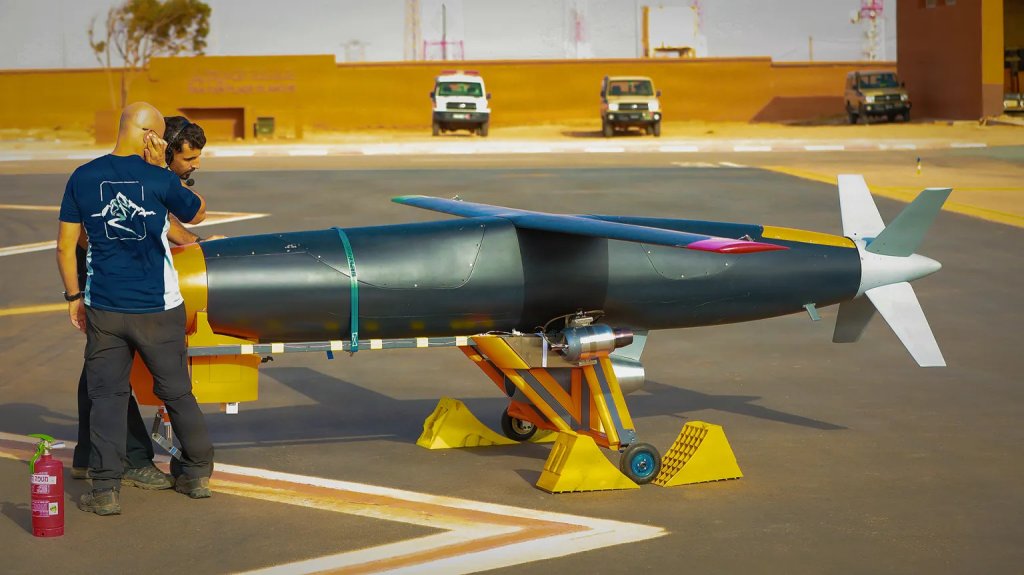 An example of Covenant’s Anthem long-range strike weapon, seen here being tested by the US Army. US Army
 “The reason we like those types of systems is because they’re EMI [electromagnetic interference] resilient, they’re longer range, and they’re higher yield, so they can go ahead and destroy like SS-26 systems, SS-21 systems,” the MDC-E commander added.
SS-26 Stone and SS-21 Scarab are the NATO reporting names for Russia’s Iskander-M and the older Soviet-designed OTR-21 Tochka short-range ballistic missiles, respectively. They are both fired from road-mobile launchers. Russia and Ukraine have employed Tochka in the course of their ongoing conflict, though their role on both sides has steadily diminished amid shrinking inventories. Tochka is also increasingly limited in service elsewhere globally. Iskander-M is a much more capable design that has factored heavily into U.S. military planning in Europe for years now. The U.S. military has previously acknowledged that war in Ukraine has led to improvements to that missile that make it even more dangerous and difficult to intercept.
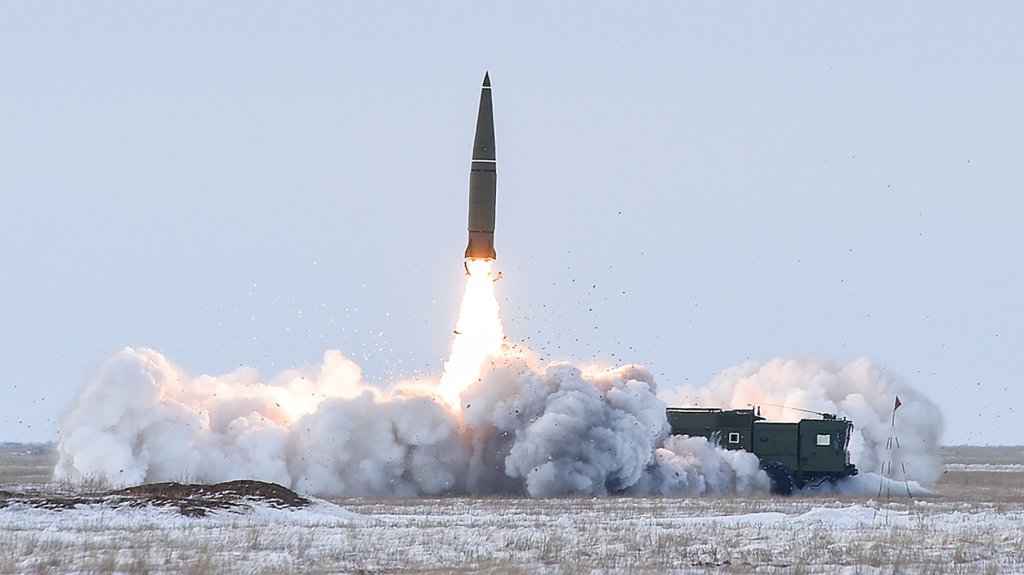 A stock picture of an Iskander-M short-range ballistic missile being fired from a road-mobile transporter-erector-launcher. Russian MoD
 Long-range one-way attack munitions like LUCAS are well suited to striking surface-to-surface and surface-to-air missile launchers, along with other high-value and time-sensitive targets, as TWZ highlights regularly. It’s also worth noting that Iran’s Shahed-136, specifically, traces its roots back to pioneering Israeli developments in munitions of this kind, where the focus initially was explicitly on finding new avenues to neutralize hostile air defenses. Iran has shown Shahed-136s and other related designs being employed in exactly this way in large-scale exercises in the past, as seen in the video below.

Shahed 136 drone Great Prophet 17 drill
More recently, Iranian forces demonstrated just how effective these capabilities could be in a real-world context in retaliatory attacks on prized air defense radars on the opposite side of the Persian Gulf after the United States and Israel launched their open waves of strikes back in February. TWZ previously explored the far-reaching ramifications of this in a detailed feature that you can find here.
Overall, as we’ve previously written:
“When it comes to this class of drone, speed and advanced guidance concepts do not define its utility. Range and cost do. Survivability comes in numbers, and due to their smaller size, use of composite materials, and small internal combustion engine, as well as their slow speed. These attributes, along with their low-altitude flight profile, mean they possess a reduced signature and general level of detectability that can be a challenge for traditionally configured ground-based radars. Despite their smaller signature, the fact that they are still somewhat vulnerable to interception is actually a positive, but we will get to that in a moment.”
“Above all else, the Shahed-136 and other long-range one-way attack drones exist to put a relevantly-sized warhead on a target far from their launch position at the lowest possible cost. It was previously estimated that the Russian Shahed-136 variant costs around $50,000 per copy, with some estimates being far lower. This cost has also likely declined significantly since Russia has mastered the design and drastically ramped up serial production. By comparison, traditional cruise missiles with similar range have costs in the millions of dollars per round, so the price differential is very dramatic. The Shaheds are also just far easier to build and can be produced in much less time than a typical cruise missile.”
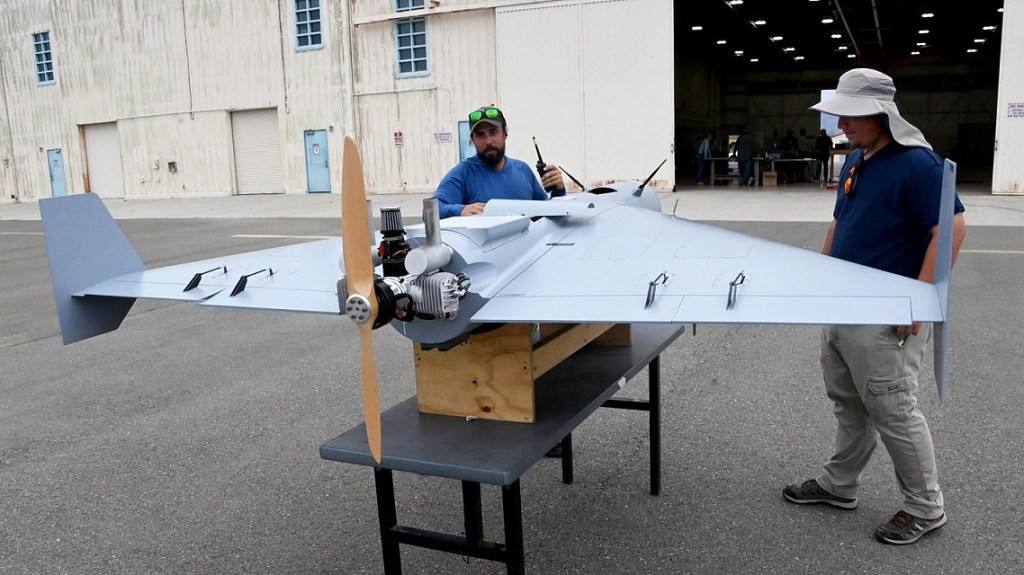 Another look at a LUCAS long-range one-way-attack drone. Mark Schauer/US Army
 The ‘mass’ afforded by LUCAS and other long-range kamikaze drones also imposes problematic cost calculations for opponents when it comes to the air defense equation, and offers a way to rapidly drain an opponent’s stocks of vital interceptors. These are realities the U.S. military is currently grappling with after expending thousands of anti-air interceptors in conflict with Iran and in other crises in the Middle East in recent years, as well as supporting allies and partners, such as Ukraine.
LUCAS, specifically, is already in line to become even more capable through the introduction of a swarming capability, made possible by the Hivemind autonomy software package from Shield AI. As we’ve explained before:
“Using the software, multiple LUCAS drones will be able to share tasks and maneuver cooperatively, making saturation attacks even more effective. As well as the drones dynamically rerouting, avoiding air defenses, and otherwise adapting to changing battlefield conditions, an AI pilot makes it easier for missions to continue despite hostile jamming or loss of datalink connectivity. Indeed, using AI, drone swarms can maintain near-perfect combat efficiency even if it loses members. Drones can be configured with all different payloads, with the swarm’s makeup tailored to each mission, and the AI system can maximize their collective effectiveness at all times.”
The U.S. Army still has many questions to answer about how it will field LUCAS and other long-range one-way-attack drones on a more widespread basis, as well as train personnel to employ them. As evidenced by the establishment of the MDTFs, and now the MDC-PAC and MDC-E formations, the underlying force structure that will go along with all of this is still evolving, as well.
The remarks from Maj. Gen. Bernard Harrington and Brig. Gen. Steven Carpenter at AUSA this week show senior Army leaders are working hard now to lay the groundwork to answer these questions. A clear vision for how LUCAS and similar weapons will be employed in future fights against land-based and maritime threats is taking shape already.
Contact the author: [email protected]