By Engadget | Created at 2026-09-03 22:07:18 | Updated at 2026-10-01 11:27:54
3 weeks ago
By Engadget | Created at 2026-09-03 22:07:18 | Updated at 2026-10-01 11:27:54
3 weeks ago
The most powerful hub runs on Nvidia's Jetson Thor platform and costs $20,000.
Max Miller for Engadget
Ugreen is stepping into the local AI market today with the launch of its smart home product lineup. At the center of that lineup are HomeAgent and MasterAgent, local AI-powered smart home hubs based on ARM architectures. Alongside three different home hubs with AI systems-on-chip, the company unveiled indoor and outdoor security cameras, a smart picture frame and a smart speaker at a Gillette Stadium launch event in Foxborough, Massachusetts. The goal is to provide smart features similar to those offered by products from Amazon and Google, but without sending sensitive user data to the cloud. An "AIoT" line represents uncharted territory for Ugreen, best known for products including fast chargers, USB cables and network attached storage (NAS) devices, but the company is differentiating itself with a privacy-forward approach.
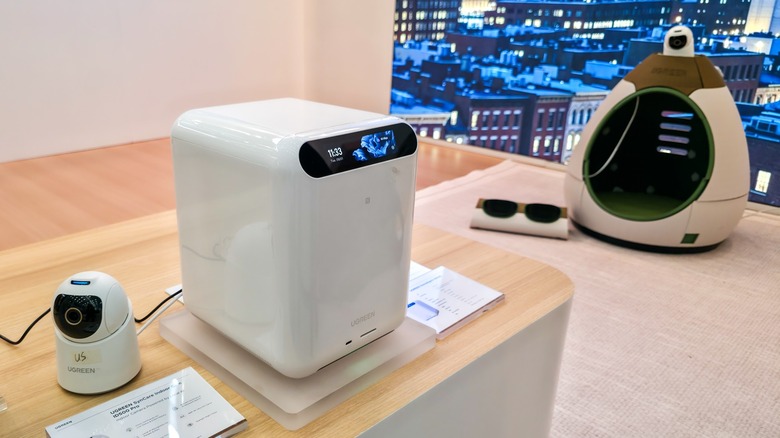
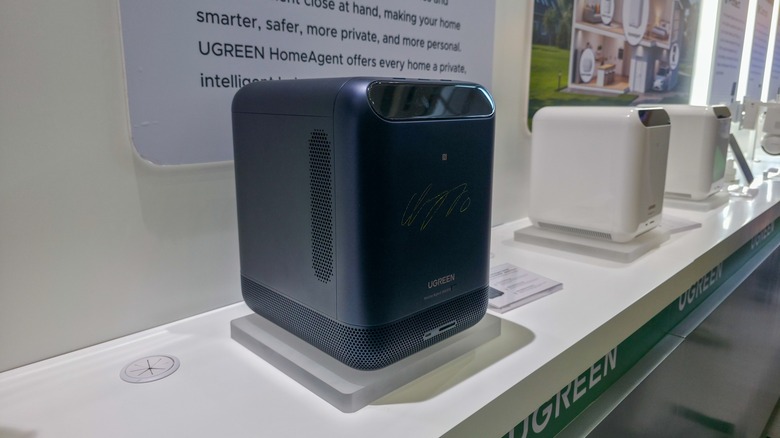
The HomeAgent comes in two flavors, with a more capable HA100 Pro model offered alongside the baseline HA100. The latter offers features including rule-based automation for home routines, categorical object recognition and home control through device commands, while the former builds more complexity atop those capabilities. In addition to object recognition, it can understand motion and infer behavioral intent, and it allows users to create automation rules with natural language voice input.
The cheaper HA100 runs on an RK3588 platform with 16GB of LPDDR5 memory onboard and a combined 26 TOPS of AI performance, while the HA100 Pro runs on the more powerful CIX-CP8180(P1) SoC and doubles the RAM to 32GB, resulting in a 205 TOPS. The HA100 will retail for $1,799, with an early bird price of $899, while the HA100 Pro goes for a significantly steeper $5,999, or $2,999 with the early bird deal.
The master of all agents is a $20,000 Nvidia-powered home hub
Max Miller for Engadget
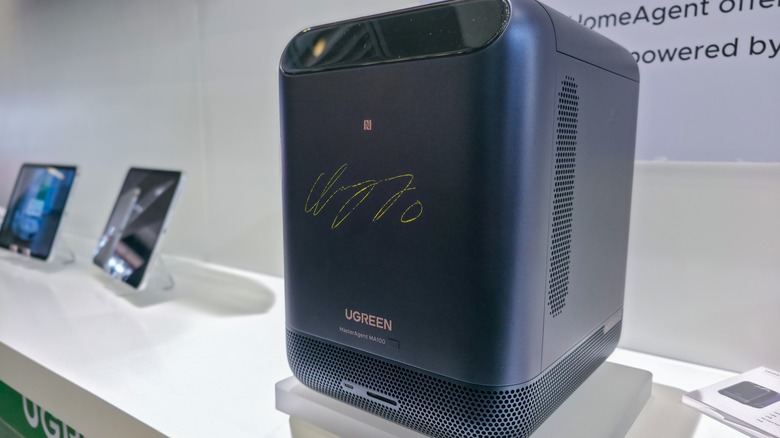
For those who want to run even more demanding AI models, Ugreen is launching an even more premium flagship home hub called the MasterAgent MA100. Running on the Nvidia Jetson Thor platform — a Blackwell system-on-module (SoM) with 128GB of unified memory — the top-end box will set you back a stomach-turning $20,000 at retail, though early bird pricing is 50 percent off that MSRP. With up to 2,070 TOPS of AI performance, it's a bit like having a scaled-down AI server in your living room, but you'll empty your wallet instead of your local aquifer for the privilege.
The costliness of even the base model HomeAgent, let alone the MasterAgent, indicate that privacy will come at a steep cost in the AI era. In a panel at the launch event, Ugreen NAS community manager Thomas Brown suggested that the savings accrued by running local AI models as opposed to paying token costs for cloud inference would make these hubs attractive. Marketing materials also point to savings on cloud storage costs. That may be so, but the upfront cost is still prohibitive.
The three hubs work out of the box with ONVIF and Matter-compatible devices. According to product planning manager Markus Xie, Zigbee and Thread are also on deck. That means you'll be able to run devices from competitors like Anker (or its subsidiary, Eufy), which also announced an AI powered smart home hub today. Unfortunately, there's no official Home Assistant support. That's a bitter pill to swallow, given that Anker's hub supports Home Assistant, Apple HomeKit and more.
As with Ugreen's NAS bays, you'll need to bring your own SATA hard drives to install in the included bays for NAS-style storage. There are also M.2 and and SD card slots. Other connectivity includes HDMI, Ethernet and multiple networking ports.
There was only a single working model of the HomeAgent at the launch event, with a couple of party tricks on deck. Attendees were able to control smart curtains and lights, and those devices responded as expected. The more complex features Ugreen promises, like voice-based rule creation, weren't demoed.
Ugreen's SynCare cameras will let you put yourself in the Truman Show
Max Miller for Engadget
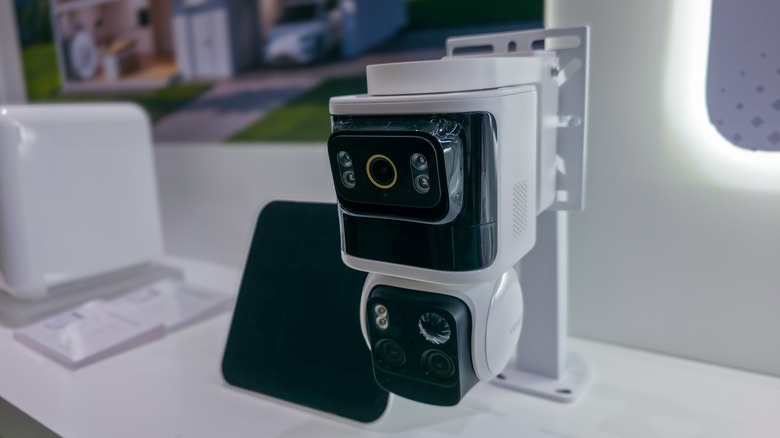
Three SynCare branded security cameras — the Indoor Cam ID500 Pro, PoE Cam OD600 Pro and Battery CAm OD800 Pro — look among the most promising products in Ugreen's smart home package. These appear to be the final versions of the security cameras Ugreen showed off at CES early this year, which were promised in the back half of 2026.
There's no denying that, at least when they work, AI smart camera features such as facial recognition and package detection can be convenient. The problem is that to get those features from a Ring or Nest camera, you're forced to let Amazon or Google process your video footage in the cloud. Ugreen heavily emphasized local-first privacy at its launch event, with both of the aforementioned features highlighted in presentations and panels. Xie told me any remote access will use end-to-end encryption, with local data protected using standard AES-256 encryption.
Attendees at the launch event were able to try a demo of the facial recognition-based security features. As I approached a door with a SynCare camera mounted overhead, it gave me increasingly stern warnings that I was trespassing on private property, until a blaring alarm sounded as I got within a few feet.
Ugreen emphasized that security was not the only focus for SynCare cameras. In a promotional video shown at the launch event, New England Patriots cornerback and newly announced Ugreen global brand ambassador Christian Gonzalez was shown using the indoor camera to take candid photos of himself with his family. The idea that your cameras will constantly roll footage and pick out the highlights of your life is a bit unsettling, even if the footage never leaves your home network. It's a bit closer to staging your own, personal Truman Show than I'm comfortable with.
The ID500 Pro retails for $149, the OD600 for $269, and the OD800 Pro for $399, with early bird deals at $89, $159 and $199, respectively.
Ugreen's voice assistant is called Uliya
Max Miller for Engadget
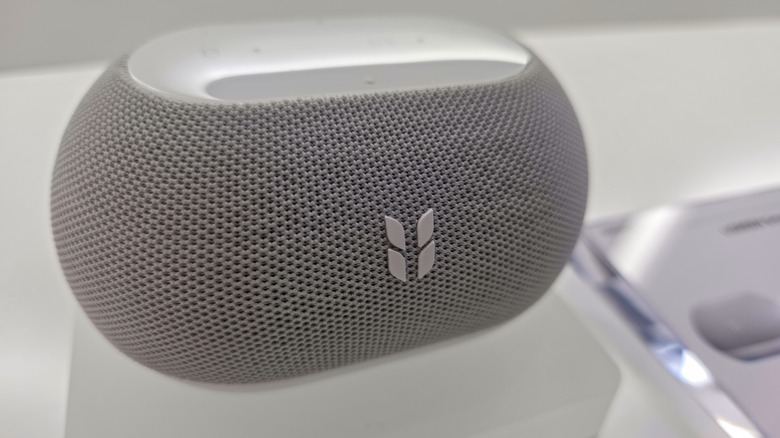
A smart home ecosystem wouldn't be complete without a voice assistant, and Ugreen's is named Uliya. The accompanying Smart Speaker for Uliya has an oblong, fabric-coated design that looks a bit like someone stretched out a Google Nest Mini, but with an LED ring around the base more akin to the new Google Home Speaker. It will, of course, play audio in addition to its voice assistant capabilities, but the real draw here is as an interface for the HomeAgent. It activates when you say the wake word "Uliya," which seems distinct enough that you won't accidentally trigger it in the course of normal conversation. The speaker will retail for $99, with an early bird deal of $69.
The odd duckling here is a 13.3-inch color E-Ink picture frame, the Ugreen Gallery. E-Ink actually seems like a great choice for a smart display with ambient home control information, but this ain't that. At least right now, it functions only as a 4:3 picture frame to show off those family vacation photos in your living room, with the E-Ink serving only to make them look a bit more like real prints. It will cost $439, or $299 with early bird pricing.
Pre-orders are open now for Ugreen smart home products
Max Miller for Engadget
Oddly, Ugreen's AIoT products are a Kickstarter project. A direct-to-consumer pre-order begins September 3 until October 27 for HomeAgent and MasterAgent, with a Kickstarter crowdfunding period thereafter through the rest of the year, at which point the rest of the lineup will also be available. Ugreen plans to start shipping in January.
The platform sounds great on paper, at least for those who can afford to go all-in on the ecosystem and have Matter-compatible smart devices. But review samples were scarce, and there's no telling how HomeAgent and MasterAgent will perform on the ground. If the AI-powered smart home experiences we've seen from Google Gemini or Amazon Alexa+ are a bellwether, you can expect some frustration. Then again, these products don't seem geared toward the set-and-forget crowd. The theory behind personal home intelligence is that you can tinker with different AI models and device setups. Given the lack of truly private options in the AIoT space, Ugreen clearly believes there's an audience for these devices.