 By The Epoch Times | Created at 2026-09-24 00:17:00 | Updated at 2026-09-24 00:58:37
1 hour ago
By The Epoch Times | Created at 2026-09-24 00:17:00 | Updated at 2026-09-24 00:58:37
1 hour ago
The U.S. Arctic Coast Guard chief said that the U.S. military is monitoring China’s activities in the Arctic region “very closely” as the United States secures permanent military control over Greenland, which analysts say is an important outpost to counter the Chinese regime’s threats in the region.
Chinese ships have sailed in the maritime zones off the state of Alaska, including the Aleutian Islands, into the Bering Strait, and as far north as the North Pole, Rear Admiral Bob Little, commander of the U.S. Coast Guard’s Arctic District, said during a visit to Oslo at a conference on Arctic security on Sept. 21.
“Where I have responsibility, interest, and concern is when they are operating in and around U.S. sovereign space,” Little said.
“So inside of our exclusive economic zones, or over our extended continental shelf, we certainly have a security concern. And so those are the types of activities that we see that we’re watching very closely.”
The Chinese ships remained in international waters but had not notified the United States of their presence in advance through diplomatic channels, as would be the usual practice.
“When we challenge them and query them as to the purpose of their activities, their response typically is either ‘we are conducting operations in international waters’ or ‘we are conducting scientific research,’” Little said.
So far in 2026, four Chinese research vessels have conducted work offshore in the U.S. Arctic, compared to a total of five in 2025, Little told Reuters.
China Threat and Greenland Deal
The U.S. concern over the Chinese ships’ activities entails both security and economic reasons. These Chinese vessels conduct activity that might “provide [the Chinese] with a military advantage or pose a security threat to the United States,” Little said.
China may also be involved in scientific research focused on the mineral exploitation of the seabed in an area that belongs to the United States, he added.
The Chinese regime’s vessels are researching for future military deployments in the waters near Alaska and the Arctic, specifically the positioning of strategic nuclear submarines, Su Tzu-yun, researcher and director of Division of Defense Strategy and Resources at Taiwan’s Institute for National Defense and Security Research, told The Epoch Times.
“Submarine-launched ballistic missiles fired from that region could reach the U.S. mainland in as little as 15 minutes. This is part of the geopolitical strategy pursued by the authorities in Beijing,” Su said.
For the United States, China’s presence in the Arctic—which directly connects Alaska, the Bering Sea, and Greenland—is viewed as a matter of U.S. homeland security, Chung Chih-tung, associate research fellow at Taiwan’s Institute for National Defense and Security Research, told The Epoch Times.
The United States has always positioned China as a non-Arctic country, but China calls itself a “near-Arctic” state and is actively involved in Arctic affairs.
“Greenland is related to Arctic affairs and to the U.S. homeland security,” Chung said. Therefore, the United States “can use [China’s presence in the region] to justify its military and security control over Greenland, citing the need to counter the threat posed by China’s activities in the Arctic.”
And the new Greenland deal “serves as a warning to China,” he added.
The United States, Denmark, and Greenland signed a historic security agreement on Sept. 22, which expands U.S. military and security presence on the Arctic outpost. The deal also bans adversarial non-NATO nations like China and Russia from establishing military posts, deploying troops, or making sensitive investments without U.S. approval.

The HDMS Ejnar Mikkelsen of the Danish Navy patrols Greenland in Nuuk, Greenland, on Jan. 22, 2026. Sean Gallup/Getty Images
Greenland serves as a crucial strategic outpost for containing infiltration by the Chinese regime and Russia via the Atlantic, as well as for countering the threats they pose to the United States and NATO nations, Su said.
Overall, they are all part of a grand geopolitical chessboard, Su said. “The CCP [Chinese Communist Party] seeks to reduce its reliance on maritime routes like the South China Sea, the Suez Canal, and the Strait of Malacca by opening up a northern route near the Arctic, which would also allow for future submarine deployment. The U.S. move to contain China via Greenland is, therefore, highly targeted at this strategy of China. The U.S. Atlantic Fleet also aims to plug the strategic gaps around Greenland and the UK,” he explained.
Also, the marine data that the Chinese vessels are collecting have military and civilian duel use, Chung noted. “The information covering seabed conditions, water depth, temperature, and underwater sound propagation can be framed as routine geographical surveying; however, in reality, this data can also be utilized for military purposes. The United States views China’s collection of this dual-use data through the lens of security,” he said.
Beijing views itself as a major power and believes its activities throughout the Arctic are fully consistent with international law, Chung said. “This clearly reflects the Chinese regime’s ambition to extend its influence into the Arctic.”
Beijing perceives U.S. actions of maintaining international rules in the Taiwan Strait and the South China Sea as challenging its strategic interests, he said. “Consequently, Beijing can now open a new front in the Arctic to make things difficult for the United States in return.”
CCP and Russia Cooperation
The U.S. government’s threat assessment report for 2026 specifically mentioned China’s threat to the Arctic. It particularly emphasized that China and Russia have joined forces to pose a threat to the United States in the Arctic.
Moscow has been working with Beijing to expand the “Polar Silk Road” proposed by the Chinese regime in 2018 as an extension of its high cost global infrastructure investment project—the “Belt and Road Initiative.” The “Polar Silk Road” aims to develop Arctic shipping lanes, particularly the Northern Sea Route along Russia’s Arctic coast, and invest in infrastructure along the corridor. The route can cut shipping distances between East Asia and Europe by 25 percent to 50 percent, reducing travel time from about 40 days via the Suez Canal to about 20 days.
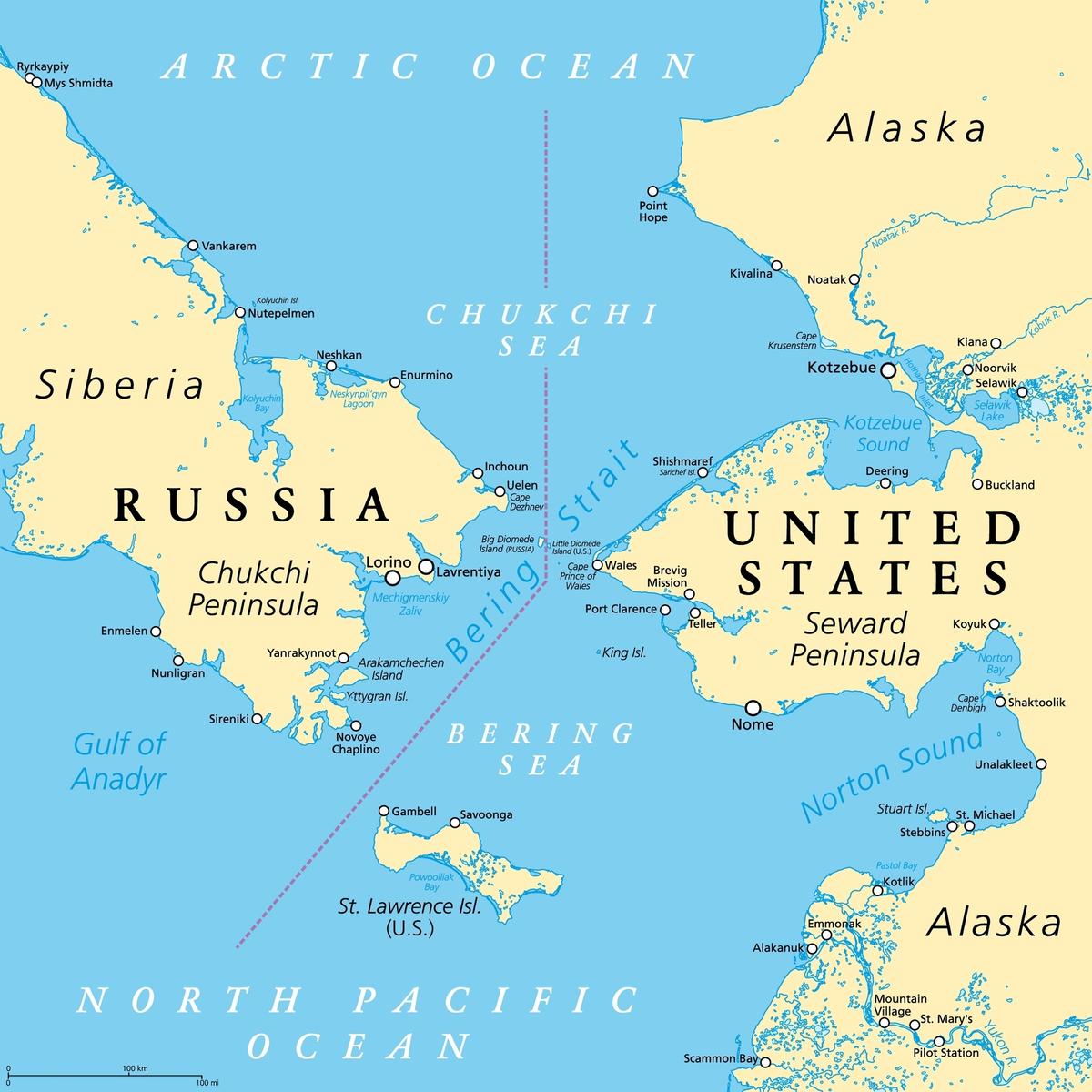
A political map showing the Bering Strait region, including parts of Alaska (USA) and Siberia (Russia), along with surrounding seas and oceans. Shutterstock
The “Polar Silk Road,” also known as the Arctic shipping route, passes close to Alaska’s waters in the Bering Sea and Arctic.
“Over the past decade or so, there has been a period of about 10 to 20 days each summer when the Arctic ice melts, allowing cargo ships from countries like Japan, South Korea, and China to navigate the route on a trial basis,” Su said.
Russia’s role in the cooperation with Beijing on the “Polar Silk Road” would likely be undertaking icebreaking duties in the future, Su said. “Essentially, when merchant fleets travel north from the Sea of Japan, pass through the Bering Strait, and enter the Arctic Ocean, Russia would provide icebreaking services in exchange for a fee. This arrangement would allow for significant savings in both time and costs along the route,” he said.
China seeks to leverage cooperation with Russia to gain influence over the Arctic Ocean, Sun said.
Chung said that the Arctic is of great importance in terms of overall global and geostrategic considerations, as it involves future Arctic shipping routes—not to mention the energy, mineral, and scientific research potential, as well as other underlying strategic value.
There’s a military aspect in China–Russia cooperation on the Arctic route, he pointed out.
Geopolitically, China is still some distance away from the Arctic, so any related naval operations there require bases, which the Russians can provide, he said. “Russia is China’s primary partner; thus, activities in the Arctic serve to demonstrate, to a significant extent, the strategic coordination between China and Russia, which poses a threat to the United States.”
The Arctic has now emerged as a new focal point of U.S.–China geostrategic competition, joining the Western Pacific, space, cyberspace, and critical industries, Chung added.
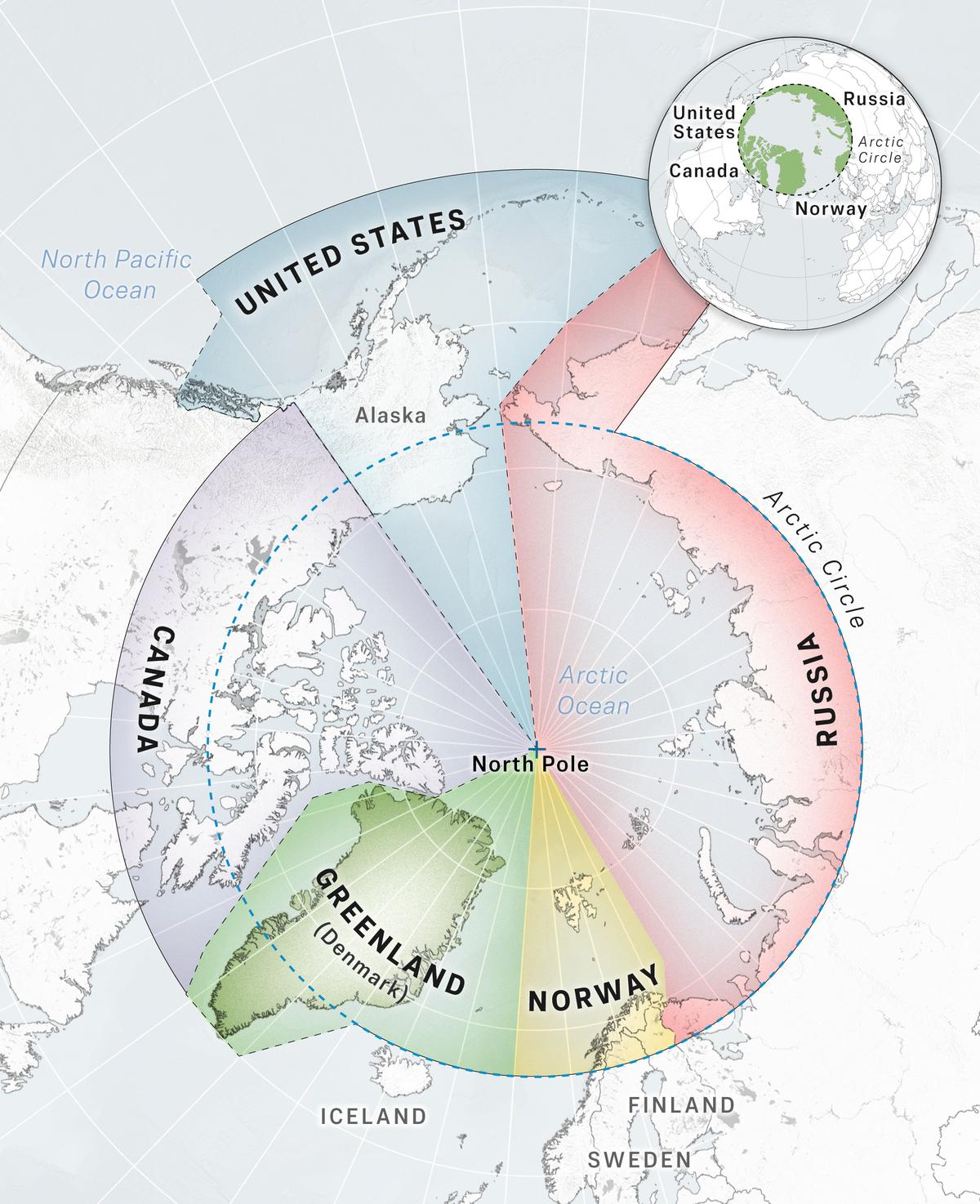
A map centered on the North Pole, showing the Arctic region and surrounding countries. Illustration by The Epoch Times
Beijing is looking forward to the melting of Arctic ice, according to Sun. However, he pointed out, “if regular navigation in the Arctic Ocean becomes possible in the future, vessels from China will still need to pass through the Bering Strait—near Alaska—to reach the Arctic Ocean.”
So, the United States can contain Chinese marine presence from three northern straits, Sun said. “The first is the Tsushima Strait, located between Japan and South Korea; the second is the Sea of Japan; and the third is the Bering Strait, situated at the boundary between Alaska and Russia. These locations form a network of straits to counter the CCP’s future strategy in the Arctic Ocean.”
The tensions reflect the competitive dynamic between the bloc comprising China, Russia, Iran, and North Korea, and the other bloc consisting of the United States, Europe, and Japan, extending into the Arctic, Chung said.
Currently, the United States has eight military bases in Alaska, and Pituffik Space Force Base in Greenland.
Sun noted that the U.S. Arctic forces’ bases in Alaska are ready for rapid deployment. Meanwhile, Russia is rebuilding certain military bases within the Arctic Circle, aiming to increase its control over the Arctic Ocean.
“The United States is currently stepping up its strategic positioning in the Arctic,” Sun said. “Should year-round navigation become feasible, it would at least have established outposts, such as in Greenland, to exercise control and counter potential challenges.”
What the U.S. Coast Guard chief said this week serves as a warning to both Russia and China, Sun said.
Beijing is demonstrating its strategic bid to monopolize the discourse on global governance, and claims its expansion activities are under international law, which makes it harder to prohibit its presence in the Arctic, Chung said. “It has the same ambitions for the Antarctic,” he warned.
Luo Ya and Reuters contributed to this report.