 By The War Zone | Created at 2026-09-30 23:40:55 | Updated at 2026-10-01 00:29:56
50 minutes ago
By The War Zone | Created at 2026-09-30 23:40:55 | Updated at 2026-10-01 00:29:56
50 minutes ago
The Pentagon has announced plans for a new functional combatant command, very broadly akin to U.S. Special Operations Command (SOCOM) or U.S. Space Command (SPACECOM), but for operational activities involving autonomous and robotic capabilities. Secretary Pete Hegseth has also announced new initiatives to help further accelerate the fielding of uncrewed systems in the air, at sea, and on land, as well as explore future warfighting challenges. All of this builds on previous and long-overdue efforts to prioritize the fielding of various tiers of drones, as well as artificial intelligence (AI) and other emerging technologies, across domains, but there are questions about how these new efforts will translate into tangible developments.
Secretary Hegseth unveiled plans for what is tentatively dubbed Autonomous Warfare Command (AUTOWARCOM), as well as the aforementioned initiatives, called Project Agincourt and Project Meridian, during a speech to service members today at the U.S. Marine Corps’ base in Quantico, Virginia. Hegseth called this a State of the Force address, and said he planned to make it an annual event.
.@SECWAR “Today, at my direction—we are announcing the creation of Autonomous Warfare Command, or AutoWarCom:
A new 4-star combatant command—with service-like authorities—built to scale autonomous and robotic capabilities across the Joint Force in the fastest peacetime shift in… pic.twitter.com/kYWBxy6Dij
“At my direction, we are announcing the creation of Autonomous Warfare Command, or AUTOWARCOM, a new four-star combatant command with service-like authorities built to scale autonomous and robotic capabilities across the joint force in the fastest peacetime shift in modern military history,” Hegseth declared. “Drone warfare supercharged by SI-enabled targeting is the biggest battlefield revolution in generations. You already know that. Yet when I was sworn in to the Department of Defense, there was scant urgency in this domain.”
“SI” here stands for “super intelligence,” a term the Trump administration is now using in place of AI.
Hegseth called attention to the Drone Dominance initiative he unveiled last year, as well as the establishment of Joint Interagency Task Force 401 (JIATF-401), as examples of steps the Department has already taken in this regard. JIATF-401 is notably focused on counter-drone capabilities, as you read more about here.
“It’s a good start, but it’s certainly not enough. The pace of war is changing faster than the process to support it. Cheap compute, super intelligence, and advanced commercial manufacturing have enabled the proliferation of low-cost, high-precision strikes,” Hegseth continued. “For 40 years, the United States relied … primarily on expensive weapons that placed quality over quantity. Now, that approach gave us a lot of enormous advantages, and we need to preserve those capabilities. But today we need both quality and quantity. The term you know is high-low mix. An analogy is a thunderstorm. We need bolts of lightning high, our existing high-end kill chains capable of striking unexpectedly and decisively. We also need steady wind and rain, mass drones and other autonomous attritable systems that flip the cost exchange and impose unrelenting pressure on an adversary on the battlefield.”
Hegseth highlighted lessons learned from the ongoing conflict in Ukraine as underscoring these points.
.@SECWAR "Ukraine’s lesson is not that one type of drone wins wars but rather the need for a purpose-built system that maximizes the ability to adapt.
We will fuse procurement with operations at scale – and allow our warfighters, engineers, and entrepreneurs to learn, adapt, and… pic.twitter.com/x7iNMAbU0t
“So today, with Autonomous War Command, AUTOWARCOM, we institutionalize and we supercharge the era of SI, robotics, and autonomous systems, all in order to win,” he added.
A memo the Pentagon has now released makes clear that the establishment of this command is contingent on Congressional approval, and the current goal is for it to be established by October 1, 2027.
“Autonomous Warfare Command will define joint needs and integrate Service-provided forces in support of geographic combatant commanders,” the memo also notes. “It will test equipment and force designs with realistic opposition in demanding exercises and rugged environments, modify rapidly, and field what works. We must build a wartime arsenal whose main product is adaptation at the edge.”
Many questions remain to be answered about how these activities with work being done now within the individual services, and how all of that will translate into operational activities. Part of Project Agincourt’s role will be working to help answer the questions above. The name here is a reference to the battle in 1415 in which British forces prevailed over their French opponents, famously in part through the application of a particular military technology, the longbow.
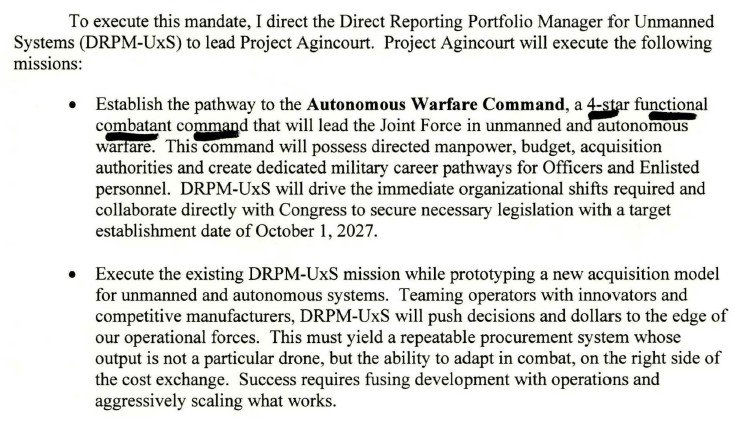 The two main tasks outlined in a memo today on Project Agincourt, one of which is laying the groundwork for AUTOWARCOM. US Military
 The office of the Direct Reporting Portfolio Manager for Unmanned Systems (DRPM-UxS) will lead this initiative. Owen West, head of the Pentagon’s Defense Innovation Unit (DIU), and U.S. Navy SEAL Senior Chief Max Strasiser are set to serve as the Chief Executive Officer and Chief Operating Officer of the DRPM-UxS, respectively.
Project Agincourt will also “prototype a new construct called warfighting acquisition, not just acquisition that happens at the Pentagon,” according to Hegseth. “This model fuses operators with entrepreneurs in rapid adaptation cycles while distributing decisions and dollars closer to frontline units, to combatant commands. Realistic training exercises, and when possible, the crucible of combat, will be used to compress innovation timelines and scale what works.”
“Also today, we are phasing in new MOS [Military Occupational Specialty] frameworks within each military department to support our shift to autonomy,” the Secretary also noted during his speech in the context of Project Agincourt and the plan for AUTOWARCOM. “We need institutional knowledge and career paths for a new generation of autonomous warfighters.”
Project Meridian sits adjacent to these efforts and has a broader mandate to explore ways to ensure the U.S. military maintains its technological edge on future battlefields.
“Project Meridian, the future of warfare, is not about developing new strategies or new policies. We already do that. Rather, its purpose is to creatively look to the future, and identify the domains that we must conquer, and capabilities we must master,” Hegseth said. “We need to be looking forward into the future to achieve technological and military dominance on the battlefield for decades to come. It is futuristic on purpose. Their work will be focused on discovering, developing, and fielding the weapons and systems that our children and our grandchildren will need in their lifetimes, without any creative limitations or restrictions, on any future battlefield, from under the Earth to beyond the Moon.”
“Project Meridian will study the battlefields of the future, identify which weapons and technologies warfighters will need to harness to dominate in these environments, and propose actionable solutions to start developing, testing and fielding these capabilities such that America will have overmatch for the 21st century and beyond,” according to a separate memo the Pentagon put out today. “The Joint Staff and all services should be prepared to connect their future warfare efforts and research to Project Meridian.”
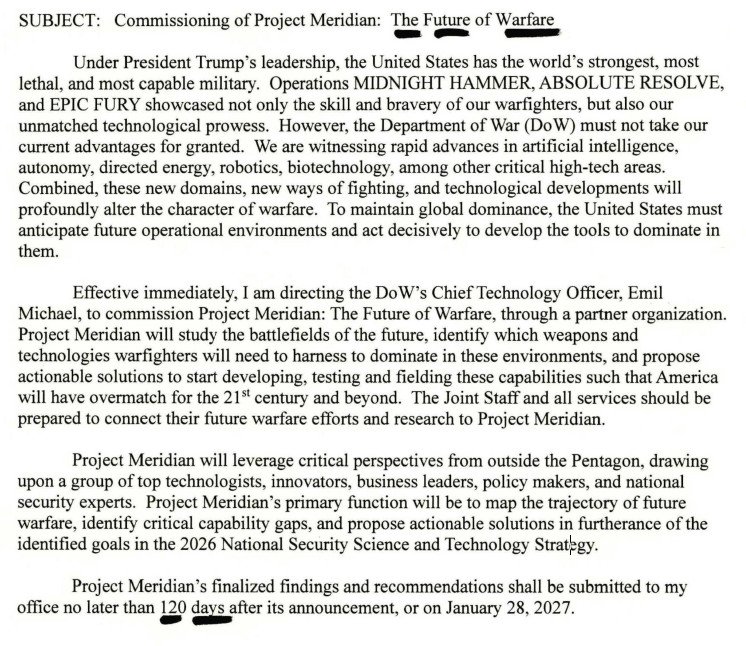 The full text of the Project Meridian memo put out today. US Military
 Furthermore, “Project Meridian will leverage critical perspectives from outside the Pentagon, drawing upon a group of top technologists, innovators, business leaders, policy makers, and national security experts,” according to the memo. “Project Meridian’s primary function will be to map the trajectory of future warfare, identify critical capability gaps, and propose actionable solutions in furtherance of the identified goals in the 2026 National Security Science and Technology Strategy.”
This is also very much a near-term initiative, with Hegseth demanding a final report no later 120 days from now, or January 28, 2027. The Pentagon’s Chief Technology Officer, Emil Michael, has been directed to set up this project. Today, Hegseth also named Elon Musk, Palmer Luckey, and Newt Gingrich as key members.
Elon Musk, founder of SpaceX, which dominates the commercial space launch and services market globally, as well as the host of other companies, has had an on-again-off-again relationship with the Trump Administration. Palmer Luckey is another entrepreneur now best known for founding Anduril, which has increasingly a major player in the U.S. defense industry. Newt Gingrich, a highly influential member of Trump’s Republican Party and former Speaker of the U.S. House of Representatives, has more recently become an outspoken advocate of advancing AI technology in the United States.
 A screen capture from today’s livestream of Secretary Hegseth’s speech. From left to right, Palmer Luckey, Newt Gingrich, and Elon Musk. US Military capture
 The inclusion of Musk and Luckey does raise ethical questions, as they both lead companies with major U.S. government contracts already, and which could be in line to see more opportunities based on Project Meridian’s findings. What guardrails might be put in place to prevent conflicts of interest is unclear.
To reiterate, it remains to be seen how all of these efforts will progress and how, or if, they will ultimately translate to more tangible developments. The U.S. military has a long history now of launching high-profile initiatives that still struggle to demonstrate real progress, despite widespread support for accelerating the fielding of uncrewed systems, AI, and other advanced technologies. The Pentagon has certainly produced tangible results through other organizational shifts in recent years, including the aforementioned Drone Dominance initiative and JIATF-401, as well as the Replicator initiative under President Joe Biden.
At the same time, there are real potential hurdles to these new plans. The Pentagon has itself already acknowledged that support from Congress will be key to the AUTOWARCOM vision. Annual budgeting, and the uncertainty that often surroudns that will also be a factor. There is also the matter of efforts to expand the U.S. defense industrial base. The limitations of existing U.S. industrial capacity and supply chains have already become a matter of national debate in light of concerns about dwindling stockpiles of critical munitions as a result of the ongoing conflict with Iran, as well as a succession of other global crises in recent years.
During his speech, Hegseth called attention to efforts to broaden the defense industrial base with new, smaller firms, as well as agreements with large established contractors to expand on their existing capacity. He also highlighted the Trump administration’s $1.5 trillion defense spending plan for Fiscal Year 2027 and issued a new call on Congress to pass an additional $350 billion reconciliation package.
With today’s announcements, the Pentagon has certainly reinforced its commitment to expanding the fielding of uncrewed and other high-tech capabilities across all branches of the U.S. military, but there is clearly work still to be done to turn those visions into realities.
Contact the author: [email protected]