By Literary Hub | Created at 2026-10-02 10:15:54 | Updated at 2026-10-02 12:06:23
2 hours ago
By Literary Hub | Created at 2026-10-02 10:15:54 | Updated at 2026-10-02 12:06:23
2 hours ago
The Coral Coast Highway, considered one of the world’s greatest road trips, starts in Perth, Australia, and follows the coastline north to Exmouth. Halfway along this epic tour of red sand meeting azure water, there is a W-shaped set of bays, marking the westernmost point of Australia. Known as the Shark Bay UNESCO World Heritage Site, the place gets its name from English buccaneer-cum-naturalist William Dampier, who was overcome by the bay’s sheer abundance and the size of the marine predators during a visit in 1699.
Article continues after advertisement
In an early example of the “charismatic megafauna” effect, while Dampier was busy gawping at sharks, he unfortunately failed to notice that he was also surrounded by the oldest known life-forms on our planet, still hanging in there after 3.5 billion years. If you take a look at satellite imagery of the region, you’ll notice that the rightmost of the two bays is a richer emerald color than the other, having been long isolated from the ocean by sediment and seagrass, causing it to accumulate salt.
At the southern point of this pool of hypersaline water, you will find Hamelin Pool, where hundreds of dome-shaped chunks of rock emerge from the shallow water like gargantuan rabbit droppings. These rocks, known as “stromatolites,” might not look particularly interesting compared to the sharks, but they are in fact ancient survivors and the reason that we have air, soil, and all terrestrial life on Earth.
This was perhaps the planet’s first mass extinction event.
About 750 kilometers northeast of Shark Bay, in the Pilbara Craton region of Western Australia, is a series of undulating red hills, which, 3.4 billion years ago, were a shallow marine environment somewhat similar to modern Hamelin Pool. Buried within these hills are some of the most important records of early life on Earth: kilometers of undulating fossilized stromatolites, the first evidence of microbial life on our planet. The term stromatolite means “layered rock” in ancient Greek, referring to the layers of accretionary organic cement material that are produced by the colonies of microorganisms as they go about their daily business, converting sunlight and chemicals such as sulfur into energy. As the colonies grow, more layers of sediment are trapped and solidified beneath them by biofilms that the organisms produce, causing the whole colony to build upward in layers, like the pages in this book. For a few billion years, these stromatolite microbial mats were the dominant form of life on Earth, and the closest thing at the time to land-based life.
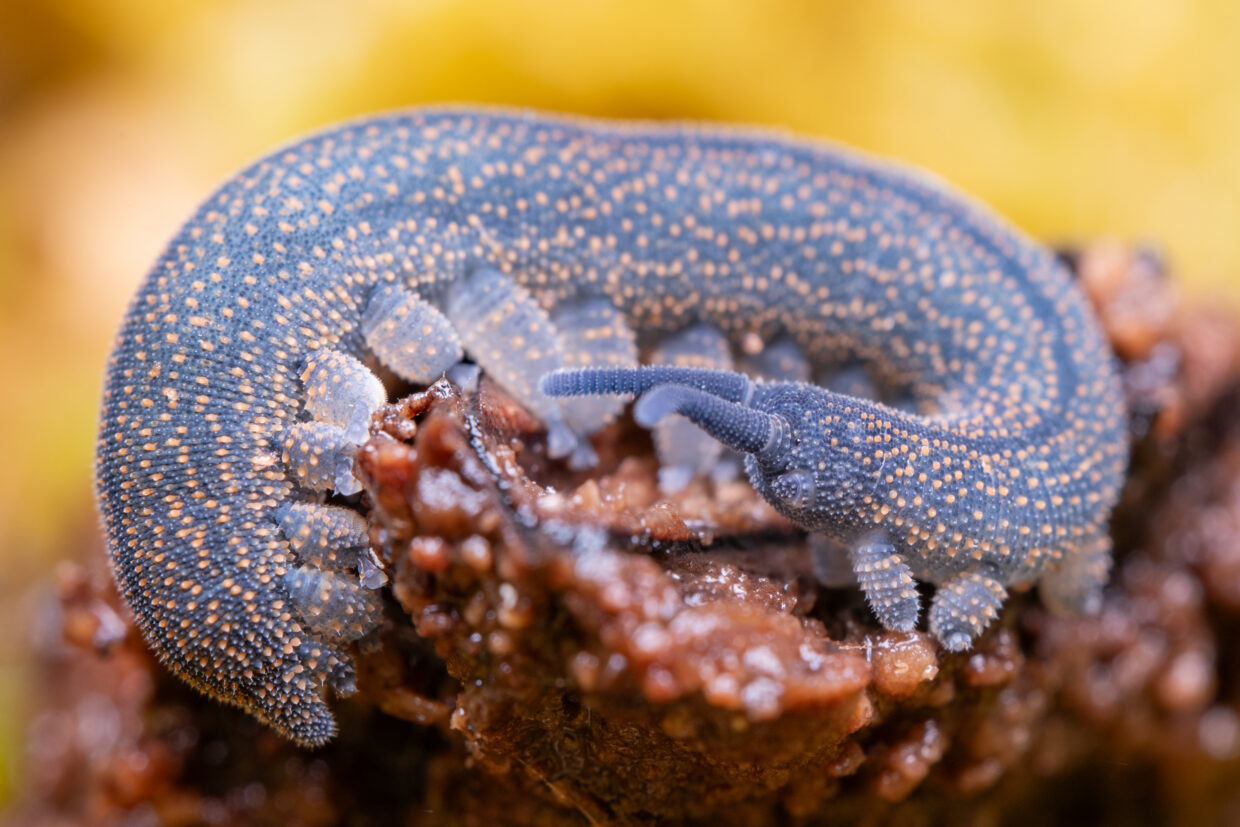 Velvet worms have changed very little in over 400 million years, still closely resembling their Cambrian marine ancestors. Photo by Frank Ashwood.
Around 2.1 billion years ago, the “Great Oxidation Event” happened. Thanks to the “invention” of photosynthesis by marine cyanobacteria in the form of these stromatolites, the oxygen they produced had finally saturated the oceans, and now began to diffuse into the Earth’s atmosphere, eventually nudging out methane as a dominant atmospheric gas. This probably sounds great to us air-breathers, but it was pure poison to most other microbial life on Earth at the time, which was anaerobic and used chemicals other than oxygen to obtain energy (much like the sulfur-based microbes we still find today on deep-sea hydrothermal vents).
This was perhaps the planet’s first mass extinction event. The stromatolites themselves managed to adapt to the new conditions and survive. With methane—a potent greenhouse gas—ousted from the atmosphere, and the creation of the UV-protective ozone layer (which still shields us from the sun’s rays today), the Earth began to cool and experienced one of its earliest ice ages. Under the increased oxygen levels, the planet’s early pre-soils developed a reddish hue, as the chemical process of oxidation occurred. Thanks to a billion years of work by tiny single-celled cyanobacteria, the trajectory of life on Earth permanently shifted in favor of aerobic (oxygen-based) organisms and, eventually, multicellular life. We humans owe our entire existence to lumpy microbial mats such as those still found at Hamelin Bay.
Over the course of the next billion years, life on Earth slowly began to take shape. The earliest “soils” may have begun forming billions of years ago, although they did not resemble what we call soil today. Those first examples were devoid of plants or animals and had developed in an atmosphere without oxygen. There are several ways in which soil can develop, and the study of that development is called pedogenesis (from the Greek pedon, meaning “earth,” and genesis, meaning “origin”).
Historically, five major factors interacted to create soil: parent material (the origin of the mineral component), climate, topography (influencing weathering, depth, and the liquid component), biology (the organic content), and time. In the current age of the Anthropocene, we could easily add in human activity as a sixth and new soil-forming factor, affecting all others.
Modern soils are produced by biological weathering of rocks, with the mineral component coming from the bedrock (or “C-horizon”). Over time, these rocks are fragmented and broken up into small mineral particles by plant roots forcing open cracks, or lichens secreting chemicals that dissolve rocks to release nutrients. However, these very early soils were instead chemically weathered by water and possibly atmospheric gases. Interestingly, similarly aged chemically weathered “paleosols” have been found on Mars, suggesting that early soil formation processes happen elsewhere in the galaxy and perhaps even across the entire universe. These paleosols are separated from true soil due to the lack of one key ingredient: organic matter.
These first colonizers affixed themselves to the bare rocky ground with a new and game-changing innovation: roots.
Soil organic matter is a rich substance created by the decomposition of the carbon-rich litter layer above it, forming a layer that soil scientists call the O-horizon. Here, heavily decaying plant and animal remains are broken down into their constituent parts, sometimes to a point that they are completely unrecognizable from their original form—creating a specific and sometimes long-lasting type of organic matter called humus. Packed with nutrients like nitrogen, which is a key part of plants’ diets, soil organic matter is the lifeblood of the pedosphere. A by-product of decay, soil organic matter takes myriad forms.
Environmental conditions, origin material, and the activity of soil organisms all interact to determine the quality and quantity of organic matter, and the depth of the O-horizon, in any soil. Soils, and particularly their organic component, are often referred to as a “black box” because of their opacity and inherent complexity, and because of the difficulty scientists have in unraveling the multilayered biological interactions going on within them. The term is perhaps better known when used to describe an aircraft’s data and audio flight recording devices. In a similar way to that black box, soil organic matter holds an enduring record of the past.
 Springtails are the earliest known pollinators, distributing spores from the first land plants. Photo by Frank Ashwood.
Sometime around 470 million years ago, in the increasingly oxygen-rich environment of the Middle Ordovician period, life on Earth was forever changed once again with the emergence of the first land plants. These earliest plants evolved from water-living multicellular green algae—descendants of the cyanobacteria—and reproduced using spores. Lacking the specialized structures for transporting fluids and nutrients found in modern “vascular” plants, they would have resembled bryophytes (the group to which mosses and liverworts belong).
These first colonizers affixed themselves to the bare rocky ground with a new and game-changing innovation: roots. These small hair-like strings weren’t roots in the modern sense (technically, they are called “rhizoids”), but they did the job of anchoring these early plants to substrates. Even now, modern mosses and liverworts still have rhizoids rather than the complex, burrowing roots of vascular plants. The rhizoids accidentally did something else too: by trapping debris and through dying and decomposing, they inadvertently began the process of real soil development for the first time in the Earth’s history.
Within 80 or so million years—the blink of an eye in geological terms—the first transitional forms between bryophytes and vascular plants had emerged, including ferns. The first forests had spread across the land, dominated by the earliest woody trees, called Cladoxylopsida. The tapering, hollow-trunked trees stood up to four meters in height, and could be a meter wide at their swollen base. Instead of leaves, they had a crown of branching twig-like structures, which rained down to the ground, providing food for detritivorous arthropods and becoming the earliest form of deadwood. Even more crucially for early soil development, they possessed downward-pointing roots, which stabilized the ground and rapidly began soil development as we know it today.
Although it’s way past our bedtime, finally, at 11:59:59 p.m., a second before midnight, humans appear on the planet and start undoing all the hard work.
This “root revolution” fundamentally changed the structure of the land’s surface through soil creation, which had massive knock-on effects for the water and carbon cycles. The first meandering rivers and floodplains developed as tree roots stabilized soil and prevented its erosion, while at the same time locking away vast amounts of atmospheric carbon into the nascent soils. This reduced atmospheric carbon dioxide levels and turned soil into the first terrestrial carbon sinks. The evolution of land plants and the development of soil go hand in hand—as these pioneering plants, trees, and animals died and their decomposing remains were recycled on land, by fungi and the first soil invertebrates, modern soils began to form.
To help visualize the development of soil and its biodiversity on the Earth, let’s consider our planet’s history in terms of a single day, with the formation of the planet (4.54 billion years ago) starting the clock at midnight. Every minute represents roughly 3.15 million years. Roughly half a billion years after the Earth’s formation, at 2:38 a.m. on our clock, the Earth’s crust has cooled and solidified, and water and atmospheric gases have begun chemically driven weathering of exposed rocks to produce the first loose mineral particles, a biologically sterile precursor to soil.
Our alarm clock rudely goes off at around 5:10 a.m., and we pull back the curtains to see marine cyanobacteria beginning to spread across the planet’s coastal areas as stromatolite microbial mats, pumping oxygen into the shallow oceans. Late morning—11:00 a.m.—brings much excitement, as the Great Oxidation Event wipes out a significant proportion of the planet’s biodiversity, and reorients the evolution of life in a new oxygen-loving direction.
Much of the afternoon is then spent watching microbes fart, as the Earth goes through a protractedly dull billion-year period known as the “boring billion” to paleontologists (approximately 1:20 p.m. to 6:30 p.m.). This phase is notable mainly for the emergence of early algae, fungi, and invertebrate animals toward its end.
By about 9:15 p.m., during the Cambrian explosion, marine arthropods—some of the first complex animals—had evolved and diversified in the oceans. The descendants of the algae, the early bryophytes, eventually colonize the land at 9:30 p.m. and begin contributing organic matter to the loose mineral particles. Soil formation properly begins now, but it is a slow process. At 9:58 p.m., the first forests spread across the planet, their litter and deep root systems rapidly accelerating soil development into a form recognizable to us today. They are shortly followed, at 10:00 p.m., by our ancestors, the marine vertebrates, crawling up onto the land. Although it’s way past our bedtime, finally, at 11:59:59 p.m., a second before midnight, humans appear on the planet and start undoing all the hard work.
__________________________________
Excerpted from The World Beneath Our Feet by Frank Ashwood. Copyright © 2026 by Frank Ashwood. All rights reserved. No part of this excerpt may be reproduced or reprinted without permission in writing from the publisher. Feature image of mites–one of the earliest known terrestrial animals that help to decompose organic matter–by Frank Ashwood.