 By GB News (Politics) | Created at 2026-09-23 21:06:56 | Updated at 2026-09-23 22:39:00
1 hour ago
By GB News (Politics) | Created at 2026-09-23 21:06:56 | Updated at 2026-09-23 22:39:00
1 hour ago
I was in the room yesterday when Donald Trump and Andy Burnham finally met face-to-face.
As I suspected, on a personal level, these two men can easily build a rapport.
They are both natural political performers, both understand television and the importance of a good line and both have built their careers around speaking to people who feel that the political establishment has stopped listening to them.
They both pride themselves on being outside of the political ‘establishment’ having defied expectations imposed upon them by the worlds in which they grew up.
Neither is from a politically dynastic family and must have had many pinch-themselves moments during their rise to national leadership.
So the mood was friendly and warm in the small press conference, not least because they had already spoken behind-the-scenes for about an hour.
I asked the PM if he was more comfortable in Manchester or Manhattan in a nod to Starmer’s answer about preferring Davos to Westminster – a statement which cast him as a globalist rather than a patriot – and from which Starmer never really recovered.
Trump had spoken early in the morning – a brutally honest attack on globalism, mass migration, net-zero and trans-rights.
Even if you don’t agree with this administration on everything, you know exactly where they stand.
They never fail to exhibit absolute confidence in their plan for a stronger, richer, healthier America built on self-sufficiency and peace-through-strength.
So it is vital to look beyond the style of their chit-chat to the substance of their ambitions – for that is where the bromance starts to be doomed to failure.
Burnham was not on stage at UNGA until the end of the day; the auditorium was almost empty due to delegates dining and networking all across New York.
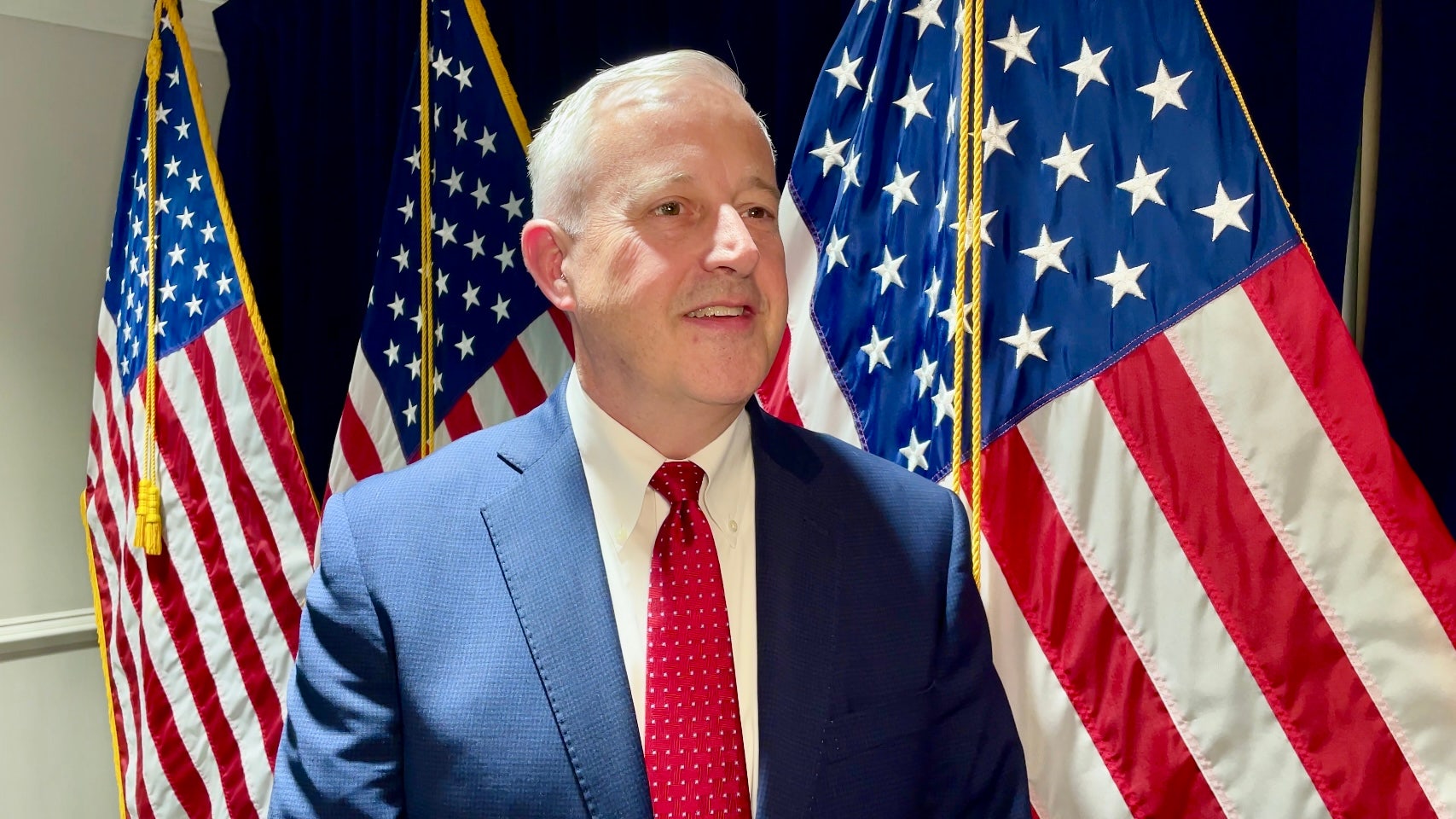
Andy Burnham and Donald Trump met for the first time yesterday

REUTERS
The symbolism was profound – is anybody listening to our formally great nation in 2026? And if not, why?
It didn’t seem to be an issue that troubled Andy Burnham who competently delivered a speech about positivity and a new age of Britain that he would develop over the next 10 years.
Some people will find it hard to accept that a PM voted in by 20,000 people in Makerfield has a mandate to govern for 10 more weeks, never mind 10 years but let’s put that to one side.
This speech was the clearest indication yet of Burnham’s vision. And I was struck by how deeply his political instincts are at odds with those of the man he had just spent time with.
His speech was a celebration of internationalism, multilateral institutions, climate action, deeper European cooperation and global regulation of emerging technology.
It ticked every single box for a WEF world in which you will “own nothing and be happy.”
By contrast, Trump's speech was a manifesto for national sovereignty, energy independence, American power and the right of individual nations to decide their own futures.
Nowhere was that contrast more striking than on the subject of Russia.
Earlier in the day, I asked Trump about the increasingly provocative rhetoric coming from Britain about Vladimir Putin and Russia.
The two had very different speeches

REUTERS
His answer was strikingly blunt: the rhetoric had become “too tough” and Britain needed to be “a little bit careful”.
Trump has consistently resisted the idea that a confrontation with Russia is inevitable and, in his UN speech, said he believed peace between Russia and Ukraine could come “more quickly than people understand”.
On the Russia–Ukraine war, Trump said: “We’re working very closely with the leaders of Russia and Ukraine, and we will get that one done,” and referenced the “Russia, Russia, Russia hoax” as shorthand for what he regards as a hysterical or politically motivated narrative about Russia.
Then Burnham walked onto the UN stage and delivered a speech in which Russia was a central villain in his account of what is going wrong in Britain and the wider West.
He accused Moscow of an “industrial-scale assault” on Britain and its allies, describing Russian use of bots, fake websites and forged newspaper articles and alleging that the Kremlin spends £1.3billion interfering in British elections and is currently amplifying “far-right narratives”.
Presumably he has access to their accounts otherwise, where could such a figure possibly have come from?
Gob-smackingly, Burnham connected Russian disinformation campaigns to the social problems facing young Britons.
He argued that the one million young people who are not in employment, education or training are particularly vulnerable to Russian influence that exploits division, despair and disengagement.
Anybody who knows a disillusioned and unmotivated young person will tell you this is due to the Conservatives and Keir rather than the Kremlin!
It is due to an economy with no growth; hospitality businesses who can’t afford to employ youngsters; resentment about migrants who are handed easy options and an education system that has told every child they are special, when in fact, many just need to get a job and stop believing they are a victim.
Of course, Russia conducts information operations; that is a legitimate subject for governments to take seriously.
But are we really supposed to believe that Britain's political discontent and general malaise is due to Vladimir Putin? That sounded rather like a PM coercing us into seeing Putin as the ultimate adversary.
It begs the question as to why? To prepare us for war perhaps? Wars are excellent at resetting troubled economies; emboldening flailing governments and ushering in deeper levels of control over skittish populations tired of their leaders.
I have no evidence that such a plan is in process and I dearly hope that it is not.
But watching Trump play down the fearmongering over Russia whilst Burnham and EU leaders wring their hands about its apparent inevitability is concerning.
Trump said that he and Burnham had already discussed migration behind closed doors and then kindly conceded that it is a ‘global’ problem shared by many countries rather than his usual depiction of us as a basket-case with open borders.
In his UN speech, he said: “There is no human right to illegal immigration, but there is a right to remain a sovereign nation, and we want to remain a sovereign nation, and so should you.”
That sentence goes a long way towards explaining the philosophical difference between these two men.
Burnham's instinct is to look at the forces creating insecurity and ask how government and international institutions can manage them.
Trump's instinct is to begin with the sovereignty of the nation itself and ask what it needs to do to protect its citizens.
Burnham's instinct to defend the underdog is, in human terms, entirely understandable and is undoubtedly one of the qualities that has made him such an effective politician.
But there is a question that follows from that instinct which matters enormously when you are talking about the future of Britain: at what point does defending the underdog become a governing philosophy in which the state is constantly expected to intervene, regulate and redistribute, even when doing so may conflict with the interests of the country as a whole?
That difference was obvious on climate change.
Burnham told the UN that the climate crisis is now a “national security threat”, pointing to this summer's extreme heat, wildfires and flooding as evidence.
He presented the clean-energy transition as an opportunity for Britain to create jobs, attract investment and rebuild its industrial base.
He has repeatedly described what he calls radical environmentalism as a threat to energy production and economic growth.
In Trump's worldview, environmental restrictions are not simply another set of sensible safeguards; they can become a form of economic self-sabotage.
The disagreement over AI is even more revealing. Burnham wants international principles and standards; he told the UN that fundamental decisions about artificial intelligence are too important to be left to chance or to technology companies alone.
He wants elected governments to have the decisive say and intends to make AI governance a central issue of Britain's G20 presidency.
Trump detests this sort of international regulation and considers it a potential threat to American technological dominance.
He had earlier told the UN that the United States “totally rejects” a “globalist scheme” to control AI and argued that America should encourage the technology rather than rein it in.
He even suggested that the term “artificial intelligence” should be replaced by “superintelligence”, or “SI”, because he dislikes the implication that the intelligence is somehow fake.
And then there was Europe. Burnham went out of his way to promise deeper ties with the European Union.
Trump, in his own UN speech, barely engaged with the EU at all, speaking instead about Europe principally through the prism of Nato, security and the fact that the USA protects those countries.
Burnham sees Britain as an “honest broker”, able to work between America, Europe, China and emerging powers.
That is a familiar British diplomatic ambition, but it is a long way from Trump's instinctive suspicion of the globalised political establishment and his determination to put American sovereignty first.
This is why I suspect the relationship between Trump and Burnham will be fascinating to watch and is doomed to fail.
The personal chemistry is genuine; I have no reason to think otherwise.
But political relationships are ultimately tested not by whether two people enjoy dinner together, but by what happens when their world-view completely diverts.
The differences are already sitting there in black and white.
Trump wants nations to control their own borders. Burnham wants Britain to deepen its relationship with Europe.
Trump believes the warnings surrounding climate change have become part of a wider culture of exaggerated catastrophe.
Burnham calls climate change a national-security threat. Trump wants America to dominate AI and rejects global attempts to control it.
Burnham wants international rules and elected governments firmly in charge. Trump thinks the rhetoric around Russia has become too aggressive.
Burnham put Russian information warfare at the heart of his explanation of some of Britain's social and political problems.
It is difficult to imagine a more obvious collection of fault lines.
Both men believe they are speaking for ordinary people against an establishment that has failed them.
The difference is what they think that establishment should do about it.
Burnham believes in a bigger State, collective action, international institutions, regulation and protecting people from forces beyond their control.
Trump believes in sovereignty, national interest, economic power and giving countries the freedom to decide their own destiny.
They may laugh at similar jokes; they may discover that their personal stories and political instincts have more in common than the labels attached to them would suggest.
But after watching them both on the UN stage, I am convinced that the political differences will be much harder to bridge than the personal ones. In that arena, they have nothing in common.