By The Rio Times | Created at 2026-10-03 08:50:17 | Updated at 2026-10-03 09:28:24
1 hour ago
By The Rio Times | Created at 2026-10-03 08:50:17 | Updated at 2026-10-03 09:28:24
1 hour ago
One-stop reference
Company Intelligence
Every listed company in Latin America — financials, ownership and structure for 1,450+ companies across 26 exchanges, in one place.
ENVIRONMENT · COLOMBIA
Key Facts
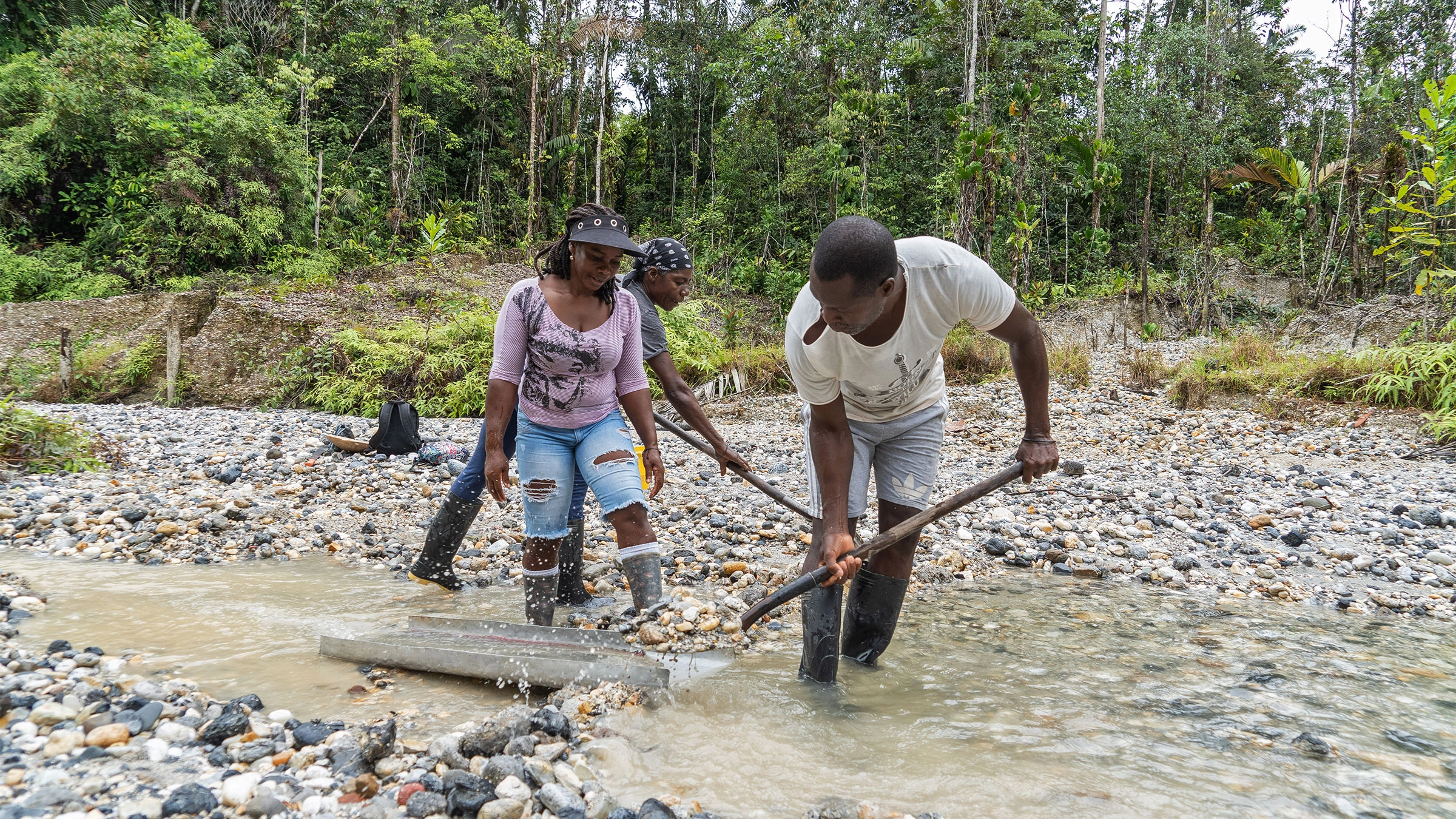
- —The country Colombia mines much of its gold from riverbeds and floodplains, known as alluvial deposits. A joint UN and government survey tracks this mining by satellite every year.
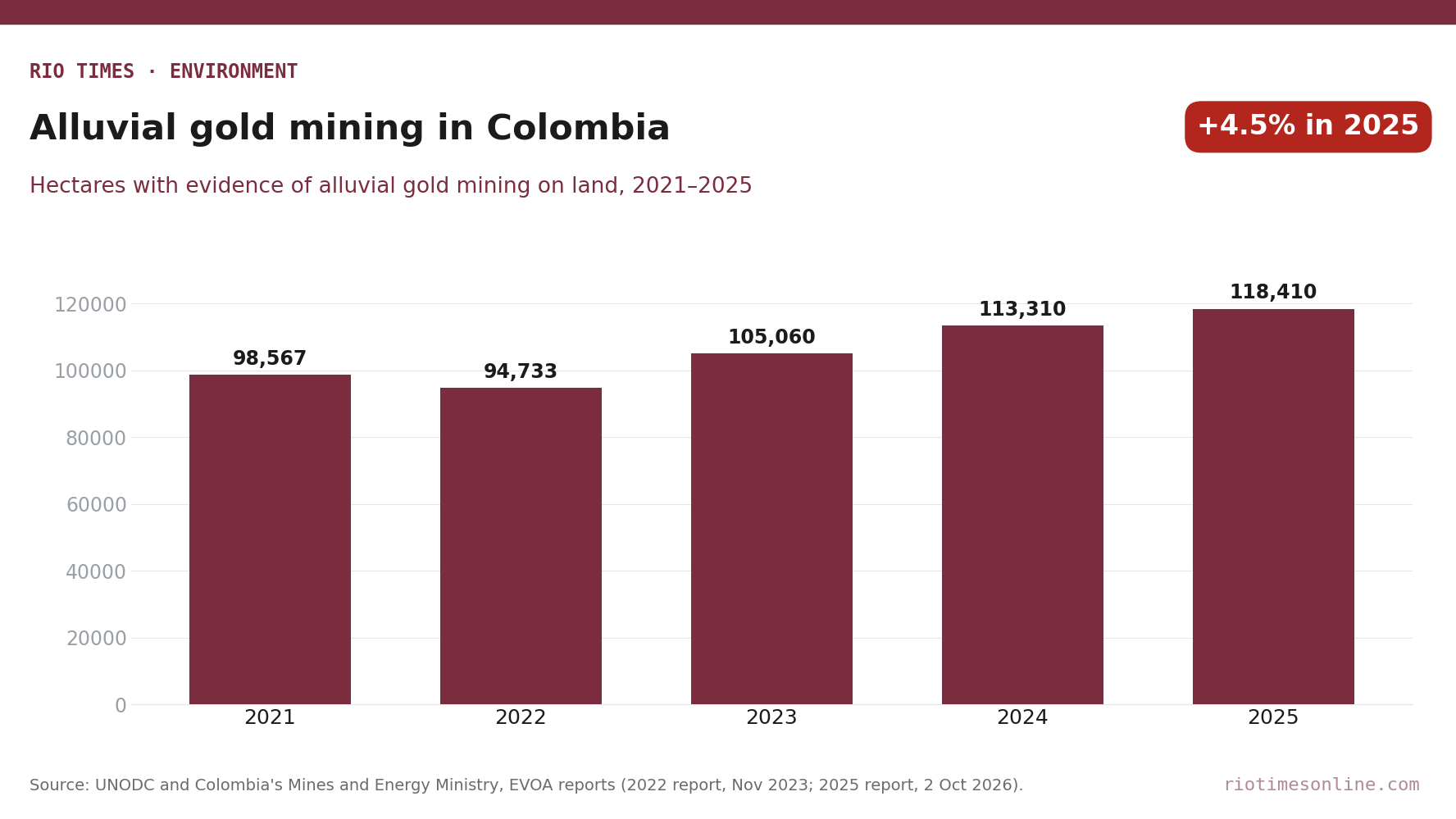
- —What happened On 2 October 2026 the mines ministry and UNODC reported 118,410 hectares with alluvial gold mining in 2025, up 4.5% from 113,310 hectares in 2024.
- —The numbers About 75% of the 2025 area is illegal, 21% has permits and 4% is moving towards legality. Illegal mining grew 10% in a year, the report says.
- —What it means for you Gold buyers and refiners face tighter scrutiny of origin. The ministry calls traceability a priority and asks gold-importing countries to share responsibility.
- —Still open No production or value figures came with the 2025 survey. The ministry has set no targets or timetable for its new three-front plan.
Alluvial gold mining in Colombia covered 118,410 hectares in 2025, a rise of 4.5% on the year before. The UN Office on Drugs and Crime (UNODC) and the mines ministry published the annual satellite survey on 2 October.
About three-quarters of that land is mined illegally, and illegal mining grew 10% in a year. Overall growth did slow, though: the mined area had risen almost 8% between 2023 and 2024.
Three years of growth
The survey, known by its Spanish initials EVOA, measures land showing evidence of alluvial gold extraction. After declines in 2021 and 2022, the area has grown every year since 2023, when it stood at 105,060 hectares.
In 2022 the survey found 94,733 hectares, 73% of it illegal, UNODC reported in November 2023. Fifteen of Colombia’s 32 departments now show the activity, up from 13 in that report.
Follow this story
Get an email when there’s news on Colombia markets
Free. One email a day at most, and only when there is news. This also signs you up to our weekday newsletter, The LatAm Brief. Nothing arrives until you click the confirmation link, and you can stop either with one click. Privacy policy.
Where the mining is
Chocó, Antioquia and Bolívar hold 82% of the illegal area, with 41,493, 24,282 and 7,222 hectares respectively. Ten municipalities, including Nóvita and Quibdó in Chocó and El Bagre in Antioquia, account for 54% of it.
Nearly half the total, 58,216 hectares, lies where mining is not allowed, such as forest reserves and national parks. Of that, 43,048 hectares sit in the Pacific Forest Reserve, one of the most biodiverse areas on the planet.
Inside the National Natural Parks System, the mined area grew 153% between 2023 and 2025. Black communities’ collective lands hold 45% of the national total, and Chocó accounts for 84% of that share.
Indigenous reserves, known as resguardos, hold only 0.4% of the area, but it rose 25% in two years. The survey also flagged 215 river sectors with mining alerts on 11 Amazon rivers near 64 reserves.
Armed groups and coca
At least one illegal armed group is present in 85.6% of the municipalities where the mining was detected. In 79 of them, coca, the raw material for cocaine, was also grown in 2024.
Coca and alluvial gold overlap on 48% of the mined area. Amado Philip de Andrés, UNODC’s regional representative, said illegal mining “does not happen in isolation,” La Silla Vacía reported.
A Universidad EAFIT study put the illegal gold economy at about US$3.5 billion a year (Illegal Gold in Colombia Now Rivals Coffee at US$3.5 Billion). Most of that value stays inside Colombia, the researchers said.
The government’s response
Mines Minister María Nohemí Arboleda set out three fronts: formalising willing miners, prosecuting criminal networks and restoring damaged land. She described “a confrontation between the state and the criminal economies that use gold to finance violence.”
With the defence ministry and prosecutors, the government plans to seize assets and close the trade routes for illicit gold. It has already restricted where mining excavators may enter Colombia (Colombia Narrows Where Mining Excavators Can Enter the Country).
A mining code overhaul with a mercury ban is also under way (Colombia Mining Reform Bans Mercury, Tightens Rules). UNODC says its next step is to trace gold and mercury after extraction, to support controls at the source.
What Is Not Yet Known
The published findings give no estimate of how much gold the mined area produced, or what it was worth. Nor do they say how much land returned to legal status or was restored in 2025.
Whether the slower overall growth marks a turning point is unclear, since the illegal share kept rising. The ministry has not attached targets, budgets or a timetable to its three-front plan.
Sources: Ministry of Mines and Energy and UNODC, EVOA 2025 report release, 2 October 2026; La Silla Vacía, 2 October 2026; Caracol Radio, 2 October 2026; UNODC, EVOA 2022 report, 21 November 2023.
This article was produced by The Rio Times’ automated newsroom system. How we use AI · Report an error · Editorial responsibility: Matthias Camenzind, Editor-in-Chief