By The Rio Times | Created at 2026-06-23 18:56:43 | Updated at 2026-06-23 20:51:00
2 hours ago
By The Rio Times | Created at 2026-06-23 18:56:43 | Updated at 2026-06-23 20:51:00
2 hours ago
NIGERIA · CULTURE
Key Facts
—Looted in 1897: The Benin Bronzes are thousands of artworks taken from the Kingdom of Benin, in today’s southern Nigeria, by British troops in 1897.
—Swiss returns: In 2026, three Swiss museums agreed to transfer ownership of 28 Benin pieces back to Nigeria.
—A 2025 wave: The Netherlands handed back 119 bronzes in 2025, the largest single return so far.
—The big hold-out: The British Museum still holds about 900 bronzes, blocked from giving them up by a 1963 law.
—A new home: Nigeria is building a museum in Benin City, designed by the late architect David Adjaye, to house the returns.
—Who owns them: A quiet question lingers over whether the pieces belong to the Nigerian state or the Oba of Benin.
The Benin Bronzes return is gathering pace in 2026, as Swiss museums agree to hand back 28 looted pieces and Nigeria builds a new home for the treasures in Benin City.
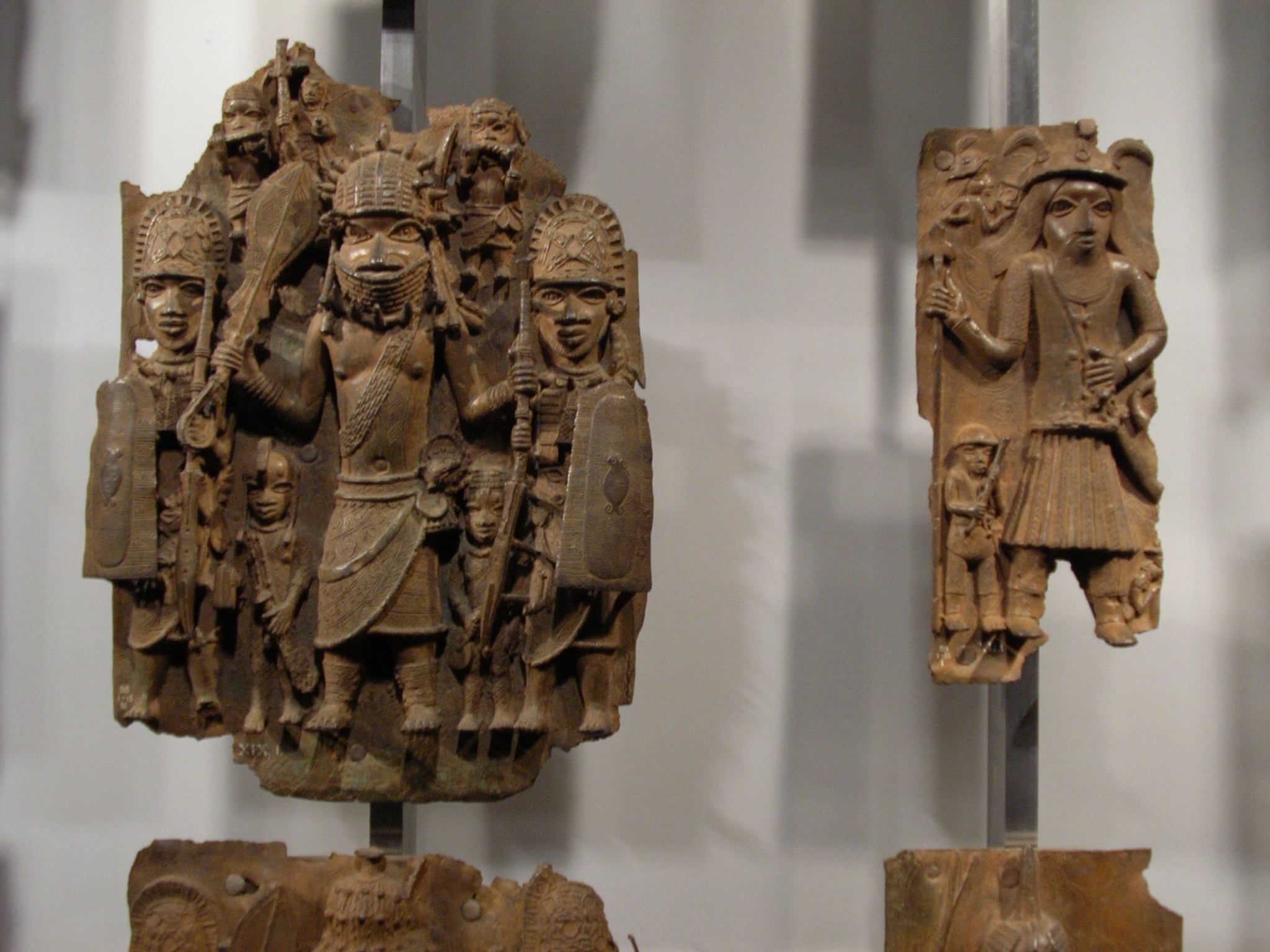 Benin Bronze plaques on display — among thousands of works looted from the Kingdom of Benin in 1897. (Photo: Warofdreams, CC BY-SA 3.0, via Wikimedia Commons)
What the Benin Bronzes are
They are not a single object but a civilisation’s archive in metal and ivory. The Benin Bronzes are thousands of plaques and sculptures made over centuries for the royal court of the Kingdom of Benin, in what is now southern Nigeria.
British forces looted them during a punitive raid in 1897, scattering them to museums and collectors across Europe and North America.
The Benin Bronzes return, 2026 edition
This year added a fresh chapter. Three Swiss institutions — the Rietberg Museum, the University of Zurich’s ethnographic museum and Geneva’s Musee d’ethnographie — agreed to transfer ownership of 28 Benin works to Nigeria.
It is a modest count next to the thousands still abroad, but the symbolism is large. Switzerland is not a former colonial power, yet it too is letting go.
A wave that began in 2025
The Swiss move follows a busy year. In 2025 the Netherlands returned 119 bronzes, the single largest restitution to date.
Months later, Ghana’s Asante king received more than 100 looted gold and silver regalia from British and South African collections, part of the same continental reckoning.
The hold-outs
The biggest collection has barely moved. The British Museum holds roughly 900 Benin Bronzes and is barred from giving them away by the British Museum Act of 1963.
London has explored loans rather than returns, an arrangement many Nigerians reject as treating the rightful owner like a borrower.
Pressure on London keeps building, and a change to the 1963 law is no longer unthinkable over time.
A new home in Benin City
Nigeria is preparing to receive what comes back. A new museum in Benin City, designed by the celebrated Ghanaian-British architect David Adjaye before his death, is meant to house the returning works.
The plan is to anchor the bronzes near the restored royal palace, where their story began.
Until it opens, returned works will be cared for in Nigerian museums, kept on home soil rather than abroad.
Who should hold them
One sensitive question remains at home. Ownership has been contested between the Nigerian federal government and the Oba of Benin, the traditional ruler whose ancestors commissioned the art.
How Nigeria settles that will shape whether restitution feels like justice or merely a transfer between institutions.
Why the returns are speeding up
The pace has a politics behind it. Younger curators, public pressure and a wave of provenance research have made holding looted art harder to defend.
Governments in Europe increasingly see restitution as a way to reset relations with Africa, not just to right a historic wrong.
The African Union has helped, making reparations and the return of cultural heritage a banner cause for the continent.
Germany broke the ice earlier this decade, formally transferring ownership of its Benin holdings, while institutions in the United States returned dozens more. Each handover made the next easier.
Diaspora campaigners and African governments have kept up steady, patient pressure for decades, and it is finally telling.
What the bronzes mean to Nigeria
For Nigeria, the bronzes are more than art. They are proof of a sophisticated African kingdom that cast masterpieces in brass while parts of Europe were still in the Middle Ages.
Their return is a chance to tell that story at home, to schoolchildren and tourists alike, rather than in a glass case in London or Berlin.
It is also an economic bet, since a world-class museum could anchor cultural tourism in Benin City and the wider region.
Schoolbooks and tour guides may be rewritten around objects that can finally be seen at home, rather than only abroad.
Frequently asked questions
What are the Benin Bronzes?
They are thousands of metal and ivory artworks made for the royal court of the Kingdom of Benin, in today’s southern Nigeria. British troops looted them in 1897.
What was returned in 2026?
Three Swiss museums agreed to transfer ownership of 28 Benin pieces to Nigeria. It followed the Netherlands’ return of 119 bronzes in 2025.
Why hasn’t the British Museum returned its bronzes?
The British Museum holds about 900 Benin Bronzes and is barred from giving them up by the British Museum Act of 1963. It has discussed loans rather than permanent returns.
Where will the returned bronzes go?
Nigeria is building a museum in Benin City, designed by the late architect David Adjaye, to house them. Ownership between the state and the Oba of Benin is still being resolved.
The Rio Times · Power Map
See who really holds power in Latin America
Click to open the Power Map →