By The Straits Times | Created at 2026-09-24 21:57:04 | Updated at 2026-09-24 22:58:57
1 hour ago
By The Straits Times | Created at 2026-09-24 21:57:04 | Updated at 2026-09-24 22:58:57
1 hour ago
NEW DELHI – After a thriving career of nearly four decades in the semiconductor industry, Sabu Mohamed Ayub retired in 2024, hoping to catch some well-earned rest.
“I had put up my feet happily, and was enjoying eating and sleeping,” the 64-year-old India-born Singapore national said. “Eating and sleeping,” he added for emphasis. This bliss was, however, interrupted by a phone call.
An acquaintance had rung him saying that Dou Yee Enterprises, a Singaporean company that specialises in semiconductor equipment and materials, was looking for someone to lead its operations in India.
Ayub was initially hesitant, but when it turned out that he would be based in Tamil Nadu – he was born in Cuddalore, a port city in the state – and would be part of the effort to help Dou Yee grow in India’s booming and increasingly attractive semiconductor market, he lapped up the opportunity.
“I thought, why not take up this challenge in our hometown?” said Ayub, who relocated from Singapore to Chennai, the capital of Tamil Nadu state, with his wife in December 2025. “There is a lot of potential for Dou Yee to grow in India,” he added.
Ayub, now a branch manager for the firm in India, was among the many Singaporean participants at the recently held SEMICON India 2026 in New Delhi, the third edition of the annual flagship summit for India’s semiconductor industry.
As the country’s semiconductor market gallops ahead and is projected to surpass US$200 billion (S$256 billion) by FY2035 from the current US$64 billion – India has a key priority. It wants to indigenise its semiconductor supply chain to boost self-reliance, improve technological competitiveness and create jobs for its youth.
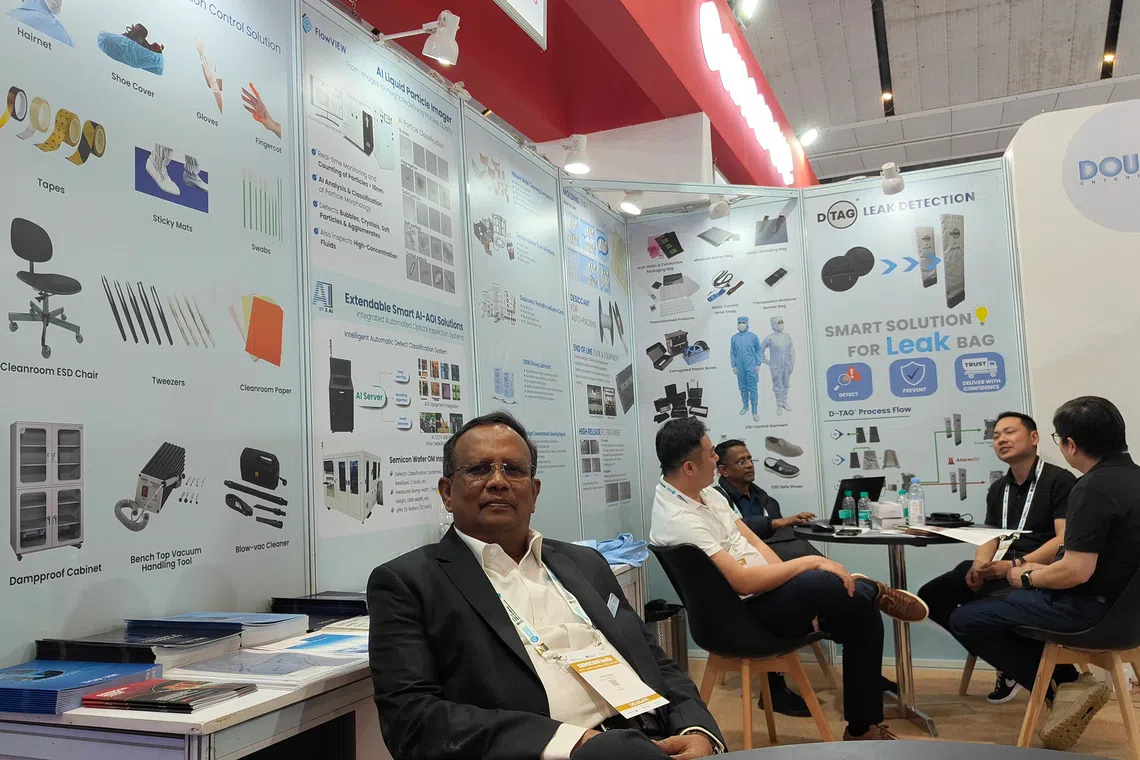
Sabu Mohamed Ayub was among the many Singaporean participants at the recently held SEMICON India 2026 in New Delhi.
ST PHOTO: DEBARSHI DASGUPTA
It is a goal currently embodied by an empty nail on a wall in a ministerial office room in New Delhi. Indian Minister of Electronics and Information Technology Ashwini Vaishnaw, who studied electronic engineering at college and is keenly following semiconductor-related developments, told a packed hall of reporters and industry representatives at the summit in September that he had marked out the empty spot on his wall to proudly display India’s first locally made semiconductor wafer.
Powering this journey from its current nascent manufacturing stage to a thriving domestic semiconductor ecosystem are numerous foreign companies, including those from Singapore. These companies bring a range of expertise that spans the value chain and hope to profit from the many opportunities that India has to offer.
“We have garnered a lot of experience through the years,” said Ang Wee Seng, executive director of the Singapore Semiconductor Industry Association, referring to Singapore’s diverse semiconductor ecosystem that took root in 1968.
Since then, it has grown to extend across the entire value chain, encompassing everything from research and development to front-end manufacturing and back-end testing. “So we bring to the table… a complete ecosystem that supports the semiconductor industry already,” he told The Straits Times at SEMICON India 2026.
A record 27 Singapore-based companies exhibited at the Singapore Pavilion at the summit in 2026 – up from 10 in 2024, highlighting growing interest in India, which has been aided by bilateral engagement ranging from ministerial roundtables to industry delegation visits.
Singaporean companies have also secured semiconductor contracts worth over $180 million in India since 2024. They have also invested over $20 million in the country, hiring over 300 employees to support the development of some of India’s key government-backed semiconductor projects aimed at attracting supply chains, material vendors, and equipment makers.
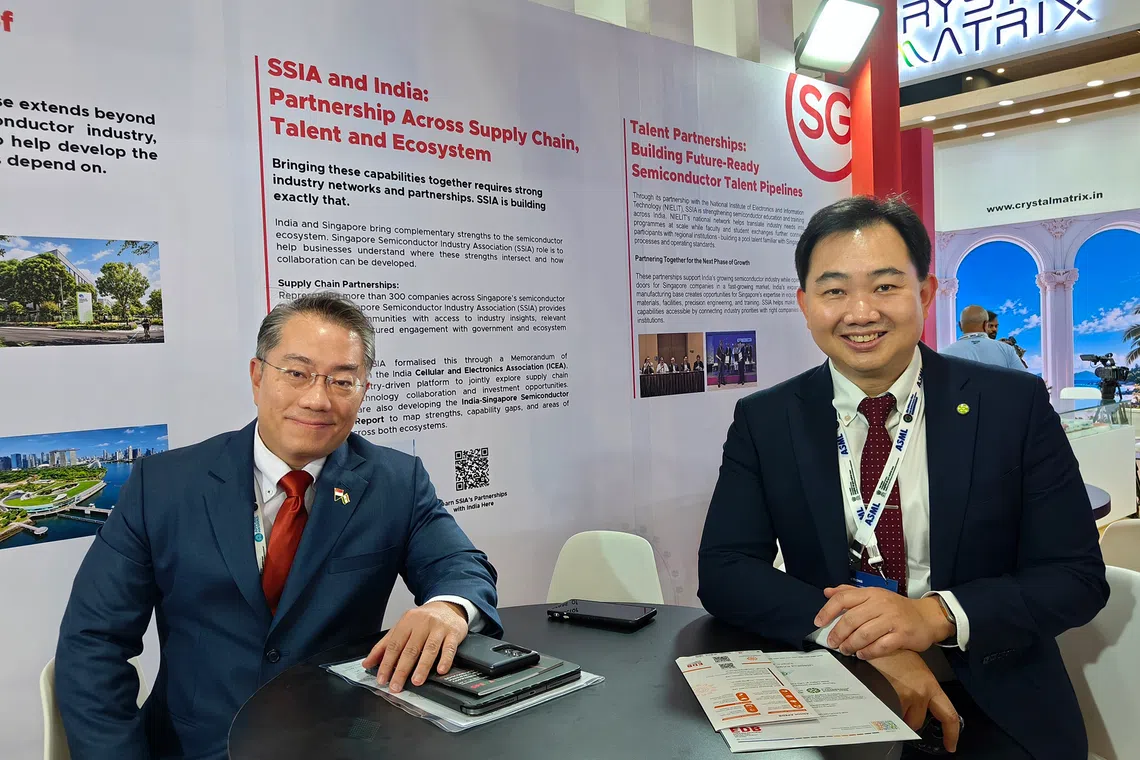
Tan Soon Kim (left), deputy managing director of Enterprise Singapore, with Ang Wee Seng, executive director of Singapore Semiconductor Industry Association, at SEMICON India 2026 on Sept 17.
ST PHOTO: DEBARSHI DASGUPTA
These include semiconductor units being developed by the likes of Tata Electronics, which, together with Taiwan’s Powerchip Semiconductor Manufacturing Corporation, is building India’s first semiconductor fabrication plant in Gujarat’s Dholera. Built with an investment of around US$11 billion, it is expected to be commissioned in 2028.
Another such big-ticket project is the American multinational Micron Technology’s semiconductor assembly and test plant in Gujarat’s Sanand. Developed with an investment of US$2.75 billion, this facility began commercial production in 2026.
Singapore setting foot
“We are interested in engaging India because of its very strong growth trajectory,” said Tan Soon Kim, deputy managing director of Enterprise Singapore.
“Clearly, semiconductors are a sector which we see is poised to take off in India.”
Some of the Singaporean companies already present in India’s growing semiconductor market include Industrial Vision Technology (IVT), a manufacturer of test and factory automation equipment, and Chasen Holdings Limited, which specialises in the relocation and installation of high-tech semiconductor equipment.
For them, India is important not just because of potentially lucrative contracts but also because it allows them to diversify away from existing major markets such as China and Taiwan.
A good illustration of the deepening Singaporean engagement in India is Specmax Techno, a Singapore-based engineering company that specialises in semiconductor manufacturing engineering and high-purity piping installations necessary for semiconductor manufacturing units.
Starting with business worth around 100 million rupees (S$1.33 million) in 2024, the year it started operations in India, it has now surpassed 1 billion rupees. “There has been much progress in this (Indian semiconductor) field, but the only problem is securing the materials,” said Dr. M. Gopinath, the Chennai-based operation manager for Specmax Techno.
The firm currently relies on imported equipment, such as gas valves from Taiwan, often leading to waiting periods that can extend up to 18 weeks and thereby delaying project timelines.
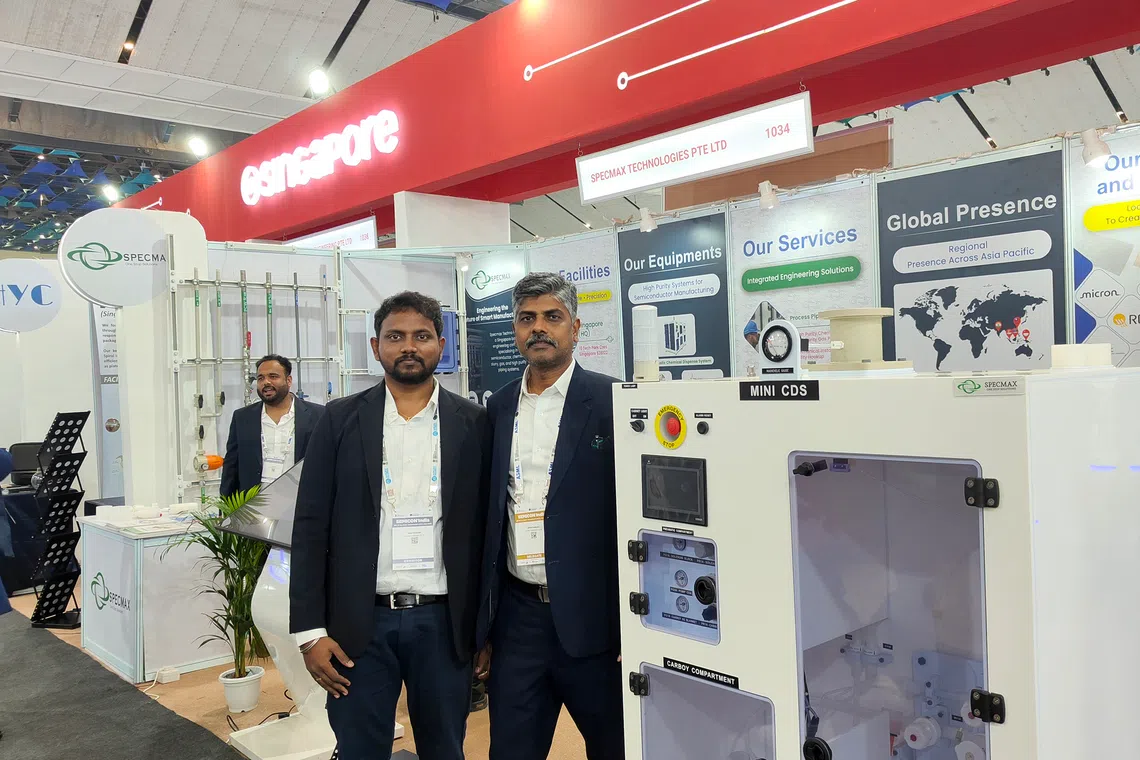
M. Gopinath (right) and Sekar Pitchaimani from Specmax Techno at SEMICON India 2026 in New Delhi.
ST PHOTO: DEBARSHI DASGUPTA
As a partial workaround, the firm has begun constructing a manufacturing unit in Tindivanam in Tamil Nadu that is expected to begin production of some of the equipment Specmax Techno currently imports in June 2027.
Built with an investment of around 2 billion rupees, it will also include a training institute to equip workers with the skills to handle its equipment for the firm’s clients. And if all goes well, Specmax Techno also hopes to start a semiconductor fabrication plant near India’s tech hub Bengaluru, in Karnataka, before 2030.
The optimism around India’s semiconductor ecosystem was palpable at the SEMICON India summit, which attracted around 40,000 visitors from over 50 countries. The event also featured dedicated country pavilions from Japan, South Korea, Malaysia, the Netherlands, Sweden and Singapore.
Five out of the 12 approved projects under Semicon 1.0 – the Indian government’s support programme launched in December 2021 to build a resilient semiconductor ecosystem – have already begun production. The second iteration of this mission was approved in July with a budget of 1.27 trillion rupees to further accelerate this goal.
Vaishnaw told reporters at the summit that contracts worth around US$12 billion had already been clinched under Semicon 2.0. Market opportunities created through this push are drawing foreign companies, including Singapore’s IVT, a first-time exhibitor at SEMICON India.
“I think India is a very big consumer market for electronic devices and, consequently industries like ours,” said Wang Yuchang, managing director of IVT, referring to the increasing use of semiconductors in everyday electronics such as washing machines and refrigerators.
The company has already supplied two units of their wafer defect inspection systems costing around US$700,000 each to two projects in India’s eastern Odisha state. Being in India has provided an opportunity for IVT to find new customers and form partnerships to help service their equipment locally.
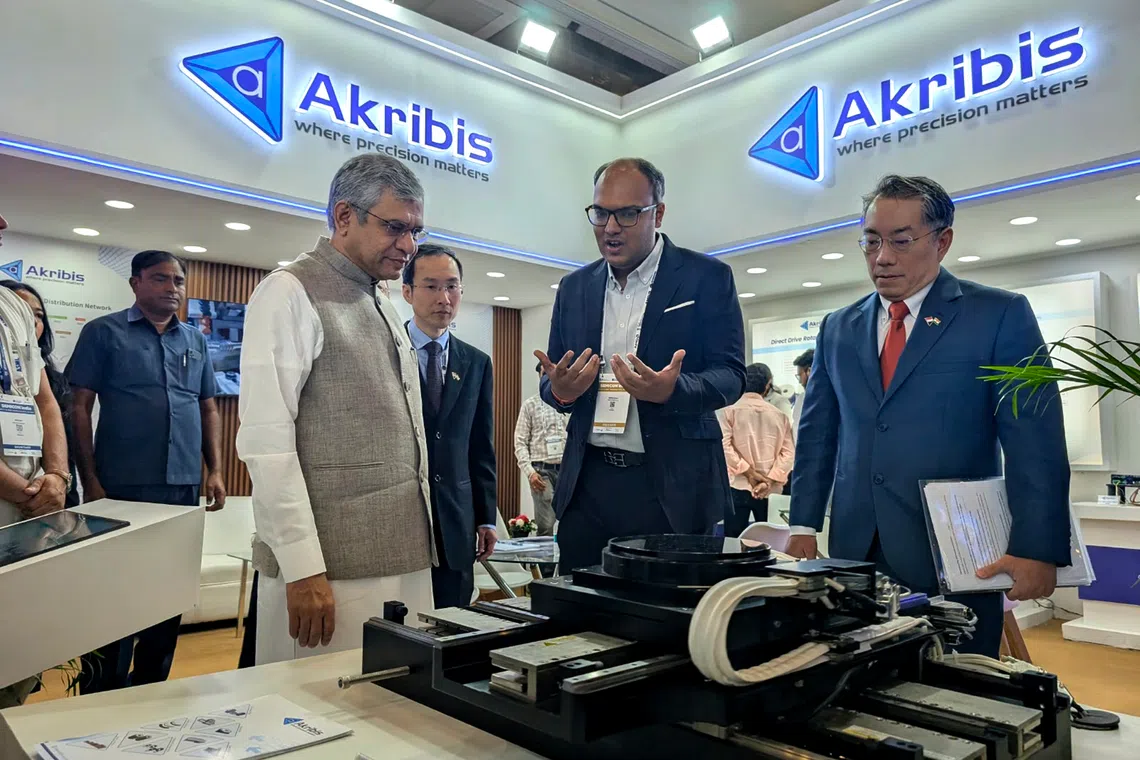
Indian Minister of Electronics and Information Technology Ashwini Vaishnaw visiting the booth of Akribis Systems Pte Ltd, a Singaporean firm that exhibited at the SEMICON India 2026 summit.
PHOTO: ENTERPRISE SINGAPORE
The growing presence of international semiconductor firms like Micron and Intel in India is another draw, particularly for Singaporean logistics firm Chasen that has worked with these brands abroad offering its specialised services for transporting their sensitive electronic equipment.
“I think the market here is like what we saw 20 to 25 years ago in China. So we, Chasen as a group, see the potential in India. That is why we are setting foot here now,” said Alvin Lau, country manager for Chasen (India) Hi-Tech Logistics Services, which was also a first-time exhibitor at SEMICON India 2026.
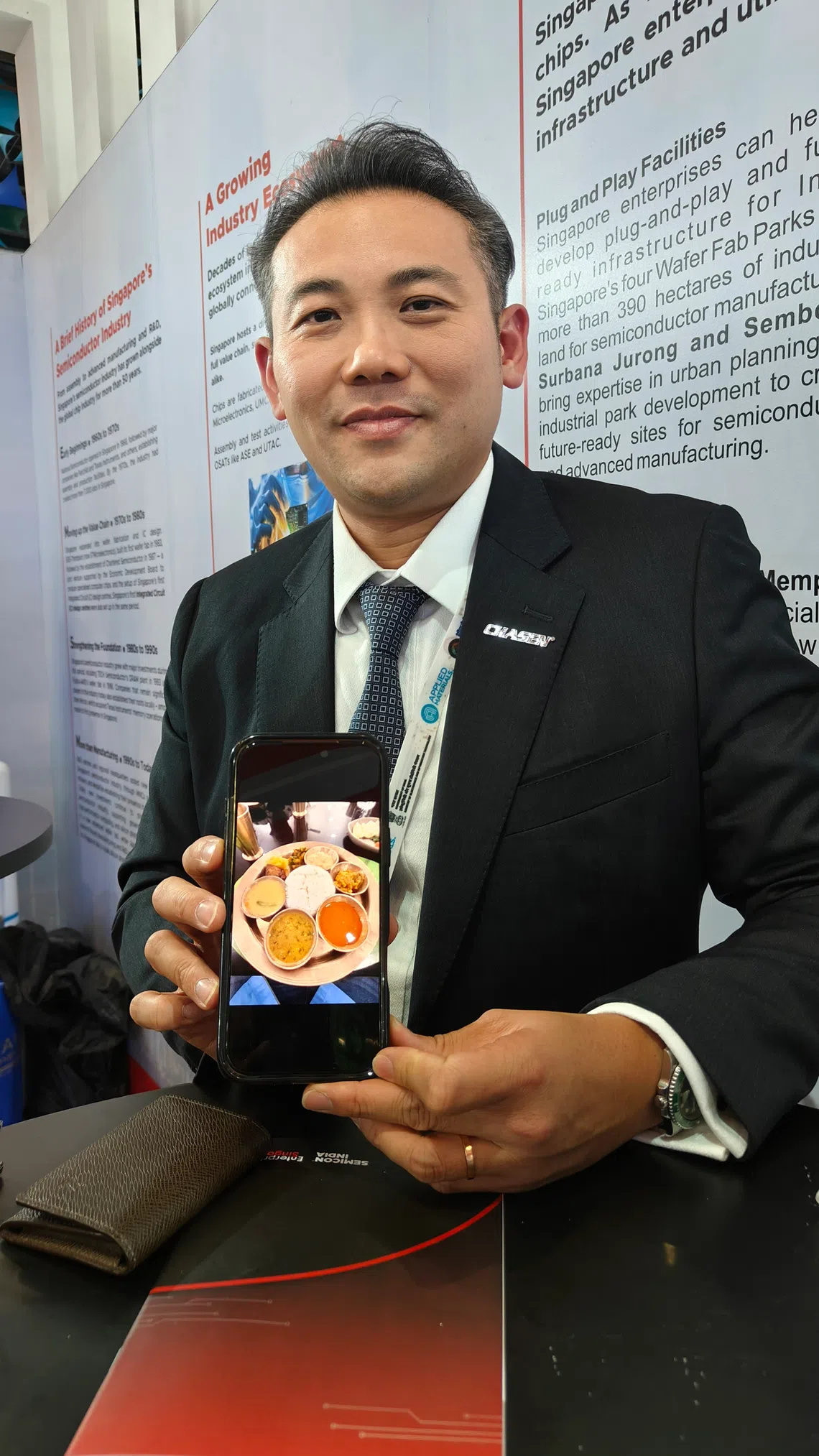
Alvin Lau, country manager for Chasen (India) Hi-Tech Logistics Services, at SEMICON India 2026. He is showing a pork thali meal he enjoyed at a restaurant in Assam, one of the Indian states that has attracted attention from semiconductor firms.
ST PHOTO: DEBARSHI DASGUPTA
The firm is currently working with Dixon Technologies, an Indian multinational electronics manufacturing services company, to relocate equipment used for producing LCD screens from China into India.
Encouraged by Indian attitudes to learn, the firm is “more than willing” to teach and hopes to localise its operations. “I told our CEO back home, I said I (will) target to localise all the workforce in India, probably in two years,” added Lau.
Navigating challenges
But even lofty ambitions can be stalled by stubborn hurdles in India’s complex business and social environment. Among them are linguistic differences and challenges in finding as well as retaining the right talent when skilled professionals in the semiconductor industry are already scarce.
Then there are what IVT’s Wang dubbed “cultural differences”, which lead to long planning periods. “In Asia, especially in Singapore, maybe everything goes faster, very fast. But here, it is slightly slower,” added Wang, noting that planning for something in a month’s time in India might lead to actual execution taking several more months.
A particular concern comes from equipment and component shipments being held up at Indian ports because of complex import regulations for weeks and even months, upsetting project schedules. Enterprise Singapore’s Tan said they will soon launch a checklist that Singapore-based companies can refer to, to ensure smoother flow.
This challenge – one faced by other stakeholders – has been flagged to the Indian government. Vaishnaw told ST his ministry has been working with the Ministry of Finance to address this concern and that it has “made many changes also in their customs rules based on our feedback”. Any further concerns will also be looked into, he added.
But if one perseveres through these challenges, the rewards in India can be handsome. For instance, Dou Yee’s Ayub does not think too much about the frustrations he encounters here – such as chaotic driving on Indian roads that has him “sweating like mad”.
Instead, he focuses more on how his firm can create a long-term market for its products that range from consumables such as factory apparel to specialised equipment, including air cushion-based transfer tools to move delicate material like wafers.
“From where we started, selling consumables, it (Dou Yee’s annual revenue in India) has come up to $2 million,” he said. “By the end of 2032, we are targeting to get to $10 million.”