By The Straits Times | Created at 2026-09-24 21:57:02 | Updated at 2026-09-24 22:58:28
1 hour ago
By The Straits Times | Created at 2026-09-24 21:57:02 | Updated at 2026-09-24 22:58:28
1 hour ago
TOKYO – At a completely random time during waking hours each day, a push alert from the social media app BeReal gets sent to more than six million Japanese smartphones simultaneously, urging users to upload a photo of themselves “now”.
Across the country, millions of young Japanese respond reflexively – whether lounging at home, sitting in class or working at an office desk. While global hype has largely cooled in many markets, the photo-sharing app remains an obsession among Gen Zs in Japan.
Yet what appears on the surface to be a harmless game of digital tag has triggered growing alarm over a wave of accidental corporate data leaks and privacy breaches in Japan, especially when users post photos from their workplace without thinking.
This has pushed companies to review workplace protocols and tighten control over social media use during office hours.
Created in France in 2020 and going viral around the world in 2022, BeReal took off slightly later in Japan around 2023 as an unvarnished “anti-Instagram” alternative. Its rules are uncompromising: upon receiving the daily prompt, users have two minutes to snap a dual-camera photo capturing both their face and their surroundings with an optional “making of” video snippet.
Post on time, and they unlock “bonus” uploads for the day. Miss the window, and their post is publicly marked “late,” while access to their friends’ feeds remains locked until an upload. The app permits no filters, no edits, and no uploads from the camera roll.
I have never quite understood the craze, as a millennial and largely passive user of social media. But its footprint in Japan is undeniable: As at June 2026, the platform surpassed 6.5 million monthly active users in the country, with an astonishing 92 per cent aged between 13 and 27. This is an increase from five million in June 2025.
Nominated for Japan’s Buzzword of the Year in 2024, the app has hosted advertising campaigns for brands ranging from Uniqlo, Shiseido and Netflix to major film releases like Spider-Man: Brand New Day (2026).
Conversations with younger Japanese acquaintances shed light on its appeal. In a society weighed down by the pressures of kira-kira (”sparkling”) culture – the social obligation to curate a polished, flawless public persona – BeReal’s demand for candidness and unedited authenticity can feel like a relief.
Often shared only with an intimate circle of close friends and designed to disappear after 24 hours, these mundane snapshots feel like a safe way to reveal one’s “true self”.
To be sure, Japanese youth are also heavy users of TikTok, Instagram, X and LINE, as well as the latest fad, Setlog, the viral South Korean app that stitches hourly video snippets from small groups of peers into a vlog.
But unlike these platforms, BeReal’s panic-inducing countdown timer has created a unique corporate hazard.
An investigation by public broadcaster NHK found that over a 45-day window from April to May, at least 40 cases of institutional data leaks were traced directly back to the app.
I have heard high school teachers grouse about how their students scramble to post, even during class. But beyond the classroom, BeReal is forcing a sweeping security rethink across Japan Inc.
Lulled into a false sense of security by “friends-only” privacy settings, young employees unthinkingly snap photos at their work desks. Once posted, however, this digital intimacy vanishes as screenshots have been shared on other platforms, where they quickly go viral.
The most high-profile fallout engulfed Fukuoka-based regional lender Nishi-Nippon City Bank, where an employee snapped a BeReal photo inside a branch office that later appeared on X on April 29, amassing over 10 million views overnight.
Captured on a whiteboard in the background were the names of eight private banking clients, a customer’s home address, details on 19 corporate accounts, and internal sales targets.
The backlash was swift. Bank president Hideyuki Murakami was forced to issue a public apology as shares in parent company Nishi-Nippon Financial Holdings dropped nearly 3 per cent, with the case triggering an inquiry by the Financial Services Agency.
Similar slip-ups have surfaced across the country since April.
In Sendai, an elementary school teacher snapped a desk photo, accidentally broadcasting a monitor displaying the city’s internal school management system.
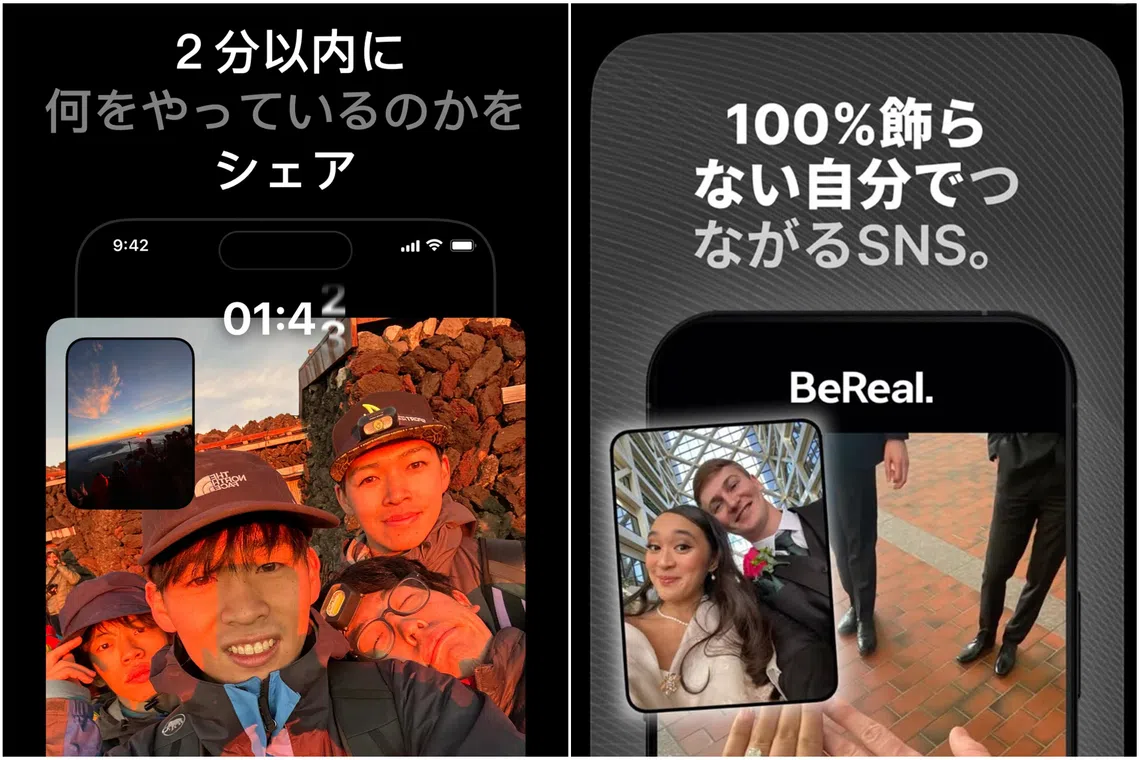
Social media app BeReal allows users to take photos simultaneously from the front and rear cameras, to be posted and shared with friends.
PHOTO: BEREAL JAPAN
“I received a notification and took a picture of the computer in front of me without thinking too much about it,” she was quoted by domestic media as saying.
In Tokyo, a part-time worker at pizza chain Pizza-La uploaded an image containing customer details, while a staff member at gyoza chain Nikujiru Gyoza no Dandadan captured an applicant’s resume. In Ishikawa, a machinery manufacturer suffered a leak of internal pricing models, while a Hokkaido hospital inadvertently exposed patient names and ages via a reception desk photo.
It is not known if any employee was disciplined for the data leaks. Reports of such accidents appear to have dwindled, ostensibly the result of greater user awareness after a wave of negative media commentaries in 2026, while companies also tighten their defences and social media policies.
While ignorance is no excuse, sociologists and security experts draw a clear distinction between BeReal’s accidental leaks and the deliberate mischief that fuelled previous social media-driven scandals like “sushi terrorism”.
BeReal users harbour no ill intent toward their employers, but instead forget a cardinal rule of the internet age: that no digital space is truly private and that any upload can become a permanent “digital tattoo”.
The fallout has forced Japan Inc to confront modern cybersecurity with renewed urgency, as more companies scramble to enforce strict workplace protocols, ranging from social media bans during office hours to mandatory storage lockers for personal smartphones.
Even Nishi-Nippon City Bank admitted that while it already has a rule barring personal smartphone use in the office, the policy had long gone unenforced – until now.
Both employers and employees will need patience and pragmatism to navigate digital shifts. As Japan’s younger workforce learns digital literacy, companies too, are being reminded that outmoded workplace practices must continuously evolve to keep pace with new tools that are shaping the real world.